
Medical Disclaimer: This content is for general informational purposes only and does not constitute medical or nutritional advice. If you have a medical condition, are pregnant or breastfeeding, or are on medication that affects metabolism or blood sugar, consult a qualified healthcare provider before starting a calorie-restricted meal plan.
Vegan 30-Day Weight Loss Meal Plan: The Complete Structured Fat Loss Guide
TL;DR
The vegan 30-day weight loss meal plan in this guide is a four-week progressive structure: Week 1 resets eating habits and eliminates the main weight-gain foods, Week 2 builds the protein and fiber foundation, Week 3 accelerates fat loss through a targeted calorie deficit and carb distribution optimisation, and Week 4 sustains results with a protocol designed to prevent rebound. Daily calorie targets range from 1,500-1,700 kcal depending on body weight and activity level. Protein targets are 100-130g daily across all four weeks. Plateau prevention is built structurally into Weeks 2 and 4 through macro cycling, not willpower. The plan requires no exotic foods, no expensive supplements, and no weighing every meal. It requires consistency, protein priority, and understanding which foods are doing the work.
The 30-Day Framework: Weekly Phases and Goals
The vegan 30-day weight loss meal plan is built on a progressive four-week structure rather than a uniform 30-day calorie restriction. Progressive structuring is more effective than static restriction for three reasons: the body adapts to a fixed calorie deficit within 10-14 days, producing a metabolic slowdown that stalls fat loss. Progressive macro cycling prevents this adaptation. Varying the protein-to-carbohydrate ratio weekly keeps metabolic rate elevated and prevents the muscle loss that accompanies prolonged fixed caloric restriction.

Ultimate 28-Day Vegan Meal Plan,
Easy Grocery List + 40 Recipes
• Comprehensive Guide
• 4-Week Structured Calendar
• Categorized Weekly Grocery Lists
• Chef-Verified Nutritional Tips
• Family Friendly Meal Prep
• Print & Use Today
How This Plan Differs from Generic Vegan Eating
A vegan diet is not automatically a weight loss diet. Many people switch to plant-based eating and gain weight, or lose none, because they replace animal products with high-calorie processed vegan alternatives, over-rely on healthy-sounding but calorically dense foods like nuts and avocado, and do not hit adequate protein to preserve muscle during weight loss.
The Five Structural Differences
- Protein is explicitly targeted, not assumed. Generic vegan eating does not guarantee 100-130g protein daily. This plan uses a protein-first meal architecture where every meal is built around a high-protein plant anchor before other components are added.
- Calorie-dense vegan foods are portioned, not avoided. Nuts, seeds, avocado, tahini, and plant milks are healthy but calorically dense. This plan includes them in measured portions rather than excluding them. The difference between a weight-loss vegan diet and a maintenance vegan diet is often found in unmetered tahini and nut butter.
- Refined vegan carbohydrates are replaced. White bread, white rice, vegan pastries, and processed snack foods are removed and replaced with legumes, whole grains, and vegetables. This single change produces most of the caloric deficit without hunger.
- Plateau prevention is built in structurally. Weeks 2 and 4 use a carbohydrate refeed day and higher protein allocation to prevent metabolic adaptation. This is not optional or improvised. It is the designed mechanism that keeps fat loss progressing through the second and fourth weeks when most plans stall.
- Meal timing is deliberate. Front-loading calories (larger breakfast and lunch, smaller dinner) aligns eating with circadian insulin sensitivity peaks and reduces evening overeating, the most common cause of caloric surplus in people who believe they are eating a restricted diet.
The foundational science behind vegan weight loss is covered in the vegan weight loss strategy guide, and the most common reasons plant-based eaters plateau are addressed in the vegan weight loss plateau guide.
Week 1-4 Themes: Reset, Build, Accelerate, Sustain
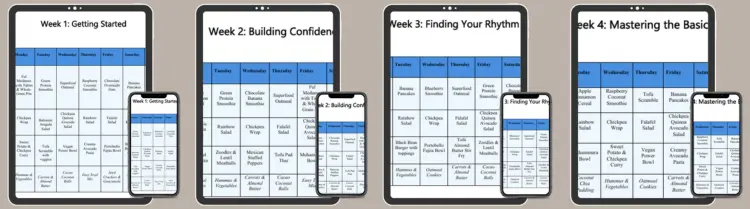
Representative Weekly Meal Structure
Below is a representative Week 1 (Reset) daily meal template showing the protein-first architecture. All four weeks follow this structure with adjustments to calorie allocation and carbohydrate distribution described in Section 4.
Daily Macro Targets by Week
The chart below shows how protein, carbohydrate, and fat allocations shift across the four weeks of the vegan 30-day weight loss meal plan. The progressive macro cycling structure is what separates this plan from a simple calorie cut. Note how protein increases each week while overall calories step down and then back up at Week 4.
For practical guidance on reaching 100g+ protein daily on a plant-based diet, the 100g protein vegan guide provides the complete food-by-food framework. The full protein sources library is at the vegan protein sources guide.
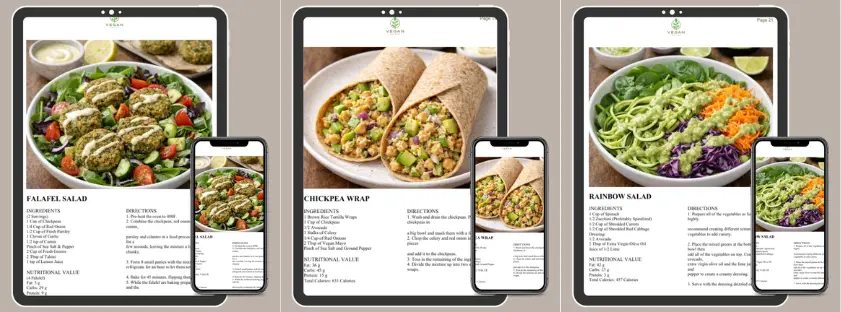
28-Day Vegan Meal Plan
+ Grocery List
Complete Solution · Nutritionist-Approved · Print & Use Today
Read on any device · No apps needed
The 30-Day Shopping List Structure
The vegan 30-day weight loss meal plan uses eight food category anchors. Keeping these eight categories stocked means the full four-week plan can be executed without specialist shopping, expensive products, or complicated preparation. Each category serves a specific role in the macro and satiety structure.
1. Legumes (Protein + Fiber Core)
The single most important category. Buy weekly in bulk.
- Red and green lentils (dried or canned)
- Chickpeas (dried and canned)
- Black beans, edamame (frozen)
- Weekly: 2 cans + 500g dried legumes
2. Soy Proteins (Complete Protein)
Tofu and tempeh are the highest-protein complete plant foods.
- Firm tofu (calcium-set): 2-3 blocks weekly
- Tempeh: 2-3 packs weekly
- Edamame (frozen): 2 bags weekly
- Unsweetened soy milk: 2-3 litres
3. Seeds (Healthy Fat + Zinc + Omega-3)
Seeds are calorie-dense. Measure portions carefully.
- Hemp seeds: 1 bag (200g)
- Pumpkin seeds: 1 bag (200g)
- Chia seeds: 1 bag (250g)
- Ground flaxseed: 1 bag
4. Whole Grains (Complex Carb Base)
Replace all white grains with these from Day 1.
- Rolled oats and steel-cut oats
- Brown rice or quinoa
- Whole grain bread (small loaf)
- Bulgur wheat or whole grain pasta
5. Non-Starchy Vegetables (Volume + Fiber)
Eat these freely. They fill volume without significant calories.
- Broccoli, cauliflower, bok choy, kale
- Spinach, courgette, cucumber, celery
- Red bell peppers, tomatoes, mushrooms
- Fresh or frozen: both count
6. Moderate-Starch Vegetables (Portioned)
Excellent nutrition but eat in measured portions.
- Sweet potato: 1 medium per serving
- Butternut squash, carrots
- Peas (frozen)
- These count toward carbohydrate targets
7. Condiments and Flavour (Low Calorie)
The difference between a sustainable and abandoned diet.
- Tahini: 1 jar (measure 1-2 tbsp per use)
- Soy sauce or coconut aminos
- Cumin, turmeric, cinnamon, paprika, za’atar
- Lemon juice, apple cider vinegar
8. Snack Foods (Portion-Controlled)
Pre-portion into daily bags on Sunday to prevent overeating.
- Almonds or walnuts: 30g bags
- Dark chocolate 85%+: 1 square daily
- Berries: 100g portions (fresh or frozen)
- Raw vegetables for hummus dipping
The weekly meal prep guide for executing this shopping list efficiently is at the vegan meal prep guide and the vegan batch cooking guide.
Plateau Prevention Built Into Weeks 2 and 4
The weight loss plateau is not a failure of willpower. It is a physiological adaptation: the body reduces metabolic rate, thyroid output, and leptin production in response to sustained caloric restriction. This adaptation begins within 7-14 days of a fixed caloric deficit. The vegan 30-day weight loss meal plan prevents this by designing refeed days structurally into Weeks 2 and 4.
What a Refeed Day Does and How to Execute It
A refeed day is a planned increase in calories, primarily from carbohydrates, that temporarily restores leptin levels, upregulates thyroid output, and signals to the body that the restriction is not starvation. The effect lasts 3-5 days, which is sufficient to prevent the metabolic adaptation that would otherwise slow Week 3 and 4 fat loss.
Refeed Day Protocol (Day 10 and Day 25):
- Calories: increase to 1,900-2,100 kcal (from the week’s baseline of 1,500-1,600)
- Carbohydrates: increase to 200-250g, primarily from legumes, whole grains, and fruit
- Protein: maintain at the week’s target (120-130g). Do not reduce protein on refeed day.
- Fat: keep at week’s baseline. The refeed calorie increase comes entirely from carbohydrates, not fat.
- Do not treat the refeed as a cheat day. It is a planned, clean carbohydrate increase. Refined sugar, alcohol, and processed foods undermine the physiological purpose of the refeed.
Signs the Plateau Prevention Is Working
- No weight loss stall in Week 3 despite the lowest calorie week of the plan
- Energy levels maintain or improve in Week 3 rather than declining (the hallmark of unmanaged metabolic adaptation)
- Hunger is manageable in Weeks 3 and 4, not increasing week-over-week as it does in non-structured restrictions
- The scale continues moving in Week 4 despite the higher calorie allocation, because metabolic rate has been preserved
If plateauing occurs outside of the planned refeed days, the vegan metabolism guide covers the full diagnostic and intervention framework.
Psst..just to add: reading about anti-inflammatory eating and actually eating that way every day are two very different things. The 28-Day Vegan Meal Plan gives you 40+ recipes, a full shopping list, and a 28-day calendar. No subscription.
Get the Plan →Exercise and Plant-Based Eating Synergy
The vegan 30-day weight loss meal plan is designed to produce measurable fat loss through diet alone. Exercise accelerates results but is not required. For those who do train during the plan, the specific combination of plant-based dietary patterns and exercise creates additive effects through shared mechanisms: both activate AMPK, both improve insulin sensitivity, and both support gut microbiome diversity through different routes.
Resistance Training (3x Weekly)
The highest-value exercise for the vegan 30-day weight loss meal plan. Builds metabolically active muscle tissue that raises basal metabolic rate. Prevents sarcopenia during caloric restriction. Post-training muscle protein synthesis requires immediate protein: eat a high-protein meal within 60 minutes of training. Tempeh, tofu, or a legume-based meal covers this. Target 30-45 minute sessions.
Zone 2 Cardio (2-3x Weekly)
Low-intensity aerobic exercise (walking, cycling, easy swimming) at 60-70% max heart rate primarily oxidises fat for fuel and does not suppress appetite the way high-intensity cardio does. 30-45 minutes of Zone 2 per session is the sweet spot for fat oxidation without the cortisol elevation that interferes with fat loss. Can be performed fasted (before breakfast) for additional fat-burning effect.
HIIT (1x Weekly Optional)
One 20-25 minute HIIT session per week activates AMPK maximally, improves insulin sensitivity acutely, and creates an elevated post-exercise metabolic rate (EPOC) for 24-36 hours. Do not do HIIT more than once per week during caloric restriction. The cortisol response from frequent high-intensity training interferes with fat loss and increases muscle breakdown on a calorie deficit.
Recovery Days (2-3x Weekly)
Rest is when fat loss consolidates. Growth hormone is released during deep sleep and drives fat oxidation overnight. Sleep 7-9 hours. On rest days, light walking (5,000-8,000 steps) maintains NEAT (non-exercise activity thermogenesis) without creating cortisol stress. Protein intake on rest days is equally important as on training days: muscle protein synthesis continues for 24-48 hours after training.
The complete framework for combining plant-based eating with athletic performance is at the vegan athletes guide. The high-protein vegan breakfast guide for training days is at the high-protein vegan breakfast guide.
The 7 Rules of the 30-Day Plan
These seven rules are the non-negotiable operating principles of the vegan 30-day weight loss meal plan. Everything else in the plan is flexible. These are not.
Protein First at Every Meal
Every meal is built around a protein anchor before other components are added. The protein anchor must deliver at least 25-30g protein per meal. This means tofu, tempeh, lentils, chickpeas, edamame, or black beans at every main meal, not as a side note but as the structural base.
- No meal without a 25-30g protein source
- If the protein anchor is absent, the meal does not meet the plan standard
- Protein satiety lasts 3-4 hours. Carbohydrate satiety lasts 1-2 hours. Building meals protein-first reduces afternoon and evening hunger by a measurable margin.
Replace All White Grains Immediately
White rice, white bread, white pasta, and processed vegan crackers are removed from Day 1. No transition period. The replacement foods (lentils, brown rice, quinoa, oats) are more satiating, have lower glycaemic load, and deliver more protein and fiber per calorie. This single rule eliminates the most common source of caloric surplus in vegan diets.
Eat the Refeed Days as Planned
Day 10 and Day 25 refeed days are not optional extras. They are structural components of the plateau prevention mechanism. Missing them or replacing them with restriction means the metabolic adaptation that slows Week 3 and 4 results is not prevented. Execute both refeed days exactly as specified: increased clean carbohydrates, maintained protein, no fat increase, no alcohol or refined sugar.
Close the Eating Window by 8pm
The 12-14 hour overnight fast from last meal to breakfast is the minimum intermittent fasting protocol for metabolic benefit. Evening insulin sensitivity is at its daily low. Any significant caloric intake after 8pm produces a disproportionately large insulin response and a disproportionately small satiety return. The full intermittent fasting framework is at the vegan IF guide.
Pre-Portion Nuts and Seeds on Sundays
Nuts and seeds are the most common source of untracked caloric excess on a vegan weight loss plan. They are nutritionally valuable but calorically dense: 30g of almonds is 180 kcal. 60g eaten mindlessly from a bag is 360 kcal. Pre-portioning into 30g daily bags on Sunday removes this decision from every day of the week. The bag is the portion. When the bag is empty, the snack is over.
Front-Load Carbohydrates to Before 3pm
Carbohydrates consumed in the morning and at lunch are processed by cells with higher insulin sensitivity and are more likely to be used for energy rather than stored as fat. Carbohydrates consumed after 3pm, particularly in the evening, are processed by cells with declining insulin sensitivity and are more likely to contribute to fat storage. Move the grain or starchy vegetable component of the daily diet to breakfast and lunch. Keep dinner protein-and-vegetable-dominant.
Weigh Once Weekly, Not Daily
Daily weight fluctuations of 0.5-2kg are normal and reflect water retention, food volume, hormonal cycles, and bowel timing rather than fat gain or loss. Daily weighing in a caloric deficit produces false alarm days that trigger anxiety and plan abandonment. Weekly weigh-ins (same day, same time, same conditions) show the real fat loss trend. If the weekly average is declining, the plan is working. If the weekly average has not declined in two consecutive weeks, revisit the refeed protocol and calorie calculation.

| Plan Comparison | Standard Search | Your 28-Day Plan |
|---|---|---|
| Structured 4-Week Calendar | — | ✓ Included |
| Ready-to-Use Grocery Lists | — | ✓ Included |
| 40+ Professional Recipes | Random Results | ✓ Included |
| Nutrition & Transition Guide | — | ✓ Included |
| Chef-Verified Methods | — | ✓ Included |
| High-Quality Recipe Photos | — | ✓ Included |
Chef Section: MENA Flavour for Calorie-Conscious Cooking
Twenty years of professional MENA and Mediterranean kitchen experience reveals the most common reason vegan weight loss plans fail: not hunger, not macros, but flavour fatigue. People can sustain caloric restriction when the food is genuinely delicious. They abandon it within two weeks when the food is bland, repetitive, and joyless. The MENA culinary tradition solves this structurally, because MENA cooking is built on spice, acid, texture, and layered flavour rather than fat and cream.
Four MENA Techniques for Flavour Without Calories
1. The Spice-First Principle
Every MENA professional kitchen starts with spices bloomed in a small amount of oil or dry-toasted before any other ingredient is added. Cumin, coriander, turmeric, paprika, and cinnamon release their aromatic compounds through heat in a way that cold addition never achieves. The resulting depth of flavour makes a simple lentil soup or roasted vegetable dish taste as complex and satisfying as a dish containing three times the caloric density. For the vegan 30-day weight loss meal plan, this technique is critical: the flavour compensation for reduced fat and carbohydrates comes from spice complexity, not added calories.
2. Lemon and Vinegar as the Finish
Acid is the single most powerful flavour enhancer available to a calorie-conscious cook. A squeeze of fresh lemon over a roasted vegetable and tofu dish brightens every flavour compound simultaneously. It creates the perception of richness without the calories of fat. Every MENA kitchen uses lemon, sumac (dried lemon), or pomegranate molasses as a finishing element that transforms a nutritionally complete but potentially flat-tasting diet dish into something the palate genuinely wants. The satiety research supports this: people eat less and feel more satisfied from flavourful, complex-tasting food than from calorie-equivalent bland food. Flavour investment is a caloric investment.
3. Za’atar and Herb-Based Sauces Instead of Calorie-Dense Dressings
Commercial salad dressings average 150-200 kcal per 2-tablespoon serving. A za’atar-based dressing made from za’atar spice blend, lemon juice, and 1 teaspoon of olive oil delivers a fraction of those calories with superior flavour complexity. Herb-based sauces using parsley, coriander, mint, and garlic blended with lemon and a small amount of tahini are the MENA equivalent of creamy dressings at a quarter of the caloric cost. This is not deprivation cooking. It is flavour engineering with an understanding of what actually makes food satisfying.
4. Texture Through Legume Variation
Boredom with legumes, the caloric backbone of the vegan 30-day weight loss meal plan, is the most common complaint of people attempting plant-based weight loss. The solution is not variety of food category but variety of legume preparation: ful medames slow-cooked to a creamy paste feels entirely different from crunchy roasted chickpeas, which feels different from lentil soup, which feels different from cold lentil tabbouleh salad. The same 200 calories of lentils can be presented in five texturally distinct forms in one week without changing the macros at all. Professional MENA kitchen practice rotates legume preparation rather than legume type, extracting maximum sensory variety from a core ingredient.
The MENA Calorie-Conscious Weight Loss Day
- Breakfast (400 kcal): Ful medames with olive oil drizzle (1 tsp), lemon, cumin, and fresh parsley. 1 slice whole grain toast. Green tea. Total: approx. 25g protein, 45g carbs.
- Lunch (500 kcal): Quinoa tabbouleh with chickpeas, tomato, cucumber, parsley, lemon, and 1 tbsp olive oil. No bread. Total: approx. 22g protein, 60g carbs.
- Snack (200 kcal): 30g pumpkin seeds + 1 kiwi + green tea. Total: approx. 10g protein, 15g carbs.
- Dinner (400 kcal): Tempeh (150g) marinated in soy sauce, cumin, and smoked paprika + roasted broccoli and courgette + tahini-lemon sauce (1 tbsp tahini). Total: approx. 35g protein, 18g carbs.
- Day total: 1,500 kcal / 92g protein / 138g carbs / 44g fat
Putting It Together: The Vegan 30-Day Weight Loss Meal Plan as a System
The vegan 30-day weight loss meal plan works because it is a structured system rather than a calorie count. The four-week progressive framework prevents the metabolic adaptation that makes most diets fail after two weeks. The protein-first architecture preserves muscle while reducing fat. The built-in refeed days on Day 10 and Day 25 keep leptin, thyroid output, and metabolic rate elevated through the highest-deficit weeks. The MENA flavour framework keeps the food genuinely satisfying.
The results this plan produces in 30 days for a committed participant: 2-4kg of fat loss (plus 1-2kg additional water weight loss in Week 1), measurable improvement in energy levels and sleep quality from the higher fiber and protein intake, reduced bloating from the removal of refined carbohydrates, and most importantly, a practical daily eating template that works beyond Day 30 as a long-term maintenance pattern.
A vegan 30-day weight loss meal plan built on legumes, soy proteins, whole grains, seeds, and the MENA culinary tradition of spice-forward cooking is the most nutritionally complete and practically sustainable fat loss structure available from any dietary pattern. The 30 days are the beginning, not the end.
28-Day Vegan Meal Plan + Grocery list.
Transform your lifestyle with our comprehensive guide. This isn’t just a recipe book; it’s a complete system designed for success:
- The Vegan Guide: Essential transition tips and nutritional benefits.
- 40+ Chef Recipes: Breakfast, lunch, and dinner with high-quality photos.
- 4-Week Meal Plan: A fully structured day-by-day calendar.
- Grocery Lists: Categorized weekly lists to save you time and money.
- Photos: High-Quality Recipe Photos.
- Nutritions: Vegan Nutrition Guide Toolkit.
FAQ: 12 Questions About the Vegan 30-Day Weight Loss Meal Plan
At a 500 kcal daily deficit, the physiological rate of fat loss is approximately 0.5kg per week, or 2kg over 30 days. Week 1 typically shows a higher number on the scale (3-5kg) due to water weight reduction as glycogen stores deplete and refined carbohydrate intake drops, but this is not fat loss. True fat loss is the 2-3kg that accumulates from Weeks 2-4 at a consistent 500 kcal deficit. People with significantly more body fat to lose may see faster initial results. People very close to their goal weight may see slower progress. The 500 kcal deficit and 100-130g protein targets are calibrated for sustainable fat loss that preserves lean muscle across the 30 days.
Precise daily calorie counting is not required if the meal structure in this guide is followed consistently. The plan is designed so that the food architecture (protein anchor, measured nuts and seeds, free non-starchy vegetables, limited whole grains, no refined carbohydrates) naturally produces the 1,500-1,700 kcal daily range without counting. However, for people who have previously been on unstructured vegan diets and are not losing weight, a two-week logging period using a free tracking app (Cronometer is recommended for its detailed vegan nutrient tracking) is useful to identify where untracked calories are entering the diet. The most common source is unmeasured tahini, nut butter, nuts, plant milk, and cooking oil.
For most women aged 25-55 with sedentary to moderate activity levels, 1,500 kcal creates a 400-600 kcal daily deficit which is the appropriate range for sustainable fat loss. For men or people over 80kg, the plan recommends 1,600-1,700 kcal as the floor target. Never go below 1,400 kcal regardless of body size: below this threshold, protein requirements cannot be met alongside sufficient vitamins and minerals from plant foods, and metabolic rate suppression becomes significant. The 1,500-1,700 kcal range with 100-130g protein is specifically calibrated to prevent the muscle loss and metabolic slowdown that occurs at lower caloric thresholds, more good source are here Obesity Medicine.
Reduced hunger on a high-fiber, high-protein plant-based diet is expected and desirable. Legumes, whole grains, and high-protein plant foods produce the longest-lasting satiety of any macronutrient combination. If appetite is genuinely low and you are eating below 1,400 kcal consistently, increase the volume of non-starchy vegetables (which add bulk and nutrients with minimal calories), increase the protein target slightly (additional legumes or tofu), or add an additional snack of 30g nuts. The goal is not to eat the target calories regardless of hunger, but to ensure that the minimum protein target (100g+) and fiber target (40g+) are met every day even if the calorie ceiling is not reached.
Yes. Replace tofu and tempeh with the non-soy high-protein plant foods: lentils (18g protein per cup), chickpeas (15g per cup), black beans (15g per cup), seitan (25g per 100g), pea protein-based products, and hemp seeds (10g per 30g serving). The protein targets are achievable without soy, but require slightly more meal planning and greater legume variety. Ensure at least three different legume types are included weekly to cover the complete amino acid spectrum without relying on soy’s complete protein profile.
The breakfast must anchor the protein target for the first third of the day while delivering the fiber and carbohydrates needed for morning insulin sensitivity. Best options:
- Steel-cut oats with hemp seeds (30g) and berries: 30g protein, 55g carbs, 400 kcal
- Tofu scramble with spinach and whole grain toast: 32g protein, 35g carbs, 420 kcal
- Ful medames with olive oil and lemon: 22g protein, 45g carbs, 380 kcal
- Tempeh hash with roasted vegetables: 28g protein, 30g carbs, 390 kcal
The high-protein vegan breakfast framework is at the high-protein vegan breakfast guide.
The plan already incorporates a 12-14 hour minimum overnight fast as Rule 4. For people who want to extend this, a 16:8 protocol (eating window from 9am to 5pm or 10am to 6pm) creates additional metabolic benefits by extending the period of low circulating insulin and maximising overnight fat oxidation. However, 16:8 must not come at the expense of the protein target. Compressing 100-130g protein into an 8-hour eating window requires four substantial protein-containing meals within that window. If this is not achievable, maintain the 12-14 hour fast rather than sacrificing protein. The full IF framework is at the vegan IF guide.
During caloric restriction, the body loses both fat and muscle. The proportion of each depends primarily on protein intake. At adequate protein (1.6g per kg body weight minimum during restriction), the body preserves lean muscle and primarily oxidises fat. At inadequate protein (the default in many vegan diets at 60-70g daily), the body cannibalises muscle alongside fat, which reduces metabolic rate, weakens the body, and causes the post-diet rebound weight gain that follows loss of metabolically active muscle tissue. High protein also produces the strongest satiety of any macronutrient, reducing hunger more effectively than either fat or carbohydrate at equivalent caloric loads.
Yes. Fruit is included and contributes to micronutrient targets, fiber, and polyphenol intake. The practical guidelines:
- Berries (blueberries, strawberries, raspberries): unrestricted. High fiber, low sugar, high polyphenol.
- Kiwi, apple, pear: 1-2 servings daily. Moderate sugar with good fiber content.
- Banana, mango, grapes: 1 serving daily maximum. Higher sugar and GL. Best eaten at breakfast.
- Fruit juice: avoid entirely during the plan. Removes fiber, concentrates sugar, produces insulin response without satiety.
Week 4 of the plan is intentionally designed as a maintenance practice week, with calories stepped up to 1,600-1,700 and the eating architecture maintained. At Day 30, two options are available. First: continue with the Week 4 calorie level as a maintenance phase until the goal weight is reached, adding back 200-300 kcal if weight loss was faster than desired. Second: complete a second 30-day cycle using the same four-week structure, which will produce further measurable fat loss from a higher baseline of metabolic health. The tools needed to sustain results beyond the 30 days are at the vegan weight loss strategy guide.
Yes, with calorie and protein adjustments. Men generally have higher basal metabolic rates and greater lean muscle mass than women. Recommended adjustments for men:
- Calorie targets: increase by 200-300 kcal across all weeks (1,800-2,000 kcal for average-size men)
- Protein targets: increase to 140-160g daily, particularly in Weeks 3 and 4
- Carbohydrate targets: can increase proportionally with the calorie adjustment
- All other rules remain identical: protein-first, white grain elimination, refeed days, eating window
Four supplements are non-negotiable for the nutritional completeness of a vegan weight loss plan:
- B12 (cyanocobalamin 250mcg daily): no reliable food sources on a vegan diet
- Algae-derived D3 (2000 IU daily): supports fat metabolism, testosterone in men, and immune function
- Algae omega-3 EPA/DHA (250-500mg daily): supports inflammation control and metabolic health during caloric restriction
- Creatine monohydrate (3-5g daily, if exercising): preserves strength output during caloric restriction and supports muscle retention
The complete vegan supplement framework is at the vegan supplements guide.
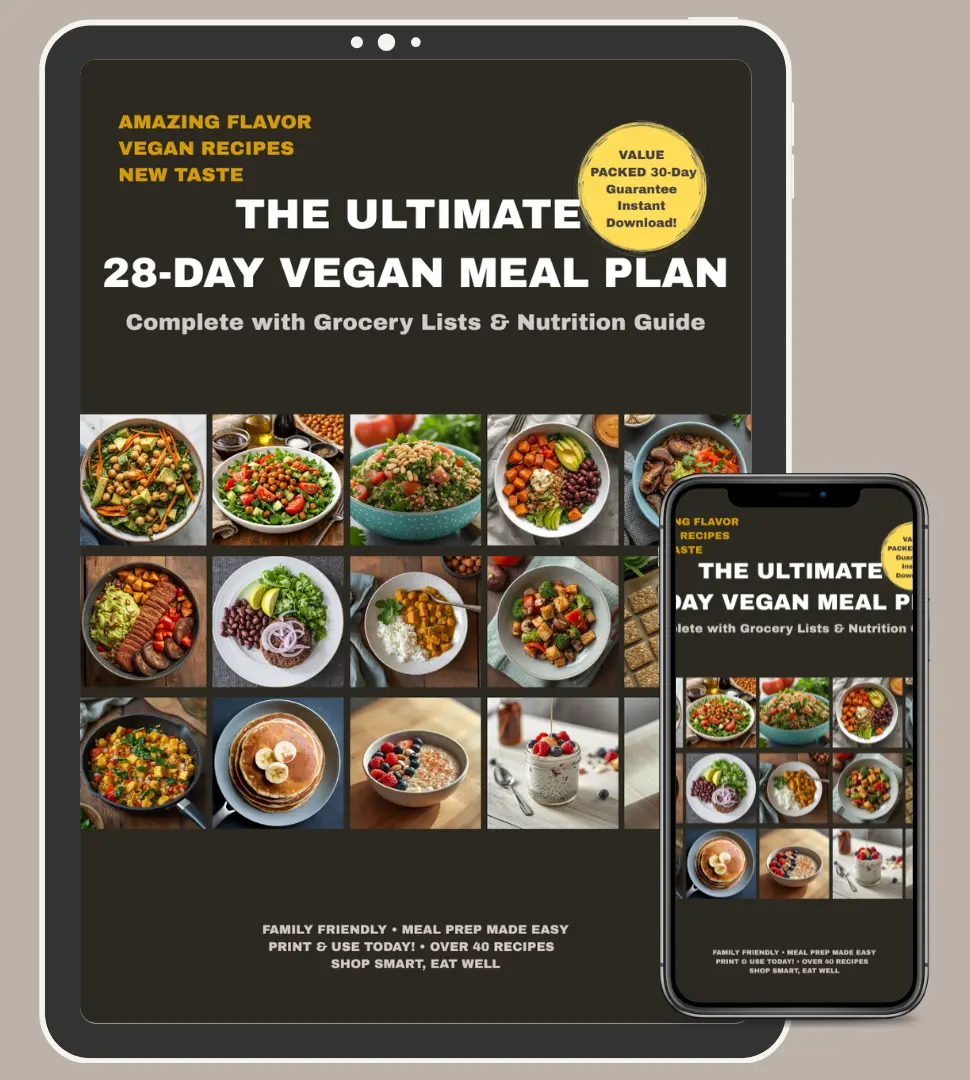
Still spending hours figuring out what to eat?
What’s included in your download
- 40+ nutritionist-approved recipes
- Complete 28-day calendar
- Meets protein, iron & B12 needs
- Family & meal prep friendly
- Vibrant photo for every recipe
- Simple, common ingredients
Instant PDF download. No subscriptions. No waiting.