
Nutritional Disclaimer: This content is for informational purposes only and does not constitute medical or dietary advice. Always consult a registered dietitian or healthcare provider before making significant changes to your diet, especially if you have a diagnosed health condition.
Vegan Mediterranean Meal Plan: 7 Days of Plant-Based Mediterranean Eating
TL;DR
A vegan Mediterranean meal plan combines the two most evidence-backed dietary patterns in nutrition science into one approach that is simultaneously the most delicious, the most anti-inflammatory, and the most sustainable way to eat plants. The Mediterranean diet is rated the number one overall diet in the world by US News for the seventh consecutive year. When fully plant-based, it retains every proven benefit and removes the one component that limits its health outcomes in the standard version: animal protein. This guide covers the science, the eight pillars, a full 7-day vegan Mediterranean meal plan with breakfast, lunch, snack, and dinner, a weekly shopping structure, olive oil and herb science, and 12 FAQs.
The Mediterranean Diet: What It Is and Why It Works
The Mediterranean diet is not a prescription. It is a culinary civilisation. Born across the coastlines of Greece, Southern Italy, Spain, and the Levant, it describes the natural eating patterns of populations who consistently outlive, outperform cognitively, and outrank on every cardiovascular health metric compared to northern European and Western counterparts.
What distinguishes it scientifically is not any single superfood. It is the pattern: abundant vegetables and legumes, olive oil as the primary fat, whole grains, nuts and seeds, herbs and spices, minimal processing, and a philosophy of eating that treats food as pleasure as much as fuel.
The Vegan Mediterranean Intersection
The traditional Mediterranean diet already derives 60-70% of its calories from plant sources. Olive oil, legumes, vegetables, grains, fruits, nuts, and herbs are its structural core. The vegan Mediterranean meal plan simply makes this default fully explicit, removing fish, dairy, and small quantities of meat that appear in the traditional version.
The result is a diet that retains every documented benefit of the Mediterranean pattern while eliminating the saturated fat from dairy and the mercury, microplastics, and environmental concerns associated with fish consumption. Research reviewed at PubMed shows plant-based Mediterranean diets produce equal or superior outcomes for inflammatory markers, cholesterol profiles, and gut microbiome diversity compared to the fish-inclusive version.
The PREDIMED and Lyon Diet Heart Study: What the Evidence Shows
The PREDIMED trial is the largest randomised controlled trial ever conducted on the Mediterranean diet. Its headline finding: Mediterranean eating reduced major cardiovascular events by 30% versus a standard low-fat diet. The mechanism identified was predominantly the polyphenol load from olive oil, legumes, nuts, and vegetables. Every single one of these sources is fully intact and amplified in a plant-based Mediterranean pattern. The meat and fish that appear in the original protocol contributed marginally to the outcome. The plants drove the results.
For the complete head-to-head analysis of these two dietary patterns, the vegan vs Mediterranean diet guide covers the full scientific comparison with outcome data.
+ Grocery List
The 8 Pillars of a Vegan Mediterranean Meal Plan
A genuine vegan Mediterranean meal plan is built on eight structural principles. These are not guidelines to follow occasionally. They are the architecture of every day of eating. Each pillar delivers specific documented health outcomes.
1. Extra Virgin Olive Oil as Primary Fat
Daily target: 3-4 tablespoons. Not a garnish. The primary cooking and dressing fat.
Oleocanthal in EVOO is a natural COX-1 and COX-2 inhibitor with effects similar to ibuprofen at anti-inflammatory doses. Oleic acid (73% of EVOO) reduces LDL oxidation. Over 30 distinct polyphenols per tablespoon.
2. Legumes Every Day
Daily target: At least 1 cup cooked. Chickpeas, lentils, fava beans, white beans, and cannellini are the Mediterranean protein workhorses.
Mediterranean populations historically ate legumes as their primary protein source. The vegan Mediterranean meal plan restores this pattern to its rightful central position.
3. Vegetables at Every Meal
Daily target: 5-7 servings. Raw, roasted, braised, or marinated. Mediterranean vegetable culture prioritises variety over volume.
Tomatoes (lycopene), aubergine (nasunin), artichokes (cynarin), fennel (anethole), and courgette form the classic Mediterranean vegetable palette. Each delivers unique phytonutrients absent in northern European produce.
4. Whole Grains, Not Refined
Daily target: 2-3 servings. Bulgur, freekeh, whole wheat, barley, farro, and oats are the Mediterranean grain canon.
Bulgur (8.2g fiber per cup cooked) and freekeh (up to 12g fiber per cup) are the highest-fiber grains in the Mediterranean tradition. Both remain underused in Western vegan cooking despite being extraordinary foods.
5. Nuts and Seeds Daily
Daily target: 30g. Walnuts, almonds, pistachios, pine nuts, sesame seeds, and tahini are structural Mediterranean fats.
Walnuts are the only tree nut with significant omega-3 (ALA). Almonds deliver the highest calcium of any nut. Tahini is one of the most nutritionally dense foods in the entire Mediterranean pantry.
6. Herbs and Spices as Nutrition Delivery
Daily target: Fresh or dried at every meal. Oregano, thyme, rosemary, basil, mint, parsley, za’atar, sumac, and saffron are not garnishes.
Oregano has one of the highest ORAC antioxidant scores of any food. Saffron has demonstrated clinical efficacy for mood and cognitive function. Sumac provides ellagitannins that gut bacteria convert to urolithins with anti-inflammatory activity.
7. Fruit as Dessert and Snack
Daily target: 2-3 servings. Figs, pomegranate, citrus, grapes, melon, and stone fruits are the Mediterranean dessert tradition.
Pomegranate delivers punicalagins, among the most bioactive polyphenols in any food. Figs provide calcium, iron, and prebiotic fiber. The Mediterranean approach to fruit is abundance without anxiety.
8. Water, Herbal Tea, and Mindful Eating
Daily practice: Water as primary drink. Herbal teas (mint, chamomile, sage) as social and wellness beverages. Meals eaten slowly, seated, and without screens when possible.
The Mediterranean diet is a lifestyle, not just a food list. The way meals are eaten, the pace, the social context, and the sensory engagement with food are documented contributors to its health outcomes through stress reduction and parasympathetic activation during eating.
The Full 7-Day Vegan Mediterranean Meal Plan
Each day of this plan applies all eight pillars simultaneously. Every breakfast, lunch, snack, and dinner delivers legumes, olive oil, whole grains, and abundant vegetables. Prep notes are included where batch cooking across days reduces time. The weekly plan is designed to be genuinely delicious, not merely nutritionally complete.
For batch cooking strategies that make this plan achievable in under 2 hours of weekly prep, the vegan batch cooking guide covers the exact prep sequence. The Middle Eastern vegan recipes guide provides detailed recipe instructions for the classic dishes featured in this plan.
Olive Oil, Legumes, and Herbs: The Plant Mediterranean Trinity
If the Mediterranean diet has a holy trinity, it is these three. Remove any one of them and the documented health outcomes decline measurably. Together, they account for the majority of the polyphenol load, anti-inflammatory activity, and cardiovascular protection that make this dietary pattern uniquely powerful.
Extra Virgin Olive Oil: The Most Studied Fat in Human Nutrition
EVOO is not simply a healthy fat. It is a pharmacologically active food. Key bioactives per tablespoon:
- Oleocanthal: natural COX inhibitor. Anti-inflammatory at 3-4 tablespoons per day. Effect comparable to ibuprofen at consistent intake levels.
- Oleuropein: antioxidant compound shown to reduce LDL oxidation and protect arterial endothelium
- Hydroxytyrosol: one of the most bioavailable polyphenols in the human diet. Crosses the blood-brain barrier. Neuroprotective.
- Squalene: a skin-protective triterpene with emerging cancer-preventive evidence
The key qualifier: only extra virgin, cold-pressed, first press. Refined olive oils lose 80-90% of these bioactives in processing. Look for harvest date on the label, not just expiry date. Fresh EVOO is a different food from old EVOO.
Legumes: Why Mediterranean Cultures Made Them the Centrepiece
Legumes appear in every Mediterranean culinary tradition because they solved three problems simultaneously: protein in a meat-scarce region, fiber in a cuisine without processed food, and affordability across all economic strata. Their nutritional profile is uniquely suited to the vegan Mediterranean meal plan:
- Chickpeas: 15g protein, 12.5g fiber, 4.7mg iron, 2.5mg zinc per cup
- Lentils: 18g protein, 15.6g fiber, 6.6mg iron per cup
- Fava beans: 13g protein, 9g fiber, 4.5mg iron per cup
- White beans: 17g protein, 11g fiber, 6.6mg iron per cup
Eaten daily, they provide the protein equivalent of animal sources without any of the saturated fat, without cholesterol, and with substantially more fiber and micronutrient density.
Herbs and Spices: Where Mediterranean Cooking Becomes Medicine
The Mediterranean spice cabinet is a secondary pharmacopoeia. These are not optional flavour additions:
- Oregano and thyme: the highest antioxidant density of any culinary herbs by ORAC score. Antimicrobial. Support gut microbiome diversity.
- Sumac: ellagitannins converted to urolithins by gut bacteria. Anti-inflammatory, anti-oestrogenic in beneficial ways, prebiotic.
- Saffron: clinical trials show 30mg saffron daily matches low-dose antidepressants for mild depression. Improves memory and cognitive speed. Safranal and crocin are the active compounds.
- Za’atar (wild thyme + sesame + sumac): the compound spice blend that delivers three distinct polyphenol classes in one sprinkle.
- Rosemary: carnosic acid crosses the blood-brain barrier. Neuroprotective. Inhibits acetylcholinesterase, the same enzyme targeted by Alzheimer’s medications.
Mediterranean vs. Standard Vegan Diet: What Changes
A standard vegan diet is not automatically a Mediterranean one. The bar chart below compares the two on the metrics that matter most for documented health outcomes. The vegan Mediterranean meal plan scores higher on almost every measure because of its structural emphasis on olive oil, whole ancient grains, abundant herbs, and legume diversity.
The core message of this comparison: the vegan Mediterranean meal plan is not a compromise between veganism and the Mediterranean diet. It is the best version of both. For a full philosophical and scientific comparison, see the vegan vs Mediterranean diet guide and the anti-inflammatory vegan diet guide.
28-Day Vegan Meal Plan + Grocery list.
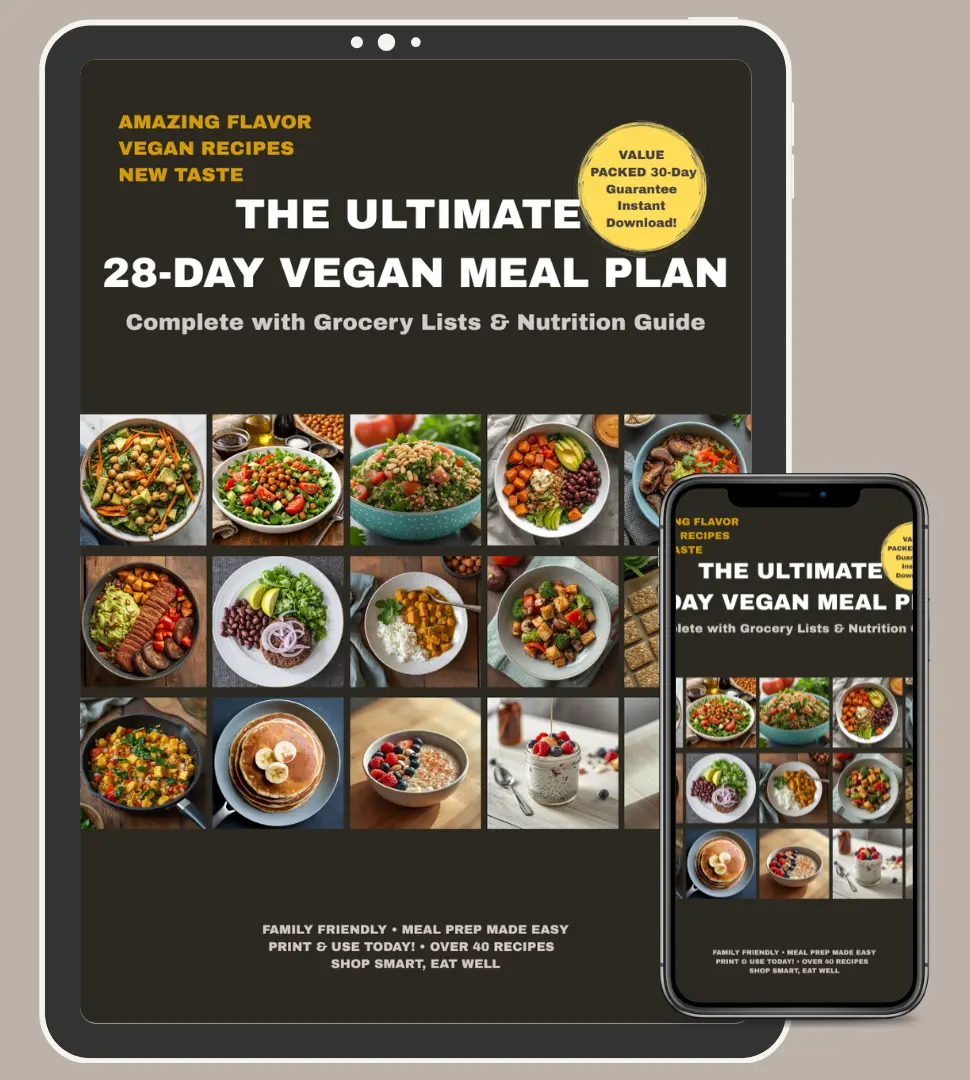
Transform your lifestyle with our comprehensive guide. This isn’t just a recipe book; it’s a complete system designed for success:
- The Vegan Guide: Essential transition tips and nutritional benefits.
- 40+ Chef Recipes: Breakfast, lunch, and dinner with high-quality photos.
- 4-Week Meal Plan: A fully structured day-by-day calendar.
- Grocery Lists: Categorized weekly lists to save you time and money.
- Photos: High-Quality Recipe Photos.
- Nutritions: Vegan Nutrition Guide Toolkit.
Weekly Shopping List Structure
A vegan Mediterranean meal plan requires a stocked pantry more than it requires sophisticated cooking skills. Once the core items are in place, almost any combination of them produces a legitimate Mediterranean meal. The shopping list below is structured by category to reflect how Mediterranean kitchens are actually organised.
Legumes (Dried or Canned)
- Lentils: red and green (2 bags)
- Chickpeas (2-3 cans or 500g dried)
- White/cannellini beans (2 cans)
- Fava beans (1 can for ful medames)
- Split peas (1 bag for soup)
Grains and Bread
- Bulgur wheat (large bag)
- Freekeh (if available)
- Whole wheat couscous
- Whole grain pasta (for ribollita)
- Whole wheat flatbread or pita
- Sourdough or whole grain loaf
Vegetables (Weekly Fresh)
- Aubergine x3
- Courgette x3
- Tomatoes (large quantity)
- Bell peppers x4
- Fennel x1
- Spinach and dark leafy greens
- Artichokes (fresh or jarred)
- Cucumber, radishes
Herbs and Spices (Pantry)
- Dried oregano, thyme, rosemary
- Za’atar blend
- Sumac
- Cumin and coriander seeds
- Smoked paprika
- Cinnamon and allspice
- Saffron (small quantity)
- Fresh parsley, mint, basil
Fats, Nuts, Seeds
- Extra virgin olive oil (quality bottle)
- Tahini (large jar)
- Walnuts (200g)
- Almonds (200g)
- Pistachios (100g)
- Pine nuts (small bag)
Fruit (Fresh and Dried)
- Lemons x6 (essential in every meal)
- Pomegranate x2
- Figs or dates
- Oranges and citrus
- Dried apricots and raisins
Pantry Staples
- Whole black and green olives
- Capers and preserved lemon
- Canned whole tomatoes
- Nutritional yeast
- Coconut yogurt (Greek-style)
- Fortified oat or soy milk
Supplements (Weekly Check)
- B12 cyanocobalamin 250mcg
- Algae D3 2,000 IU
- Algae DHA/EPA 250-500mg
- Iodine 150mcg (if not using iodized salt)
Chef Section: 20 Years of Mediterranean Flavour Science
Twenty years of working in professional MENA and Mediterranean kitchens produces a set of flavour convictions that no cookbook captures completely. The techniques below are not recipes. They are the underlying principles that make Mediterranean food taste the way it does, and why it tastes better the more you understand it.
Five Flavour Principles That Define Mediterranean Cooking
1. The EVOO Finish Rule
In a professional Mediterranean kitchen, olive oil is used twice in almost every dish: once during cooking for heat and texture, and once at the end, added raw over the finished plate. The cooking oil provides depth and fat-soluble nutrient release. The finishing oil provides the full polyphenol and aromatic profile that high heat destroys.
- Lentil soup: finish with a generous EVOO drizzle and squeeze of lemon just before serving
- Roasted vegetables: dress with fresh EVOO after coming out of the oven
- Hummus: pool of EVOO on top is non-negotiable, not decorative
This single technique transforms good vegan Mediterranean food into exceptional vegan Mediterranean food.
2. The Lemon at the End, Never the Beginning
Lemon juice is heat-volatile. Its aromatic compounds evaporate almost completely when cooked. Adding lemon at the beginning of cooking produces a flat, slightly bitter result. Adding lemon at the very end of cooking or at the table produces the bright, lifting, signature Mediterranean flavour that makes food taste alive.
3. The Caramelised Onion Foundation
Mujaddara, harira, tagine, chickpea stews, and braised beans all begin with the same act: low, slow caramelisation of onions in EVOO for 15-20 minutes until deeply golden. This process develops hundreds of Maillard reaction compounds that form the umami depth of Mediterranean cooking without any animal products whatsoever.
- Do not rush this step. Medium-low heat. Stir occasionally. 15-20 minutes minimum.
- Add a pinch of salt early to draw out moisture and speed caramelisation.
- This is the professional kitchen’s most underused tip for making vegan food taste genuinely complex.
4. The Za’atar Activation Technique
Za’atar loses aromatic intensity if simply sprinkled on food dry. In a professional kitchen, it is briefly bloomed in warm EVOO for 30-60 seconds before use. The EVOO extracts the fat-soluble aromatic compounds from the thyme and sumac, producing a concentrated flavoured oil that carries the seasoning into every element of the dish.
This za’atar oil on hummus, flatbread, or roasted vegetables is the difference between a good plate and a plate that people ask about.
5. The Preserved Lemon Shortcut
Preserved lemon is fermented lemon skin with a flavour profile that no fresh lemon can replicate: deeply savoury, slightly funky, intensely aromatic. One quarter of a preserved lemon rind, finely chopped and added to a tagine, white bean stew, or grain salad, delivers more flavour complexity than an hour of additional cooking time.
- Use only the rind. Discard the pulp.
- Rinse under cold water to moderate the saltiness before chopping.
- Store in the jar for up to 6 months once opened.
The Mediterranean Kitchen Principle That Changes Everything
The greatest lesson twenty years of professional Mediterranean cooking teaches is this: simplicity executed with quality ingredients is always superior to complexity executed with average ones. A dish of white beans braised with good EVOO, fresh rosemary, quality canned tomatoes, and a preserved lemon will outperform an elaborate preparation every time. Buy the best EVOO you can afford. Use lemons lavishly. Do not skip the fresh herbs. These are the investments that make the vegan Mediterranean meal plan taste like a cuisine worth returning to every day for the rest of your life.
For the full collection of MENA and Mediterranean recipes that underpin this meal plan, the Middle Eastern vegan recipes guide and the Blue Zones vegan diet guide cover the deeper culinary and longevity science behind these food traditions.
Why This Approach Lasts: The Vegan Mediterranean Meal Plan Is a Permanent Diet
Most dietary approaches fail because they require deprivation, willpower, or the acceptance that healthy food must taste worse than unhealthy food. The vegan Mediterranean meal plan requires none of these concessions.
It is abundant. A bowl of freekeh pilaf with caramelised onions, toasted almonds, and raisins is one of the most satisfying meals a human being can eat. A mezze spread of hummus, tabbouleh, muhammara, and warm flatbread is a feast by any culinary standard. Harira soup is warming, complex, and deeply nourishing. None of these meals feel like sacrifice.
It is permanent because it is pleasurable. The cardiovascular protection, the anti-inflammatory outcomes, the gut microbiome diversity, the cognitive benefits documented across decades of research: they are the byproduct of eating food that tastes exceptional. That is what makes the vegan Mediterranean meal plan different from every other dietary intervention in existence.
FAQ: 12 Questions About the Vegan Mediterranean Meal Plan
Yes, with three deliberate additions to the standard plan:
- Algae-based DHA/EPA (250-500mg daily): replaces the omega-3 from fish directly at the source. Algae produce the same DHA and EPA that fish contain.
- B12 supplement (250mcg cyanocobalamin): no dietary source on a fully plant diet.
- Calcium from fortified plant milk and calcium-set tofu: replaces dairy at equivalent or superior absorption rates when paired with vitamin D3.
With these three additions, the vegan Mediterranean meal plan covers every nutrient the traditional version provides.
The PREDIMED trial used 4+ tablespoons of EVOO daily as the intervention dose. This is the target for measurable cardiovascular and anti-inflammatory outcomes. Practically this means:
- 1-2 tablespoons in cooking (legume stews, sauteed vegetables)
- 1 tablespoon in dressings (salad, tabbouleh)
- 1 tablespoon as a finishing drizzle on soups and hummus
At 90-120 calories per tablespoon, 4 tablespoons add 360-480 calories from fat. This is not a concern in the context of the high-fiber, low-glycemic Mediterranean diet framework where total calorie intake is self-regulated by satiety.
Yes. Research reviewed at Examine.com shows the Mediterranean diet produces modest but sustained weight loss without caloric restriction. The mechanisms are:
- High fiber from legumes, vegetables, and whole grains drives satiety hormone production
- Low glycemic load prevents the insulin-driven fat storage of refined carb diets
- EVOO and nuts provide satisfying fats that reduce overconsumption
- Abundant food volume reduces the psychological restriction that causes rebound eating
Full weight management framework at the vegan metabolism guide.
Four structural differences distinguish a vegan Mediterranean meal plan from generic plant-based eating:
- EVOO as primary fat (not coconut oil, seed oils, or avoidance of fat entirely)
- Ancient and whole grains: bulgur, freekeh, farro, barley instead of white rice and refined pasta
- Herb and spice intensity: oregano, sumac, saffron, za’atar as nutritional delivery systems, not optional seasonings
- Legume diversity: rotating chickpeas, lentils, fava beans, white beans, and cannellini rather than defaulting to one bean type
The comparison with outcome data is covered in depth in the bar chart in Section 5 above.
The vegan Mediterranean meal plan addresses every major cardiovascular risk factor simultaneously:
- LDL reduction: soluble fiber from legumes and oats, plant sterols from nuts and seeds
- LDL oxidation prevention: EVOO oleocanthal and polyphenols
- Blood pressure: nitrates from leafy greens and beets, potassium from legumes and vegetables
- Inflammation: EVOO, omega-3 from algae, polyphenols from herbs and olive oil
- Glucose stability: low glycemic load of the entire dietary pattern
For the clinical detail, the vegan cholesterol guide covers the specific mechanisms and food protocols.
The plan can be executed with one 90-minute prep session per week, producing:
- One large pot of lentils or chickpeas (used across 3-4 meals)
- One batch of bulgur or freekeh (used for 2-3 lunches and dinners)
- One large jar of tahini sauce (used daily all week)
- One tray of roasted vegetables (mezze, grain bowls, flatbread topping)
With these four batch-cooked elements, every weekday meal is assembled in under 10 minutes. The batch cooking guide provides the exact prep sequence and storage guidelines.
Yes. The vegan Mediterranean meal plan is naturally family-compatible. Most dishes are mild enough for children and can be adjusted in spice level. The meals are designed for shared eating, which is structurally how Mediterranean food is served. Family-friendly adaptations:
- Reduce sumac and paprika quantity for children
- Serve legume dishes with familiar grain bases (pasta, rice) before introducing bulgur and freekeh
- Use hummus and nut butters as bridges for children new to plant-based proteins
- Involve children in making hummus, flatbread, and roasted chickpeas. Ownership increases acceptance.
The vegan Mediterranean meal plan is one of the most studied dietary patterns for cognitive protection. Key mechanisms:
- EVOO oleocanthal and hydroxytyrosol: cross the blood-brain barrier. Reduce amyloid-beta plaque accumulation. Neuroprotective at consistent intake levels.
- Algae DHA: the primary structural fat in neuronal membranes. Sustains synaptic plasticity and cognitive speed.
- Rosemary carnosic acid: acetylcholinesterase inhibitor. Supports acetylcholine levels critical for memory formation.
- Saffron: clinically shown to improve memory and mood.
The full cognitive nutrition framework is covered at the vegan brain health diet guide.
Four of the five Blue Zones (regions of exceptional longevity) have Mediterranean or Mediterranean-adjacent eating patterns:
- Sardinia, Italy: legumes, whole grain flatbread, local olive oil, minimal meat
- Ikaria, Greece: wild herbs, EVOO, legumes, mountain vegetables
- Nicoya, Costa Rica: beans, corn, squash (different region but parallel plant-centred pattern)
- Loma Linda, California: the most plant-based Blue Zone, Seventh-day Adventists who eat a fully vegetarian or vegan diet
The full Blue Zones dietary analysis is at the Blue Zones vegan diet guide.
Yes. The vegan Mediterranean meal plan is structurally affordable because its protein sources, legumes, are among the cheapest foods available per gram of protein. Cost optimisation strategies:
- Buy lentils, chickpeas, and beans dried in bulk (50-70% cheaper than canned)
- Buy EVOO in larger bottles (cost-per-litre drops significantly)
- Grow fresh herbs in a windowsill pot (parsley, mint, and basil cost almost nothing to grow)
- Prioritise in-season vegetables for peak flavour and lowest cost
- Freekeh and bulgur are often cheaper per serving than white rice despite being nutritionally superior
Yes, with increased portion sizes and targeted timing. For vegan athletes on a Mediterranean pattern:
- Pre-training: bulgur or whole grain couscous with legumes 2-3 hours before training for sustained glucose
- Post-training: lentils or tempeh within 30-60 minutes for muscle protein synthesis and iron restoration
- Daily protein target: 1.6-2.0g per kg body weight. Achieved through legume volume, hemp seeds, and tofu additions to the Mediterranean base plan.
- Electrolyte support: EVOO, olives, and legumes provide potassium and magnesium naturally
In practice, the differences are smaller than expected. Traditional Mediterranean meals in Greece, Lebanon, Morocco, and Italy are already predominantly plant-based. The vegan adaptation makes three practical substitutions:
- Fish replaced by: higher legume volume, seaweed snacks for iodine, algae DHA supplement
- Cheese replaced by: nutritional yeast for umami and B vitamins, tahini for creaminess and calcium, quality EVOO for richness
- Yogurt replaced by: coconut or soy yogurt Greek-style for tzatziki and breakfast bowls
The cuisine’s flavour identity: its herbs, its olive oil, its legumes, its ancient grains, its preserved lemons and olives, remains completely intact. The eating experience is Mediterranean in every meaningful sense.
Still spending hours figuring out what to eat?
What’s included in your download
- 36 nutritionist-approved recipes
- Complete 28-day calendar
- Meets protein, iron & B12 needs
- Family & meal prep friendly
- Vibrant photo for every recipe
- Simple, common ingredients
Instant PDF download. No subscriptions. No waiting.