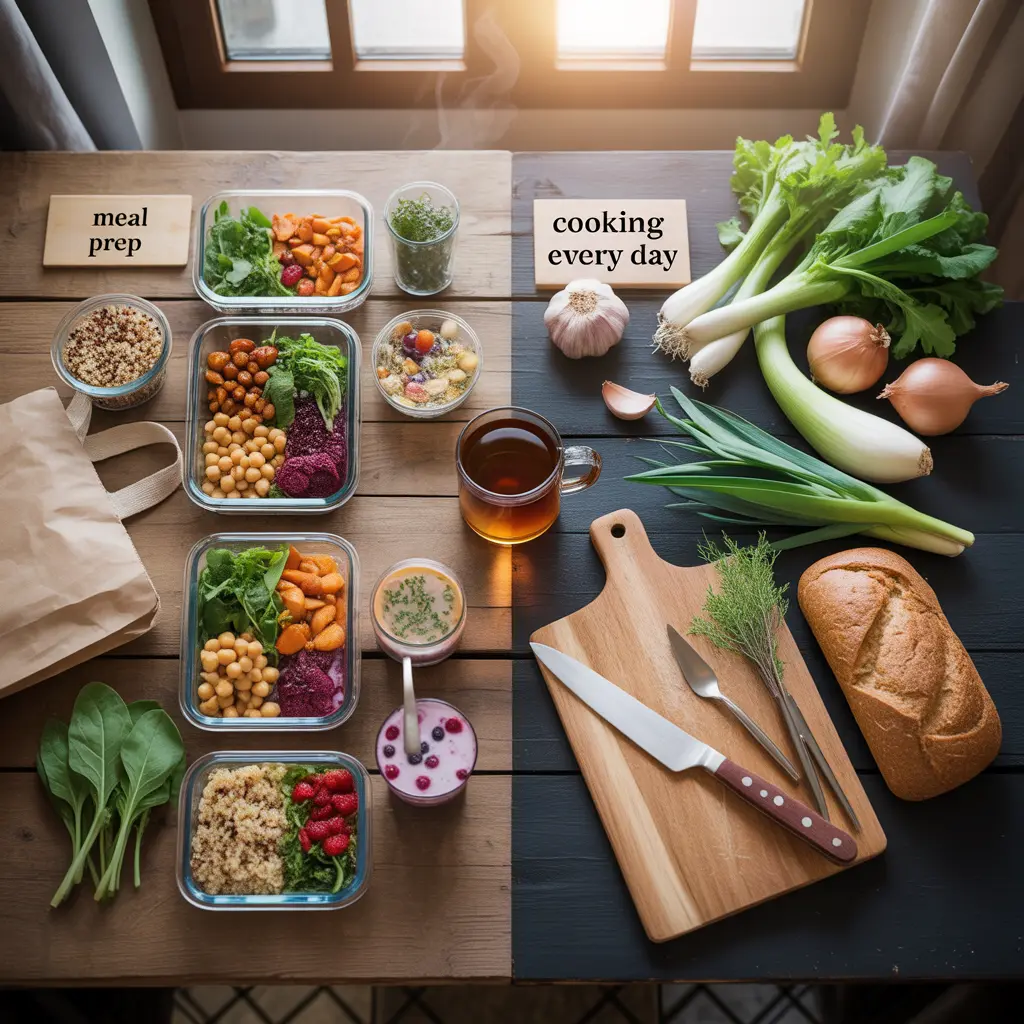
- In the vegan meal prep vs cooking every day comparison, meal prep wins on time, cost, nutrition consistency, stress reduction, and long-term dietary adherence by a significant margin.
- The average person who meal preps saves 5 to 7 hours per week compared to cooking daily from scratch. Over a year, that is 260 to 360 hours returned to your life.
- Daily cooking is not inherently worse, but it requires a level of consistent planning, energy, and discipline that most people cannot sustain alongside work, family, and other commitments.
- The best vegan meal prep system is not about cooking everything in advance. It is about preparing components that combine flexibly across multiple meals throughout the week.
- Most people fail at meal prep not because the concept is wrong but because they try to do too much on day one. A sustainable system starts with three components and builds from there.
- The Honest Vegan Meal Prep vs Cooking Every Day Comparison
- 10 Proven Reasons Meal Prep Wins
- Complete Side-by-Side Comparison Table
- The Complete Weekly Meal Prep System
- What to Prep and What to Cook Fresh
- Complete Storage and Shelf Life Guide
- When Cooking Every Day Actually Works Better
- Frequently Asked Questions
- Your Action Plan: Start This Sunday
The vegan meal prep vs cooking every day debate comes up constantly in plant-based communities and the answer most people give is frustratingly vague: “it depends on your lifestyle.” This guide does not give you that answer. It gives you the data, the real-world comparison across 18 specific categories, and a concrete system for making meal prep work regardless of your schedule, cooking skill level, or how many people you are feeding.
The honest truth about vegan meal prep vs cooking every day is that most people who cook every day do not choose it because it produces better outcomes. They do it because they have not yet built a meal prep system that works. Daily cooking feels familiar. Meal prep feels like extra effort upfront. That perception is the only real barrier between most people and a significantly easier, cheaper, and nutritionally superior approach to eating.
This guide closes that gap completely. By the end, the vegan meal prep vs cooking every day comparison will be resolved for your specific situation, and you will have a ready-to-implement system for this coming Sunday. For the complete 30-day structured version of this system, our 30-day vegan meal prep plan gives you every meal, every shopping list, and every prep instruction already built out.
The Honest Vegan Meal Prep vs Cooking Every Day Comparison
Before examining the specific advantages and disadvantages of each approach, it is worth establishing what we are actually comparing. In the vegan meal prep vs cooking every day debate, “meal prep” does not mean cooking 21 identical pre-portioned meals and eating the same thing robotically for seven days. That version of meal prep is both impractical and miserable, and it is why many people try it once and abandon it immediately.
Effective vegan meal prep means batch-cooking flexible components on one or two days per week and combining them into varied meals throughout the week. You cook a large batch of lentils, roast two full trays of vegetables, prepare a pot of quinoa, bake a block of tofu, and make two or three sauces. From those six components, you can construct completely different meals every single day without cooking anything from scratch on weekday evenings.
“Cooking every day” means making each meal largely from scratch each time it is needed, with no significant advance preparation. This is the approach most households default to without actively choosing it. The vegan meal prep vs cooking every day comparison is therefore between a proactive system and a reactive habit. Proactive systems win in almost every category that determines long-term dietary quality and sustainability.
10 Proven Reasons Meal Prep Wins the Vegan Meal Prep vs Cooking Every Day Debate
Reason 1: It Returns Hours to Your Life Every Single Week
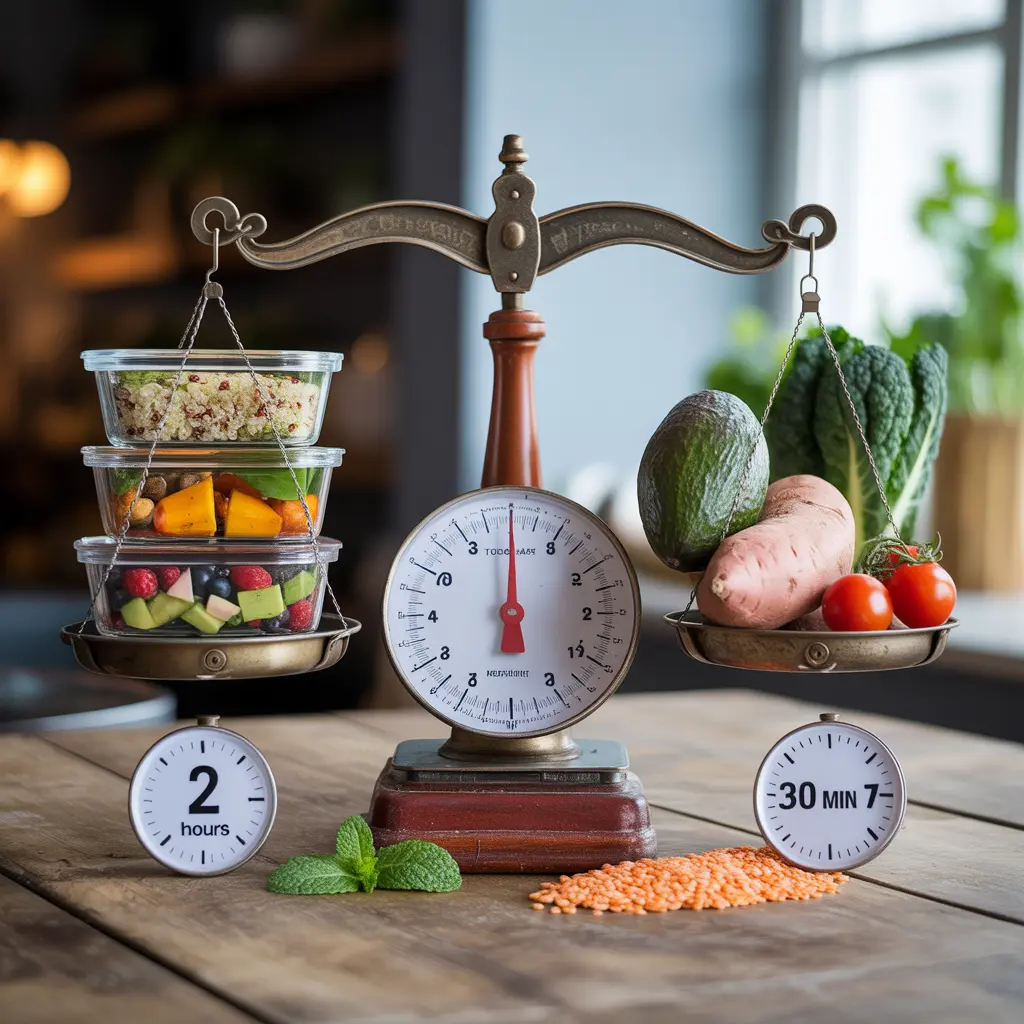
The time argument for vegan meal prep is the most straightforward in the entire vegan meal prep vs cooking every day comparison. Cooking from scratch every day for a household of two people takes between 30 and 60 minutes per meal, or 3.5 to 7 hours per week including preparation, cooking, and washing up. A well-organised meal prep session for the same household takes 2 to 3 hours once per week. The saving is 1.5 to 4 hours minimum, every week, without exception.
Over a full year, this means 78 to 208 hours returned to your life. That is two to five full working weeks. No dietary approach that requires this level of daily time investment is sustainable long-term for people with careers, families, and other commitments, regardless of how motivated they are when they start.
Reason 2: It Eliminates Decision Fatigue
Decision fatigue is one of the most significant and least discussed forces working against good dietary choices. By the end of a demanding day, the cognitive resources required to decide what to cook, check whether the ingredients are available, and execute the cooking are frequently insufficient. The result is that convenience, not health, wins. Takeaways, processed snacks, and nutritionally poor quick options fill the gap left by the absence of a plan.
Vegan meal prep eliminates all of these decision points simultaneously. On difficult days, the decision has already been made. The food is in the fridge. The only question is which combination of prepped components you feel like eating. This is the structural difference that makes vegan meal prep vs cooking every day a genuinely unequal comparison for most people in real-life conditions.
Reason 3: It Significantly Reduces Weekly Food Costs
In the vegan meal prep vs cooking every day cost comparison, meal prep wins through two separate mechanisms. First, buying ingredients in larger quantities for a planned weekly menu costs less per unit than buying small quantities for daily cooking. Second, and more significantly, meal prep eliminates the food waste that is the largest hidden cost of daily cooking. Ingredients bought for a specific dish that does not get cooked because of a change of plan, tiredness, or a spontaneous dinner out simply sit in the fridge until they are thrown away.
The average UK household throws away approximately £700 worth of food per year, with fresh vegetables, bread, and fruit as the most wasted categories. These are precisely the ingredients that form the foundation of a vegan diet. A meal prep system that buys specific quantities for specific planned uses reduces waste to near zero and produces consistent savings of $30 to $80 per month for most households.
Reason 4: It Makes Hitting Protein Targets Reliable
One of the central practical challenges of a plant-based diet is consistently meeting daily protein targets. Protein is available in abundance across plant foods, but reaching 1.2 to 1.6g of protein per kilogram of body weight reliably every day requires planning and deliberate food choices. On a daily cooking basis, this is difficult to maintain consistently. When tired, time-pressured, or poorly organised, lower-protein convenience choices fill the gap.
Vegan meal prep solves this by making high-protein components, specifically legumes, tofu, tempeh, and seitan, the foundation of every prep session. When these components are ready in the fridge, they are eaten. When they require daily preparation from scratch, they are frequently replaced by faster and lower-protein alternatives. For a complete guide to reaching protein targets on a plant-based diet, our guide to getting 100g of vegan protein easily provides the practical food combinations that work within a meal prep system.
Reason 5: It Dramatically Reduces Weekday Stress
In every survey of people who have switched from daily cooking to vegan meal prep, reduced weekday stress is the most frequently cited benefit, ranking above time savings and cost reduction. The psychological weight of knowing dinner still needs to be cooked at the end of a demanding day is underappreciated as a source of chronic low-level stress. The moment this obligation disappears, evenings feel qualitatively different.
Families in particular report dramatic improvements in the atmosphere of weekday evenings after implementing a meal prep system. Children eat at a consistent time. Adults decompress rather than cook under pressure. The dinner table becomes a pleasure rather than a deadline.
Reason 6: It Prevents Nutritional Gaps From Accumulating
A vegan diet managed through daily cooking is nutritionally strong on good days and nutritionally inconsistent on difficult ones. Over weeks and months, these inconsistencies accumulate into nutritional gaps that manifest as fatigue, poor recovery, skin changes, and the other symptoms described in detail in our guide to tiredness on a vegan diet. Meal prep prevents this by ensuring that nutritionally complete, planned meals are available and consumed consistently regardless of daily energy levels or motivation.
Reason 7: It Scales Effortlessly for Families
In the vegan meal prep vs cooking every day comparison for families, meal prep wins by an even larger margin than for individuals. Scaling a lentil soup recipe from 4 to 8 portions during a prep session adds almost no extra time. Cooking for a family of four from scratch every evening multiplies the daily effort with no equivalent efficiency gain. Parents who implement a weekend meal prep system consistently report that it is one of the most impactful practical changes they have made to family life.
Reason 8: It Supports Weight Management and Fitness Goals
For anyone using a plant-based diet for weight loss or athletic performance, vegan meal prep is not just convenient, it is structurally necessary. Consistent calorie and macro management across a week requires that meals be planned and available in advance. Daily cooking introduces too many variables and too many opportunities for higher-calorie convenience choices when hunger and low motivation converge. For a fully structured approach to weight management through plant-based eating, our vegan weight loss plan integrates meal prep as its foundational strategy.
Reason 9: It Reduces the Environmental Footprint of Vegan Eating Further
A plant-based diet already has a significantly lower environmental footprint than an omnivorous diet. Vegan meal prep amplifies this advantage by reducing food waste, reducing energy consumption through bulk cooking versus individual daily cooking, and reducing packaging waste through bulk purchasing. The environmental case for vegan meal prep vs cooking every day is clear and represents a meaningful additional benefit beyond the personal convenience and cost arguments.
Reason 10: It Makes the Vegan Diet Survivable During Difficult Life Periods
The most important and least discussed reason vegan meal prep wins the vegan meal prep vs cooking every day comparison is what happens during the inevitable difficult periods of life: illness, work deadlines, family crises, grief, exhaustion, travel. Daily cooking habits collapse under these pressures. A meal prep system, once established, has enough momentum and structural support to survive all of them. Having prepped food in the freezer during an illness means you eat well without cooking. Having a prep system that takes two hours on Sunday means even the most demanding week still has food covered.
The two tables below are your complete reference for the vegan meal prep vs cooking every day decision. Table 1 is the definitive side-by-side comparison across every meaningful category. Table 2 is your practical weekly prep guide showing exactly what to batch, what to cook fresh, and how long everything keeps. Screenshot both.
| Category | Vegan Meal Prep | Cooking Every Day | Winner | Real-World Impact |
|---|---|---|---|---|
| Weekly time investment | 2 to 3 hours once per week for a full week of meals | 30 to 60 minutes per day across 7 days = 3.5 to 7 hours total | Meal prep | Meal prep saves 1.5 to 4 hours per week. Over a year, that is 78 to 208 hours returned to your life. |
| Mental energy per day | Near zero. Decisions are made once. Execution on weekdays is automatic. | High. What to cook, what ingredients are available, is there time, am I motivated — every day, every meal. | Meal prep (decisively) | Decision fatigue is real. Eliminating daily cooking decisions reduces overall cognitive load significantly. |
| Weekly grocery cost | Lower. Buying in bulk quantities for a planned menu reduces per-unit cost and eliminates impulse purchases. | Higher. Daily shopping or frequent small shops lead to impulse buys, ingredient waste, and higher per-unit prices. | Meal prep | Most meal preppers report saving $30 to $80 per month versus daily cooking due to reduced waste and bulk buying. |
| Food waste | Very low. Every ingredient is bought for a specific purpose in a planned menu. Nothing sits unused until it rots. | High. Fresh ingredients bought for daily cooking frequently go unused, wilt, or spoil before being used. | Meal prep | UK households waste an average of £700 worth of food per year. Meal prep eliminates most of this. |
| Nutritional consistency | High. Protein, fibre, and micronutrient targets can be planned and hit reliably every day when meals are prepared in advance. | Variable. Daily cooking decisions are influenced by tiredness, available time, mood, and what is in the fridge. Nutrition is inconsistent. | Meal prep | Hitting daily protein targets consistently is one of the biggest challenges on a vegan diet. Meal prep solves this structurally. |
| Dietary adherence over 3 months | Significantly higher. Having ready-made healthy food available reduces the decision points at which convenience foods win. | Lower. Willpower and motivation fluctuate. On difficult days, daily cooking leads to convenient but nutritionally poor choices. | Meal prep (decisively) | Research on dietary adherence consistently shows that environmental design (having the right food available) outperforms willpower as a strategy. |
| Freshness and texture of food | Good to excellent when storage is correct. Some foods (salad greens, avocado) are best fresh. Most cooked vegan foods store and reheat well. | Maximum freshness. Everything is made and eaten immediately. No storage quality trade-offs. | Daily cooking (slight edge) | For most vegan foods, the freshness difference after 3 to 4 days of correct refrigeration is minimal and not meaningful. |
| Variety of meals | Can be very high with a component-based system. Batch cooking components rather than full meals creates dozens of combination options. | Unlimited in theory but limited in practice by available time and daily energy levels. | Tie | The key difference: in vegan meal prep, variety is planned. In daily cooking, variety depends on motivation that is not always present. |
| Stress on busy weekdays | Virtually zero. Food is ready. Reheating takes 3 to 5 minutes. No decisions, no washing up beyond a bowl and fork. | High. Cooking after a long day of work, with children, under deadline pressure, produces stress that diminishes the enjoyment of the food itself. | Meal prep (decisively) | This is the single most reported quality-of-life benefit by people who switch from daily cooking to vegan meal prep. |
| Cooking skill development | Lower. Prep day is repetitive rather than creative. Limited scope for spontaneous experimentation. | Higher. Daily cooking builds intuitive skills, flavour instincts, and technique through constant repetition and variation. | Daily cooking | If culinary development is a goal, daily cooking is genuinely superior. Most people prioritise convenience over skill development. |
| Suitability for families | Excellent. Scaling recipes for 4 to 6 people during one prep session is highly efficient. One session feeds a family for the week. | Can work but requires daily planning and execution that is demanding alongside family logistics. | Meal prep | Families consistently report that vegan meal prep reduces weeknight dinner stress more dramatically than any other single change. |
| Suitability for fitness goals | Excellent. Protein, calorie, and macro targets can be precisely planned and consistently hit when meals are prepared in advance. | Variable. Unless daily cooking is highly disciplined and structured, hitting precise nutritional targets consistently is difficult. | Meal prep | Athletes and people with specific body composition goals almost universally use some form of meal prep rather than relying on daily cooking. |
| Equipment required | Requires good storage containers: at minimum 8 to 10 glass or BPA-free containers of varying sizes. An instant pot or pressure cooker accelerates batch cooking significantly. | Standard kitchen equipment only. No additional investment required. | Daily cooking | Initial container investment of $30 to $60 pays back within weeks through reduced food waste and grocery savings. |
| Impact on sleep and evening routine | Positive. No cooking in the evening means more time to decompress, better sleep preparation, and fewer late meals. | Negative for many people. Evening cooking delays dinner, often pushes eating time later, and adds to evening stress. | Meal prep | Consistently eating dinner before 7pm is associated with better sleep quality and improved metabolic health. Meal prep makes this achievable. |
| Social and spontaneous eating | Slightly reduced flexibility. Prepped meals are planned. Spontaneous dinner invitations or restaurant visits require stepping outside the system. | Full flexibility. Daily cooking accommodates last-minute changes, guests, and spontaneous plans naturally. | Daily cooking | A good meal prep system accounts for 4 to 5 planned meals daily and leaves room for spontaneous eating without guilt or waste. |
| Environmental impact | Lower. Bulk cooking uses less energy per meal than cooking individual portions repeatedly. Reduced packaging from bulk buying. Less food waste. | Higher energy use per meal. More frequent small purchases create more packaging waste. Higher food waste rate. | Meal prep | Vegan meal prep amplifies the already low environmental footprint of plant-based eating through reduced energy use and waste. |
| Long-term dietary sustainability | Higher. The lower friction of a prepped diet means it is maintained through difficult periods of life when daily cooking would be abandoned. | Lower. Life disruptions including illness, work pressure, travel, and family demands consistently derail daily cooking habits. | Meal prep | The number one reason people abandon healthy vegan eating is not motivation loss. It is the friction of daily execution under real-life conditions. |
| Best for | Working adults, parents, fitness-focused individuals, budget-conscious eaters, anyone prioritising nutritional consistency and time efficiency | People with flexible schedules, culinary enthusiasts, those cooking for one or two with irregular schedules, anyone prioritising maximum freshness and variety | Context-dependent | For most people in most life situations, vegan meal prep vs cooking every day is not a close comparison. Meal prep wins clearly on the metrics that matter most. |
This is the most comprehensive vegan meal prep vs cooking every day comparison available in one place. The verdict across 18 categories is consistent: for the majority of people navigating real life with real constraints, meal prep produces better outcomes on every metric that actually determines whether a plant-based diet is maintained long-term.
For a fully built-out meal prep plan that removes all the planning work and gives you a ready-to-follow 30-day system, our 30-day vegan meal prep plan is the most complete resource available.
According to NutritionFacts.org’s research on meal planning and dietary adherence, structured meal planning is one of the strongest predictors of long-term healthy dietary adherence across multiple studies, significantly outperforming willpower-based approaches in populations followed for six months or more.
| Food Component | Prep or Fresh? | Why | Refrigerator Life | Freezer Life | Meals It Creates |
|---|---|---|---|---|---|
| Cooked lentils (red and green) | Batch prep | Cook once, use in soups, salads, grain bowls, dal, wraps, and pasta sauce across 5 days. Takes 20 minutes to cook a full week’s worth. | 5 days in sealed container | 3 months | Soups, salads, grain bowls, tacos, dal, pasta sauce |
| Cooked chickpeas | Batch prep | Versatile base for curries, salads, roasted snacks, hummus, and stews. Batch-cooking from dried is significantly cheaper than canned. | 5 days | 3 months | Curries, salads, roasted snacks, wraps, stews, hummus |
| Cooked whole grains (quinoa, brown rice, farro) | Batch prep | Grains reheat perfectly and form the base of any grain bowl combination. Quinoa provides complete protein and works in both savoury and sweet contexts. | 5 days | 2 months | Grain bowls, stir-fry base, breakfast porridge (quinoa), stuffed vegetables |
| Baked or pan-fried tofu | Batch prep | Pressing, marinating, and cooking tofu in bulk is time-intensive if done daily. Batch-cooked tofu stores well and adds high-quality protein to any meal instantly. | 4 to 5 days | 2 months | Stir-fries, grain bowls, wraps, salads, noodle dishes |
| Roasted vegetables | Batch prep | A full tray of roasted sweet potato, courgette, peppers, and cauliflower takes 30 minutes and provides vegetable volume for 4 to 5 days of meals without daily preparation. | 4 to 5 days | 2 months | Grain bowls, wraps, pasta, soups, side dishes, snacks |
| Sauces and dressings | Batch prep | A tahini sauce, a cashew cream, and a basic tomato sauce prepared on prep day transform simple grain and vegetable combinations into diverse, flavourful meals across the week. | 5 to 7 days | 1 to 2 months (most) | Used across every meal category as the primary flavour element |
| Overnight oats (3 to 4 portions) | Batch prep | Prepare 4 portions of overnight oats simultaneously on prep day. Breakfast is solved for the majority of the week in 10 minutes of hands-on time. | 4 days maximum | Not recommended | Breakfast only. Add fresh fruit and seeds each morning for variety. |
| Fresh salad leaves and greens | Cook fresh daily | Salad leaves wilt and degrade within 1 to 2 days of dressing. Fresh greens for raw salads are the one category where daily preparation genuinely outperforms batch prep. | 2 days dressed, 4 to 5 days undressed | Not suitable | Side salads, grain bowl topping, wrap filling (undressed only) |
| Avocado | Cut fresh daily | Avocado oxidises rapidly once cut. Prepare immediately before eating. Buy in batches at different ripeness stages to ensure daily availability throughout the week. | 1 day maximum once cut | Not suitable fresh | Toast topping, grain bowl addition, salad, dip |
| Tempeh | Batch prep | Steam all tempeh for the week on prep day. Store marinated and uncooked. Pan-fry fresh portions in 8 minutes as needed. This hybrid approach maximises flavour while minimising daily effort. | Marinated raw: 3 days. Cooked: 4 days. | 3 months cooked | Grain bowls, tacos, stir-fries, sandwiches, salads |
| Soups and stews | Batch prep (best freezer candidate) | Large-batch soups and stews are the most time-efficient prep category. A single pot of lentil soup or chickpea stew provides 6 to 8 portions and freezes perfectly with no quality loss. | 5 days | 4 months | Lunch, dinner, quick snack with bread. The most versatile batch prep item. |
| Energy balls and snacks | Batch prep | 20 minutes of hands-on time on prep day produces a week’s worth of oat and nut butter energy balls, roasted chickpeas, or trail mix that eliminates daily snack decisions entirely. | 7 days | 2 months | Between-meal snacks, pre-workout fuel, school lunchboxes |
This component approach is the fundamental insight that makes vegan meal prep sustainable. You are not cooking 21 complete meals in advance. You are preparing 6 to 8 versatile components that combine into dozens of different meals depending on what you feel like eating each day. The result is both the efficiency of meal prep and the flexibility of daily cooking, combined in a single system.
For a complete budget-optimised version of this component system, our cheap vegan meals on a budget guide shows how to build this entire prep week for under $30 in total grocery cost.
The BBC Good Food guide to meal prepping confirms that a component-based approach rather than full meal preparation is the most successful method for long-term meal prep adherence, with beginners reporting significantly higher consistency when they prepare flexible building blocks rather than identical pre-portioned meals.
The Complete Weekly Vegan Meal Prep System
Understanding the vegan meal prep vs cooking every day comparison intellectually is one thing. Having a concrete, repeatable system to implement is another. Here is the complete weekly system that works for the majority of households.
The Sunday Prep Session: Your Core 2-Hour Framework
The first 20 minutes: Set everything going that requires the most hands-off time first. Put a large pot of lentils or chickpeas on to cook. Put two full trays of chopped vegetables into the oven at 200°C. Set a rice cooker or pot of quinoa going. All three require minimal active attention once started.
The next 40 minutes: While the above cooks, prepare your sauces and dressings. A batch of tahini sauce (tahini, lemon, garlic, water), a simple tomato sauce, and a cashew cream or peanut sauce covers the flavour variety for the full week. Press and marinate your tofu or tempeh. Prepare overnight oats for the first four mornings of the week.
The final hour: Check and finish everything cooking. Bake or pan-fry the marinated tofu. Transfer everything to labelled storage containers. Portion soups and stews into individual servings for easy reheating. Cool everything to room temperature before refrigerating.
Total active time: approximately 60 to 75 minutes. Total hands-off time: 45 to 60 minutes. The two hours includes both. On weekdays, assembly of any meal takes 3 to 5 minutes of reheating and combining. The vegan meal prep vs cooking every day time comparison does not get more concrete than this.
The Mid-Week Refresh: 20 Minutes on Wednesday
A single 20-minute mid-week session on Wednesday extends the freshness and variety of the system significantly. Use this session to: prepare a fresh batch of overnight oats for Thursday and Friday, chop fresh salad ingredients for the second half of the week, and cook any component that is running low. This two-session approach rather than a single marathon prep day is the most sustainable format for long-term consistency.
What to Prep and What to Cook Fresh
One of the most common mistakes in the vegan meal prep vs cooking every day transition is trying to batch-prep everything. Some foods genuinely benefit from daily preparation, and recognising the distinction makes the system both more practical and more enjoyable.
Always batch prep: legumes, whole grains, roasted vegetables, tofu, tempeh, soups, stews, sauces, overnight oats, and snacks. These foods store well, reheat without quality loss, and represent the bulk of weekly eating.
Always prepare fresh: salad leaves and dressings for green salads, avocado, fresh herbs as a finishing garnish, and anything that loses its texture or quality within 24 hours of preparation. These fresh elements are what you add to your prepped base components each day to create variety and freshness within the system.
The ratio works out to roughly 80 percent prepped components and 20 percent daily fresh additions. This combination produces the efficiency of vegan meal prep while preserving the sensory quality that makes eating genuinely enjoyable.
Complete Storage and Shelf Life Guide
Correct storage is the operational foundation of any successful vegan meal prep system. These are the essential rules:
Use glass containers wherever possible. Glass does not absorb odours, does not leach chemicals, reheats evenly in the microwave, and lasts indefinitely. The initial investment pays back many times over compared to replacing degraded plastic containers.
Cool before refrigerating. Hot food placed directly in a sealed container creates condensation that accelerates spoilage. Allow all cooked food to cool to room temperature (within two hours of cooking) before sealing and refrigerating.
Label everything with the prep date. This removes the guesswork that causes people to throw away food that is still good and eat food that has gone bad. A simple piece of tape with the date written in marker is sufficient.
The three-day rule for mixed dishes, five-day rule for single components. Soups, stews, and mixed grain dishes are best consumed within three days. Single components including plain cooked grains, plain cooked legumes, and roasted vegetables maintain quality for five days. Anything beyond five days goes to the freezer.
Invest in a good freezer system. The freezer is the greatest underused tool in vegan meal prep. Soups, stews, cooked legumes, cooked grains, and baked tofu all freeze perfectly for two to four months. A well-stocked freezer means a missed prep day never results in nutritionally poor eating. It is the safety net that makes the vegan meal prep vs cooking every day system resilient rather than fragile.
When Cooking Every Day Actually Works Better
An honest vegan meal prep vs cooking every day guide acknowledges the situations where daily cooking is genuinely the better approach.
If you work from home with a flexible schedule and genuinely enjoy cooking, daily cooking provides creative satisfaction, maximum freshness, and culinary skill development that meal prep does not replicate. If cooking is a genuine pleasure and a form of daily decompression rather than a task, daily cooking serves a purpose beyond nutrition that meal prep cannot replace.
If you cook for one person with highly variable tastes and schedules, a full weekly prep session may produce more food than you can consume within the safe storage window. A lighter prep approach, prepping for three to four days rather than a full week, may serve single-person households better than the full system.
If you are in a period of active culinary learning, daily cooking builds skills, technique, and flavour intuition that meal prep does not. If developing genuine cooking ability is a primary goal, the repetitive nature of batch prep does not serve this aim as well as daily creative cooking does.
For everyone outside these specific situations, the vegan meal prep vs cooking every day comparison resolves clearly in favour of meal prep. The question is not which approach is theoretically superior in all circumstances. The question is which approach produces better outcomes for your specific life, and for most people, the answer is vegan meal prep, implemented with the component-based system described in this guide.
Frequently Asked Questions About Vegan Meal Prep vs Cooking Every Day
How long does vegan meal prep actually take per week?
A complete vegan meal prep session covering a full week of meals for two people takes 2 to 3 hours including preparation, cooking, and storage. This compares to 3.5 to 7 hours of total daily cooking time for the same household over seven days. The time saving is meaningful from the very first week and grows as the system becomes more efficient with practice. A mid-week refresh of 20 minutes on Wednesday extends the system through the full seven days without a single long session. See the complete weekly system in this guide for the exact framework.
Does vegan meal prep food taste as good as freshly cooked food?
For most vegan foods, the quality difference between properly stored meal prep food and freshly cooked food is minimal and often undetectable. Legumes, whole grains, roasted vegetables, soups, stews, and cooked tofu or tempeh all reheat well and retain their flavour and texture for four to five days when stored correctly in glass containers. The foods that do not store well, primarily fresh salad leaves and avocado, are identified in the component guide and reserved for daily fresh preparation. This combination produces the best of both approaches.
Will I eat the same thing every day with vegan meal prep?
Not with a component-based system. When you prep individual components such as lentils, roasted vegetables, quinoa, tofu, and two or three sauces rather than complete pre-assembled meals, the combinations available across a week are genuinely diverse. The same lentils become a dal on Monday, a grain bowl topping on Tuesday, a soup base on Wednesday, and a taco filling on Thursday. Variety comes from how you combine and season the components each day, not from cooking new things from scratch. This is the key insight that separates sustainable vegan meal prep from the repetitive approach that most people abandon quickly.
What containers do I need to start vegan meal prep?
Start with eight to ten glass containers in two sizes: four large containers (1 to 1.5 litres) for grains, legumes, and soups, and four to six medium containers (500 to 750ml) for sauces, tofu, and individual portions. Glass is strongly preferred over plastic for microwave reheating, odour resistance, and durability. BPA-free plastic containers work as a lower-cost starting point. Initial investment of $30 to $60 pays back within weeks through reduced food waste alone. Do not wait until you have perfect equipment. Start with whatever containers you already own and upgrade as the system becomes established. See our budget vegan meals guide for the most cost-efficient way to stock your prep kitchen.
How do I start vegan meal prep if I have never done it before?
Start with three components only: one batch of cooked lentils or chickpeas, one pot of cooked quinoa or brown rice, and one tray of roasted vegetables. This takes under 90 minutes and covers the protein, carbohydrate, and vegetable base for three to four days of meals. Add one sauce, such as a simple tahini dressing. From these four items, you can build eight to ten different meals. Once this three-component system feels automatic, add overnight oats for breakfast and a batch of soup. Build gradually rather than attempting a full system on week one. The full 30-day guided version of this approach is in our 30-day vegan meal prep plan.
Your Action Plan: Start Vegan Meal Prep This Sunday
The vegan meal prep vs cooking every day comparison is resolved. Here is your exact starting point for this Sunday:
Saturday: Write your component list for the week. Choose one legume (lentils or chickpeas), one grain (quinoa or brown rice), two vegetables for roasting (sweet potato and courgette work perfectly), one protein (tofu or tempeh), and one sauce (tahini plus lemon plus garlic). Buy everything in one shopping trip. Total grocery cost for two people: $25 to $35.
Sunday morning: Set the legumes to cook first (20 minutes). Put the vegetables in the oven (25 minutes). Set the grain going (15 minutes). While everything cooks, make your sauce (10 minutes), press and marinate your tofu (10 minutes active). Bake the marinated tofu (25 minutes). Transfer everything to labelled containers. You now have the foundation of 15 to 20 different meals in your fridge.
Every weekday: Choose a base component, add a vegetable, add a sauce, add a fresh element (half an avocado, a handful of fresh leaves, a squeeze of lemon). Your meal is ready in 5 minutes. The vegan meal prep vs cooking every day comparison stops being theoretical the moment you experience this for the first time.
Wednesday: 20-minute refresh session. Prep overnight oats for Thursday and Friday. Chop fresh salad vegetables. Check what needs replenishing and cook one component if necessary.
The vegan meal prep vs cooking every day decision is ultimately not about which approach is philosophically better. It is about which approach produces consistent, high-quality, nutritionally complete plant-based meals in the real conditions of your actual life. For the vast majority of people, that approach is vegan meal prep, implemented simply, built gradually, and maintained through the system in this guide.
Nutritionist Approved
28-Day Vegan Meal Plan
40+ recipes · Photos · Shopping lists
🔁 7-Day Money-Back Guarantee · 📱 Works on All Devices