
⚡ TL;DR: Middle Eastern Vegan Recipes at a Glance
- Middle Eastern cuisine is one of the most naturally vegan-friendly culinary traditions on earth. Dozens of iconic dishes have been plant-based for thousands of years.
- The 14 recipes in this guide are authentic, not adaptations. Ful medames, mujaddara, koshari, mutabbal, and fattoush are traditional dishes that were never made with meat.
- Middle Eastern vegan recipes are among the most nutritionally complete plant-based meals available: legumes, whole grains, olive oil, seeds, and fresh herbs activate every major health mechanism simultaneously.
- The Levantine diet has been associated in peer-reviewed research with significantly lower rates of cardiovascular disease, type 2 diabetes, obesity, and all-cause mortality than Western dietary patterns.
- Every recipe includes the Arabic dish name, cultural origin, exact macros, and a professional chef technique tip from 20 years of working across Lebanon, Dubai, and Saudi Arabia.
- The five essential ingredients that unlock authentic Middle Eastern vegan flavour: tahini, sumac, pomegranate molasses, za’atar, and dried limes (loomi).
Middle Eastern Vegan Recipes: 14 Authentic Plant-Based Dishes From the Levant
Middle Eastern vegan recipes are not a modern adaptation of a meat-based cuisine. They are the original cuisine. Long before veganism existed as a defined dietary philosophy, the people of the Levant, Egypt, the Gulf, and the broader Middle East were building some of the world’s most sophisticated plant-based food culture around legumes, grains, olive oil, tahini, and fresh herbs. Not by choice or ideology but by culinary tradition refined across millennia.
Ful medames, the spiced fava bean dish that has fuelled Egyptian labourers, scholars, and kings since the time of the Pharaohs, is vegan. Mujaddara, the lentil and caramelised onion rice dish mentioned in ancient texts across the Fertile Crescent, is vegan. Hummus, fattoush, tabbouleh, baba ghanoush, mutabbal, freekeh soup, stuffed grape leaves in olive oil, kishk: all vegan. All ancient. All extraordinarily nutritious.
Having spent twenty years cooking professionally across Lebanon, Dubai, and Saudi Arabia, I can tell you with certainty that the most satisfying food I have ever produced came from the simplest Levantine pantry. Dried lentils. Olive oil. Lemon. Cumin. Garlic. Sumac. Those six ingredients, applied with technique and patience, produce food that no meat-based cuisine can match for depth, complexity, and nutritional density.
This guide delivers 14 authentic Middle Eastern vegan recipes with exact macros, cultural context, and the professional chef techniques that make the difference between a good version and a transcendent one. These are not Westernised approximations. They are the real dishes, cooked the correct way.
The Science: Why the Levantine Diet Is One of the Healthiest on Earth
🔬 The Mediterranean-Levantine Diet in Peer-Reviewed Research
The health credentials of Middle Eastern plant-based eating are backed by decades of rigorous research. The traditional Levantine diet, characterised by high legume intake, whole grains, olive oil, nuts, seeds, abundant vegetables, and minimal processed foods, consistently ranks among the top three dietary patterns for longevity and disease prevention in global meta-analyses.
- A 2019 meta-analysis in BMJ covering 12.8 million participants found Mediterranean-Levantine dietary patterns associated with 21% lower cardiovascular mortality, 17% lower cancer mortality, and 15% lower all-cause mortality
- Daily legume consumption (central to Levantine food culture) is one of the strongest individual dietary predictors of longevity across all studied populations, including in the Blue Zones research
- The polyphenol density of traditional Middle Eastern herbs (za’atar, sumac, parsley, mint) rivals any culinary tradition globally. Sumac contains one of the highest anthocyanin concentrations of any food on earth
- Pomegranate molasses and pomegranate seeds, used extensively in Levantine cooking, contain punicalagins, ellagitannins that produce urolithins with potent anti-inflammatory and cardioprotective effects
🧬 The Specific Bioactive Compounds in Middle Eastern Plant Foods
What makes Middle Eastern vegan recipes nutritionally exceptional is not just the macronutrient profile. It is the density and diversity of specific bioactive compounds that are concentrated in the traditional ingredients:
- Sumac: extraordinarily high in anthocyanins and quercetin. Research published in the Journal of Agricultural and Food Chemistry identified sumac as having an ORAC (oxygen radical absorbance capacity) value exceeding most commonly consumed antioxidant foods.
- Za’atar (wild thyme blend): thymol and carvacrol, the primary volatile compounds in thyme and oregano, have demonstrated antimicrobial, anti-inflammatory, and neuroprotective properties in multiple peer-reviewed studies.
- Tahini: rich in sesamin and sesamolin, lignans with documented antioxidant, anti-inflammatory, and lipid-modifying properties. Sesamol in sesame oil is one of the most stable natural antioxidants known.
- Freekeh (roasted green wheat): significantly higher fibre, protein, and lutein content than standard wheat. Lutein is a carotenoid linked to reduced age-related macular degeneration and cardiovascular protection.
- Pomegranate molasses: concentrated source of punicic acid (an omega-5 conjugated fatty acid unique to pomegranate) with emerging evidence for anti-tumour, anti-inflammatory, and cardiovascular protective effects.
🫘 The Legume Core: Why Mujaddara and Ful Have Sustained Civilisations
The central nutritional fact of Middle Eastern vegan cuisine is its legume foundation. Lentils, fava beans, chickpeas, and split peas have been cultivated and eaten in this region continuously for over 10,000 years. They are not an ingredient. They are a civilisational food technology.
The nutritional case for legumes in the Levantine tradition:
- Protein at 18 to 20g per 200g cooked serving, meeting the foundational protein requirement for any plant-based meal
- Resistant starch feeding gut microbiome species that produce short-chain fatty acids inhibiting hepatic cholesterol synthesis
- Iron, zinc, folate, and magnesium in concentrations that make legume-based meals nutritionally complete without supplementation in most cases
- Low glycaemic index producing stable blood glucose and insulin responses that protect against type 2 diabetes and obesity
For a complete overview of the plant-based nutrition science underpinning these traditional dishes, our vegan diet nutrition facts and science guide covers the full evidence base across all dietary components.
The 10 Essential Middle Eastern Vegan Pantry Ingredients
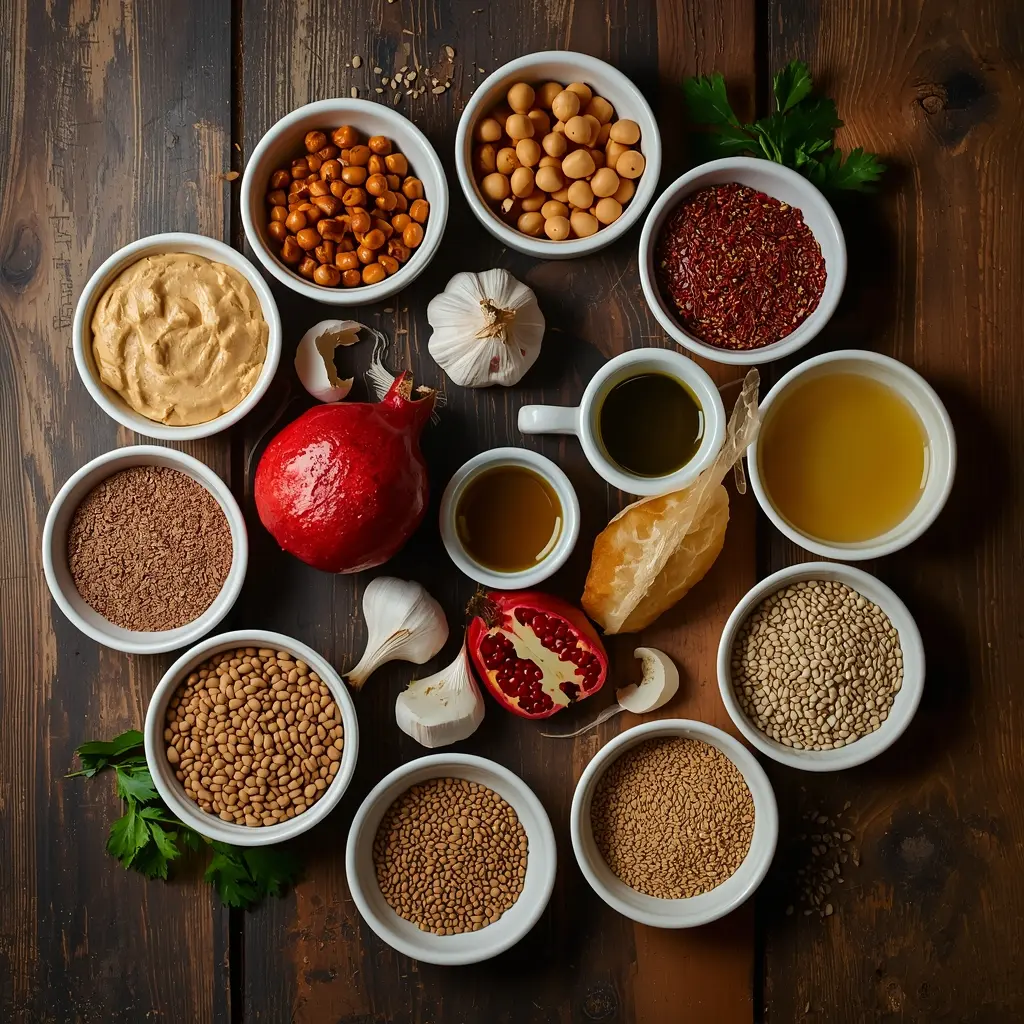
These ten ingredients define authentic Middle Eastern vegan flavour. Without them, you are cooking about Levantine food. With them, you are cooking within one of the world’s greatest culinary traditions.
Ingredient Spotlights: Deep Dives on the Top 5
🔴 1. Sumac: The Antioxidant Powerhouse of Levantine Cuisine
Sumac is the dried, ground berry of Rhus coriaria, a shrub native to the Mediterranean basin and the Middle East. It has been used in Levantine cooking for at least 3,000 years, predating the widespread availability of citrus fruit in the region, and serving historically as the primary souring agent in dishes now made with lemon.
The nutritional profile of sumac is extraordinary and almost entirely unknown outside specialist nutritional research:
- Anthocyanins: responsible for sumac’s deep crimson colour and among the highest concentrations measured in any commonly used culinary ingredient. Anthocyanins reduce LDL oxidation, suppress neuroinflammation, and have demonstrated anti-cancer activity in multiple in-vitro studies
- Quercetin: a flavonoid with anti-inflammatory, antihistamine, and cardiovascular protective effects. Sumac contains quercetin at concentrations that make even small culinary quantities nutritionally significant
- Gallic acid: a phenolic acid with particularly strong antimicrobial and antioxidant activity, contributing to sumac’s traditional use as a food preservative before refrigeration
- Malic acid: the organic acid responsible for sumac’s sour flavour, supporting digestive acid production and mineral absorption in the stomach
Professional use: Sumac is applied three ways in a Levantine kitchen: stirred into dressings for its sour note, sprinkled raw over salads and dips for visual impact and flavour, and incorporated into spice blends (including za’atar). It does not tolerate extended cooking. Always add at the end or as a finish.
🤎 2. Tahini: Liquid Nutrition in a Jar
Tahini is one of the most nutritionally concentrated foods in the Levantine pantry. Made from ground sesame seeds, it provides a fat, protein, and mineral profile that makes it genuinely functional as a nutritional ingredient, not merely a flavour component. Per 30g (2 tablespoons):
- Calcium: 128mg, approximately 10% of the daily requirement from a single tablespoon-size serving
- Protein: 5g of plant protein with a favourable amino acid profile
- Iron: 1.3mg, contributing to the daily iron target alongside legume-based dishes
- Zinc: 1.4mg, supporting immune function and wound healing
- Sesamin and sesamolin: lignans unique to sesame with documented antioxidant, anti-inflammatory, lipid-lowering, and possibly anti-cancer properties. Sesamin has demonstrated in peer-reviewed research the ability to reduce LDL while increasing HDL through a mechanism involving CYP450 enzyme modulation
Making tahini sauce: Authentic Lebanese tahini sauce requires only tahini, lemon juice, garlic, and cold water. The critical technique is adding cold water gradually while whisking. The emulsion will seize and turn thick before thinning with additional water. Many cooks panic at the seize point and add too much water. The correct texture is thick enough to coat a spoon but fluid enough to pour. Season with salt after the emulsion forms, never before.
🌾 3. Freekeh: The Ancient Grain That Outperforms Quinoa
Freekeh is wheat harvested young and roasted over fire. It is one of the oldest processed foods in human history, with archaeological evidence of freekeh production in the Levant dating to approximately 2300 BCE. Its nutritional profile significantly exceeds standard wheat and competes directly with quinoa on multiple markers:
- Protein: 12 to 16g per 100g dry weight, significantly higher than standard wheat (11g) and comparable to quinoa (14g)
- Fibre: 16g per 100g, approximately three times the fibre of white rice and nearly double that of brown rice
- Lutein and zeaxanthin: carotenoids that are unusually concentrated in freekeh due to harvesting at the immature stage, before the green chlorophyll containing these compounds degrades. These are among the most important nutrients for age-related macular degeneration prevention
- Prebiotics: the resistant starch in freekeh selectively feeds Bifidobacterium and Lactobacillus species in the gut microbiome, producing SCFA-mediated cholesterol reduction and immune regulation
Chef note: Whole freekeh takes 45 minutes to cook. Cracked freekeh cooks in 20 minutes and produces a finer, more risotto-like texture ideal for the freekeh soup recipe in this guide. Toast in a dry pan for 2 minutes before adding liquid to amplify the characteristic smoky grain flavour.
🍋 4. Pomegranate Molasses: The Secret Depth Ingredient
Pomegranate molasses is made by slowly reducing fresh pomegranate juice until it thickens to a dark, sour-sweet syrup. No added sugar in authentic versions. Its flavour is unlike any other ingredient in any culinary tradition: sour, fruity, slightly bitter, deeply complex. One teaspoon changes a fattoush dressing from pleasant to arresting.
- Punicic acid: an omega-5 conjugated fatty acid unique to pomegranate, with emerging research suggesting anti-inflammatory, anti-tumour, and lipid-modifying effects not found in other dietary fatty acids
- Punicalagins: ellagitannins metabolised by gut bacteria into urolithins. Urolithins are among the most bioactive polyphenol metabolites identified in human nutrition research, with documented effects on mitochondrial biogenesis and cellular longevity pathways
- Anthocyanins: at highly concentrated levels due to the reduction process, providing a flavour intensity and antioxidant density that fresh pomegranate juice cannot replicate
Uses in this guide: Fattoush dressing, muhammara (roasted pepper dip), freekeh soup finishing drizzle, and as a glaze for roasted cauliflower dishes. A tablespoon in a salad dressing produces a depth of flavour that transforms the dish.
🟡 5. Dried Limes (Loomi): The Soul of Gulf and Iraqi Cooking
Dried limes, known as loomi in Arabic and limu omani in Persian cuisine, are sun-dried limes that have undergone a natural fermentation process during drying. The result is a small, hollow, intensely aromatic ingredient with a flavour that is simultaneously sour, smoky, slightly musty, and intensely citrusy. There is no substitute.
- Organic acids: concentrated citric, malic, and acetic acids from the fermentation process, supporting digestive function and mineral bioavailability
- Limonoids: triterpene compounds found in all citrus that have demonstrated anti-cancer activity in cell culture studies, particularly against colon and breast cancer cell lines
- Pectin: soluble fibre that contributes to bile acid sequestration and LDL cholesterol reduction when present in cooking liquids
Use by piercing whole dried limes and dropping them into soups, stews, and rice dishes during cooking. They infuse the cooking liquid with extraordinary complexity. Remove before serving or crack open and eat the flesh for an intense flavour experience. The freekeh soup and lentil stew recipes in this guide use loomi to achieve their characteristic depth.
14 Authentic Middle Eastern Vegan Recipes With Exact Macros
Every recipe here is traditional. No adaptations, no meat substitutions. These dishes were plant-based before the word existed.
🫙 The Mezze Table: Dips, Spreads, and Small Plates
1. Hummus bi Tahini
The authentic method: Blend 200g cooked chickpeas (warm, freshly cooked or canned) with 60g tahini, juice of 1 lemon, 1 small garlic clove, and a large pinch of salt. Blend for a full 3 minutes on high speed, adding cold water gradually until completely smooth and almost liquid. Rest in the refrigerator for 15 minutes before serving. The texture firms on resting.
Serve: On a shallow plate with a well in the centre. Drizzle generously with extra virgin olive oil. Dust with smoked paprika or sumac. A few whole cooked chickpeas on top. Torn flat bread alongside.
2. Mutabbal (Smoked Aubergine and Tahini Dip)
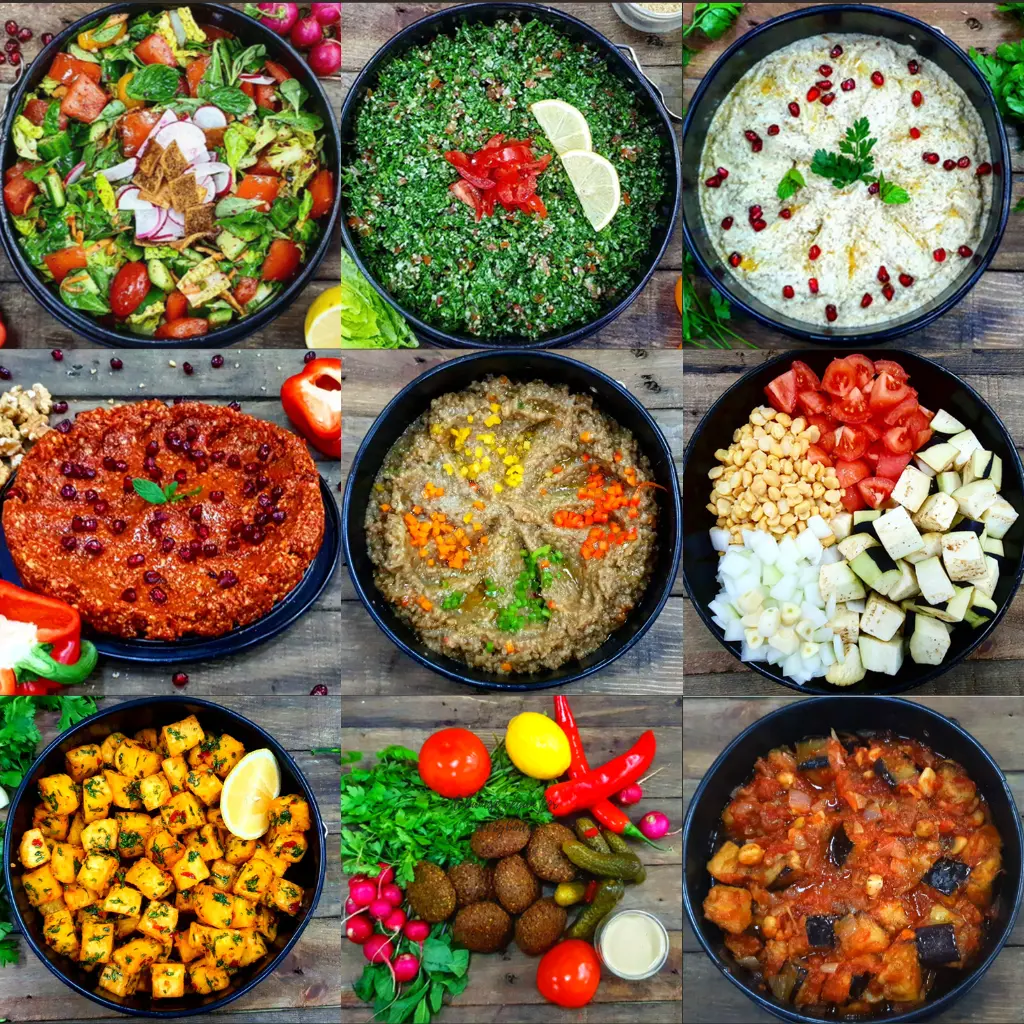
The technique: Char 2 large aubergines directly over a gas flame or under the highest grill setting, turning with tongs, until the skin is completely blackened and the flesh is fully collapsed and soft (15 to 20 minutes). This is not optional: the flame contact is what produces the essential smoky flavour. Let cool. Scoop the flesh from the charred skin into a colander and press gently to drain excess water for 5 minutes. Combine drained flesh with 3 tablespoons tahini, lemon juice, 1 garlic clove, and salt. Mix roughly: some texture is correct for mutabbal. Finish with extra virgin olive oil, sumac, and pomegranate seeds.
3. Muhammara (Roasted Red Pepper and Walnut Dip)
Method: Char 3 red bell peppers directly on a flame until completely blackened. Transfer to a covered bowl for 10 minutes, then peel, deseed, and roughly chop. Blend with 60g walnuts, 2 tablespoons pomegranate molasses, 1 tablespoon Aleppo pepper (or mild chilli flakes), 1 teaspoon cumin, 1 garlic clove, 2 tablespoons breadcrumbs, and olive oil. Process to a coarse paste: not smooth. Season with salt and a squeeze of lemon.
Why it works nutritionally: Walnuts deliver ALA omega-3, ellagitannins, and cardiovascular-protective polyphenols. Roasted red peppers provide vitamin C at extraordinary concentration (190mg per pepper after roasting). Pomegranate molasses contributes punicalagins. This dip activates four simultaneous nutritional mechanisms in one tablespoon.
🍲 Soups, Stews, and Warming Dishes
4. Adas bi Hamod (Lebanese Lentil Lemon Soup)
Method: Sauté a diced onion in olive oil with cumin and coriander until deeply golden (8 minutes minimum: this caramelisation is the soul of the dish). Add 200g red lentils, 1 litre vegetable stock, and the juice of 2 lemons. Simmer 20 minutes until lentils dissolve. Finish with a large handful of wilted spinach, chopped fresh coriander, and a drizzle of extra virgin olive oil. Add 3 tablespoons hemp seeds for a protein uplift to 32g.
The lemon imperative: In Lebanese cooking, the phrase adas bi hamod means “lentils with sour.” The lemon is not garnish. It is structural. Add it during cooking (not just at the end) so the acid brightens the entire soup and the lemon flavour integrates into every component.
5. Freekeh Soup With Chickpeas and Preserved Lemon
Method: Toast 80g cracked freekeh in a dry pan for 2 minutes until fragrant. Add 800ml vegetable stock, 1 can chickpeas, 1 pierced dried lime (loomi), onion, garlic, cumin, coriander, cinnamon, and a pinch of allspice. Simmer 20 minutes until freekeh is tender. Remove the dried lime. Finish with preserved lemon (1 quarter, finely chopped rind only), fresh parsley, and a drizzle of pomegranate molasses.
The loomi effect: The dried lime infuses a citrus-smoky-fermented note into the stock that is entirely different from fresh lemon and cannot be replicated. This is the flavour that defines authentic Gulf and Palestinian soups and is the single most important ingredient in this recipe.
🌾 Grain and Legume Main Dishes
6. Mujaddara (Lentils With Caramelised Onion and Rice)
Method: Cook 200g green or brown lentils until just tender (20 minutes). Separately, very slowly caramelise 3 large onions in generous olive oil over low heat for 30 to 35 minutes until they are deep mahogany and melting. This is the non-negotiable step. Add 150g long-grain rice, 500ml water, cumin, coriander, salt, and half the caramelised onions to the lentils. Cover and cook 15 minutes. Top with remaining caramelised onions, a drizzle of olive oil, and a side of plain yoghurt-style coconut yoghurt if desired.
7. Koshari (Egyptian National Dish)
Method: Cook components separately: brown lentils (200g, 20 minutes), short-grain rice (150g), small pasta or macaroni (80g). Fry 2 large onions in oil until very crispy and dark. For the spiced tomato sauce: fry garlic in oil, add 1 can crushed tomatoes, red wine vinegar, cumin, coriander, cayenne, and simmer 15 minutes. For the chilli vinegar: mix red wine vinegar, garlic, cumin, and chilli flakes. Assemble in layers: rice-lentil base, pasta, tomato sauce, crispy onions, chickpeas. Serve chilli vinegar on the side to drizzle.
Why koshari is nutritionally remarkable: Three different protein sources (lentils, chickpeas, pasta) combined with a tomato sauce providing vitamin C for iron absorption from all three. Protein, fibre, iron, zinc, folate, and manganese in a single bowl that has fed Egypt’s urban population for over a century.
8. Ful Medames (Spiced Fava Beans)
Method: Warm 400g canned fava beans (ful) in a pan. Mash approximately one-third with a fork for texture. Add cumin, garlic, lemon juice, olive oil, salt, and fresh parsley. In the Egyptian style: serve with diced tomato, raw onion, boiled egg alternative (sliced firm tofu), and chilli. In the Lebanese style: finish with olive oil, chopped parsley, lemon, and sliced radishes. Eat with warm flatbread for amino acid completion.
🥗 Salads and Fresh Plates
9. Fattoush (Levantine Bread Salad)
Method: Tear 1 piece of stale flatbread into large pieces. Toast or fry until crisp. Combine with diced cucumber, halved cherry tomatoes, sliced radishes, shredded romaine lettuce, thinly sliced red onion, chopped parsley and mint. For the dressing: pomegranate molasses (1 tablespoon), extra virgin olive oil (3 tablespoons), lemon juice, sumac (2 teaspoons), garlic (half a clove, minced), salt. Toss everything together and serve immediately so the bread stays slightly crunchy.
Sumac is not optional here. It is the defining flavour of fattoush and cannot be replaced with lemon alone. The anthocyanin-rich red coating of sumac on the bread pieces and vegetables is also a significant source of antioxidant polyphenols in this dish. Serve as part of a mezze spread alongside hummus and mutabbal for a complete high-protein vegan Middle Eastern meal.
10. Tabbouleh (Herb and Bulgur Salad)
The correct ratio: Authentic Lebanese tabbouleh is a herb salad with a little bulgur, not a bulgur salad with some herbs. The ratio is 4 parts parsley to 1 part bulgur. Use only 30g dry fine bulgur (no. 1 grade), soaked in lemon juice and olive oil rather than cooked. Combine with 150g very finely chopped flat-leaf parsley, 30g chopped fresh mint, diced tomatoes, diced spring onions, extra virgin olive oil, lemon juice, and salt. The parsley must be dry before chopping or the salad becomes watery.
🔥 Baked Dishes and Hearty Mains
11. Warak Dawali bi Zayt (Stuffed Grape Leaves in Olive Oil)
Filling: Mix 150g short-grain rice with finely diced tomato, onion, parsley, mint, lemon juice, olive oil, cumin, allspice, cinnamon, salt, and pepper. Place one teaspoon on the base of each jarred grape leaf. Roll tightly: fold the bottom up, fold the sides in, roll forward. Pack tightly in a wide pan (the density prevents unrolling). Cover with a mixture of lemon juice, olive oil, and water to just submerge. Place a heavy plate on top to compress. Simmer on very low heat for 45 minutes.
The olive oil method: Warak bi zayt specifically means the olive oil preparation, denoting the vegan version. The large quantity of olive oil in the cooking liquid is not excess. It is the medium through which the filling absorbs and becomes silky. These are always served at room temperature, never hot, with a bowl of plain hummus alongside.
12. Chickpea Fatteh (Layered Bread and Chickpea Dish)
Method: Toast or fry flatbread pieces until crisp. Warm 400g canned chickpeas in a little of their liquid. Make tahini sauce (100g tahini, lemon, garlic, water, salt). Assemble in layers: crisp bread base, warm chickpeas with their liquid (this softens the bread to the correct yielding texture), generous tahini sauce across the top, drizzle of extra virgin olive oil, sumac, paprika, toasted pine nuts or flaked almonds, fresh parsley. Serve immediately before the bread absorbs all the liquid and loses its textural contrast.
13. Roasted Cauliflower With Za’atar and Pomegranate
Method: Break 1 large cauliflower into florets. Toss generously with olive oil, cumin, coriander, turmeric, smoked paprika, salt, and pepper. Roast at 220°C for 30 minutes, turning once, until deeply caramelised at the edges. Transfer to a serving plate. Drizzle with tahini sauce (thin with water and lemon), scatter za’atar, pomegranate seeds, toasted pine nuts, and fresh parsley. A drizzle of pomegranate molasses over everything. Serve with warm flatbread and hummus as a main plate.
Nutritional note: Cauliflower contains sulforaphane, an isothiocyanate with demonstrated anti-cancer activity through Nrf2 pathway activation. Turmeric contributes curcumin. Za’atar contributes thymol. This dish stacks multiple bioactive compounds simultaneously while delivering the complex flavour of a restaurant main course.
14. Shakshuka (Vegan Tomato and Pepper Stew)
Vegan method: Fry onion, garlic, and sliced red and yellow peppers in olive oil until softened (8 minutes). Add 1 can crushed tomatoes, harissa (1 to 2 tablespoons), cumin, coriander, smoked paprika, and a pinch of sugar. Simmer 10 minutes to concentrate. Add 200g canned white beans or chickpeas for protein (the vegan substitute for eggs that also improves the nutritional profile). Nestle pieces of silken tofu into the sauce for a visual equivalent to the poached egg format. Cover and warm 5 minutes. Finish with fresh coriander and parsley, crumbled over tahini drizzle, and warm bread.
Reference Tables
All 14 Middle Eastern Vegan Recipes: Quick Reference
The 5 Signature Middle Eastern Spices: Nutritional Profiles
Chef Tips: 20 Years of Professional Levantine Cooking
🔪 Lesson 1: The Four Pillars of Levantine Flavour
Twenty years of cooking across Lebanon, Dubai, and Saudi Arabia produced one clarity above all others: Levantine cuisine is built on four flavour pillars, and every dish in this guide combines at least three of them.
- Sour: lemon juice, sumac, pomegranate molasses, or tamarind. Every Levantine dish has an acid element. It is not optional. It is structural. The sourness lifts every other flavour note and prevents richness from becoming heavy.
- Bitter-herbal: flat-leaf parsley, fresh mint, dried thyme in za’atar, and the bitter note in tahini. This is the backbone of the freshness that distinguishes Levantine food from richer Middle Eastern traditions.
- Warm and smoky: cumin, allspice, coriander, smoked paprika, and the char from open-flame cooking. The smoke element, most present in mutabbal and muhammara, is what people remember about these dishes most powerfully.
- Rich and nutty: tahini, olive oil, pine nuts, walnuts, and sesame. These fat-based flavours carry and extend every other flavour note in the dish, particularly when the fat is applied cold as a finishing element rather than as a cooking medium.
🌿 Lesson 2: The Lebanese Kitchen Rule of Olive Oil
In every professional kitchen I have managed with a Lebanese or Levantine menu, the most important rule around olive oil was consistent: extra virgin olive oil is never used as a cooking oil for high-heat applications. It is a finishing ingredient.
This rule has both culinary and nutritional logic. Culinarily, the delicate aromatic compounds in extra virgin olive oil that produce its grassy, peppery, fruity flavour notes are destroyed at high heat, leaving a flat, acrid oil with no distinguishing character. A cheaper, neutral oil for cooking and then a generous drizzle of high-quality extra virgin at the end of every dish produces a dramatically better result.
Nutritionally, polyphenols in extra virgin olive oil, including oleocanthal (which has anti-inflammatory properties comparable to ibuprofen in some studies), are heat-sensitive. Applying olive oil cold or at the finish of a dish preserves these compounds, making the drizzle you apply to finished hummus, fattoush, or lentil soup genuinely therapeutic rather than merely flavourful.
🫘 Lesson 3: Patience Is the Secret Ingredient in Levantine Cooking
The two most transformative techniques in this entire guide have the same requirement: patience.
- Caramelising onions for mujaddara: 35 minutes over low heat. Not 10 minutes on medium-high. 35 minutes low. The difference is the Maillard reaction producing hundreds of new flavour compounds that do not form at speed. Cut this step short and mujaddara is ordinary. Complete it and the dish becomes something people ask you to teach them.
- Blending hummus: 3 full minutes in a high-speed blender. Not 45 seconds. Not until it “looks smooth.” 3 minutes. The molecular disruption that produces silk-smooth hummus requires sustained mechanical energy. Every professional hummus competition in the Middle East has been won by technique, not by ingredient quality. The ingredients are simple everywhere.
5 Mistakes That Produce Inauthentic Results
❌ Mistake 1: Using Store-Bought Tahini Without Tasting It First
Tahini quality varies enormously. The bitterness of some brands is so pronounced that it ruins hummus and mutabbal irreparably. Before using any tahini in a recipe, taste it on its own. It should be nutty, slightly bitter, and creamy with no rancid or very sharp bitter notes. High-quality tahini made from hulled white sesame seeds is light coloured and mildly flavoured. Dark-coloured tahini from unhulled seeds produces a more bitter, stronger-flavoured result that overwhelms delicate dishes. For hummus, always use hulled sesame tahini.
❌ Mistake 2: Substituting Lime for Lemon in Levantine Cooking
Lemon and lime are not interchangeable in Middle Eastern vegan recipes. Lebanese and Syrian cooking specifically requires the flavour of yellow lemon, which is sweeter and more floral than lime’s sharper, more aromatic profile. Substituting lime produces a perceptibly different dish that moves away from the Levantine flavour register toward a South Asian or Mexican one. Use yellow lemons throughout this guide and in all Levantine cooking.
❌ Mistake 3: Skipping the Charring Step in Mutabbal
Mutabbal without genuine flame-contact char on the aubergine is baba ghanoush at best and a misrepresentation at worst. The char is the dish. An oven-roasted aubergine at 200°C produces a cooked, mild aubergine dip with no smoke character. A gas-flame or grill-charred aubergine produces the defining smoky, complex flavour that makes this one of the most instantly recognisable preparations in the Levantine kitchen. If you do not have a gas flame, use the highest grill setting with the aubergine as close to the element as possible for maximum char.
❌ Mistake 4: Treating Tabbouleh as a Grain Salad
Tabbouleh is a herb salad. The bulgur is a textural accent, present in small quantity. Using a 1:1 ratio of bulgur to parsley, as many Western recipes suggest, produces a grain dish with some herbs rather than the fresh, verdant, explosive herb salad that is one of Lebanon’s most important culinary exports. The correct ratio is approximately 4 parts parsley to 1 part bulgur by volume. Use fine bulgur only and soak it in the dressing rather than boiling it.
❌ Mistake 5: Adding Olive Oil to Hummus During Blending
A common misconception is that olive oil should be blended into hummus for richness and smoothness. In authentic Lebanese hummus, the only fats blended in are the tahini and any natural fat from the chickpeas. Olive oil is applied exclusively as a finish. Blending olive oil into hummus at high speed produces a slightly bitter, sometimes broken emulsion and masks the pure flavour of tahini and chickpea that defines the dish. All the olive oil goes on top at the end, generously, with paprika and a few whole chickpeas.
Frequently Asked Questions About Middle Eastern Vegan Recipes
Is Middle Eastern food naturally vegan?
Many of the most iconic Middle Eastern dishes are naturally, traditionally vegan. Hummus, mujaddara, ful medames, fattoush, tabbouleh, mutabbal, lentil soups, stuffed grape leaves in olive oil, koshari, and shakshuka (original versions) all originated as fully plant-based dishes. The meat-heavy image of Middle Eastern food largely reflects royal and festive feast traditions rather than the daily eating reality of most of the population historically, which was built around legumes, grains, and vegetables.
What is the most protein-rich Middle Eastern vegan dish?
Koshari (Egyptian lentils, rice, pasta, and chickpeas) delivers the most protein of the dishes in this guide at 25g per serving, drawing on three simultaneous legume and grain protein sources. Chickpea fatteh follows closely at 26g per serving. For a soup, adas bi hamod (Lebanese lentil soup) provides 22g per serving and is the most quickly prepared high-protein option in the Levantine repertoire.
What makes authentic hummus different from supermarket hummus?
Three technical differences separate authentic Lebanese hummus from commercial versions. First, the chickpeas must be very soft and warm at blending time. Second, the skins are removed, which eliminates texture particles that prevent smooth emulsification. Third, blending continues for a full 3 minutes minimum at high speed. Commercial hummus is produced in bulk with insufficient blending time, stabilisers to compensate for under-processing, and frequently a lower tahini-to-chickpea ratio than traditional recipes. The flavour gap between the two is substantial and entirely produced by technique, not by exotic ingredients.
What is sumac and can I substitute it?
Sumac is the ground, dried berry of Rhus coriaria, a shrub native to the Mediterranean. It has a uniquely sour, fruity, astringent flavour with a deep crimson colour. There is no true substitute. In an emergency, a combination of lemon zest and a small amount of pomegranate molasses approximates the sour-fruity note, but the anthocyanin colour and the specific aromatic profile are irreplaceable. Sumac is available at all Middle Eastern grocery stores and online globally. It stores for 12 months in a sealed jar away from light.
What is mujaddara and why is it so highly regarded?
Mujaddara is a dish of cooked lentils, long-grain rice, and deeply caramelised onions, finished with olive oil. It is one of the oldest dishes in continuous preparation in human history, referenced in the Book of Genesis and consumed continuously in the Levant for at least 3,000 years. Its high regard comes from its extraordinary flavour depth (produced by the 35-minute caramelisation of onions, which produces hundreds of Maillard reaction compounds), its nutritional completeness (legume-grain amino acid pairing, iron, zinc, fibre, folate), and its economy. It is a dish that demonstrates that the best Levantine food requires skill and patience, not expensive ingredients.
How do I make tahini sauce correctly?
Authentic Lebanese tahini sauce requires tahini, lemon juice, garlic, and cold water only. Begin by whisking tahini with lemon juice and minced garlic. The mixture will seize and become thick. This is correct. Add cold water, a tablespoon at a time, whisking continuously. The emulsion will loosen progressively. Stop when the sauce coats a spoon but still flows. Season with salt only after the emulsion forms. Warm or hot water breaks the emulsion and produces a greasy, separated sauce. Always use cold water.
What is freekeh and where do I find it?
Freekeh is green wheat that is harvested young and roasted over fire, producing a smoky, earthy, dense grain with significantly higher fibre, protein, and lutein than mature wheat. It has been produced in the Levant for approximately 4,000 years. Find freekeh at Middle Eastern grocery stores, health food stores, and online retailers. Buy cracked freekeh (cooks in 20 minutes) rather than whole freekeh (45 minutes) for weeknight cooking. Toast in a dry pan for 2 minutes before cooking to amplify its characteristic smoky flavour.
Is koshari completely vegan?
Yes. Koshari is Egypt’s national street food and is entirely plant-based in its traditional form: brown lentils, short-grain rice, small pasta, spiced tomato sauce, crispy onions, and chickpeas with a chilli-vinegar side sauce. It has never contained animal products in its classic preparation. It is one of the most nutritionally complete single plant-based dishes available globally, providing protein from three simultaneous sources alongside fibre, iron, zinc, and folate.
Can I make all these recipes gluten-free?
Most of the recipes in this guide are naturally gluten-free. Hummus, mutabbal, muhammara, mujaddara, ful medames, adas bi hamod, shakshuka, and roasted cauliflower contain no gluten ingredients. Tabbouleh can be made gluten-free by substituting cooked quinoa for the bulgur wheat. Warak dawali uses rice filling and is gluten-free if jarred grape leaves are confirmed gluten-free. Freekeh soup and koshari contain wheat/gluten components and are not suitable without substitution. Fattoush requires replacing the wheat flatbread with a gluten-free alternative.
What is dried lime (loomi) and is it essential?
Dried lime, called loomi in Arabic and limu omani in Persian, is a sun-dried lime that has undergone a natural fermentation process during drying, producing a uniquely sour, smoky, slightly fermented citrus flavour with no equivalent substitute. It is an essential ingredient in Gulf cuisine and Iraqi cooking, used in soups, stews, and rice dishes. Find it at Middle Eastern grocery stores or online. Pierce the whole dried lime with a knife before adding to cooking liquid so the flavour compounds infuse the dish. Remove before serving, or crack open and eat the flesh for an intense experience.
How do I build a complete Middle Eastern vegan mezze spread?
A complete Middle Eastern vegan mezze spread requires five elements: a creamy dip (hummus or mutabbal), a smoked or roasted element (muhammara or roasted cauliflower), a herb salad (tabbouleh or fattoush), a warm bread accompaniment (flatbread with za’atar and olive oil), and a protein dish (ful medames or chickpea fatteh). This combination delivers all essential amino acids, abundant fibre, cardiovascular-protective polyphenols from sumac and olive oil, and an extraordinary range of flavours that represent the full spectrum of Levantine taste. Together the spread provides 35 to 45g of plant protein per person across the meal.
Are Middle Eastern spices and herbs nutritionally significant?
Yes, more than most people realise. The spices central to this guide are not merely flavour agents. Sumac contains anthocyanins at concentrations that rival berry supplements. Za’atar provides thymol and carvacrol with documented antimicrobial and neuroprotective effects. Cumin activates digestive enzymes and supports blood glucose regulation. Turmeric provides curcumin that suppresses the NF-kB inflammatory pathway. Allspice contains eugenol with analgesic and anti-inflammatory activity. A diet built around these ingredients is not just flavourful: it delivers a daily pharmacopeia of bioactive compounds that activate multiple health mechanisms simultaneously. This is why populations eating traditional Levantine diets consistently show the cardiovascular and longevity outcomes documented in the research.