

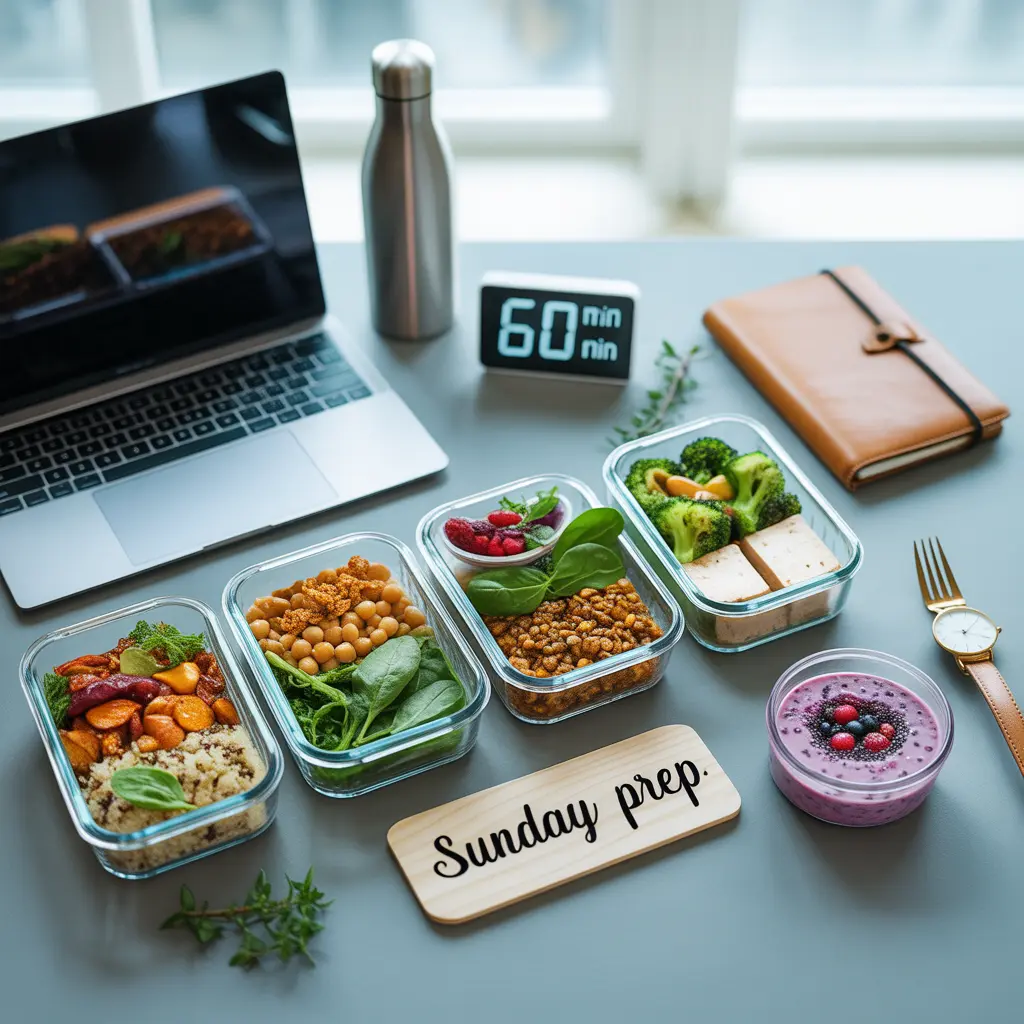
⚡ TL;DR: The 1-Hour Vegan Meal Prep System
- The 1-hour vegan meal prep method produces five components that combine into 21 meals across 7 days: without eating the same dish twice and without any weekday cooking beyond reheating and assembling.
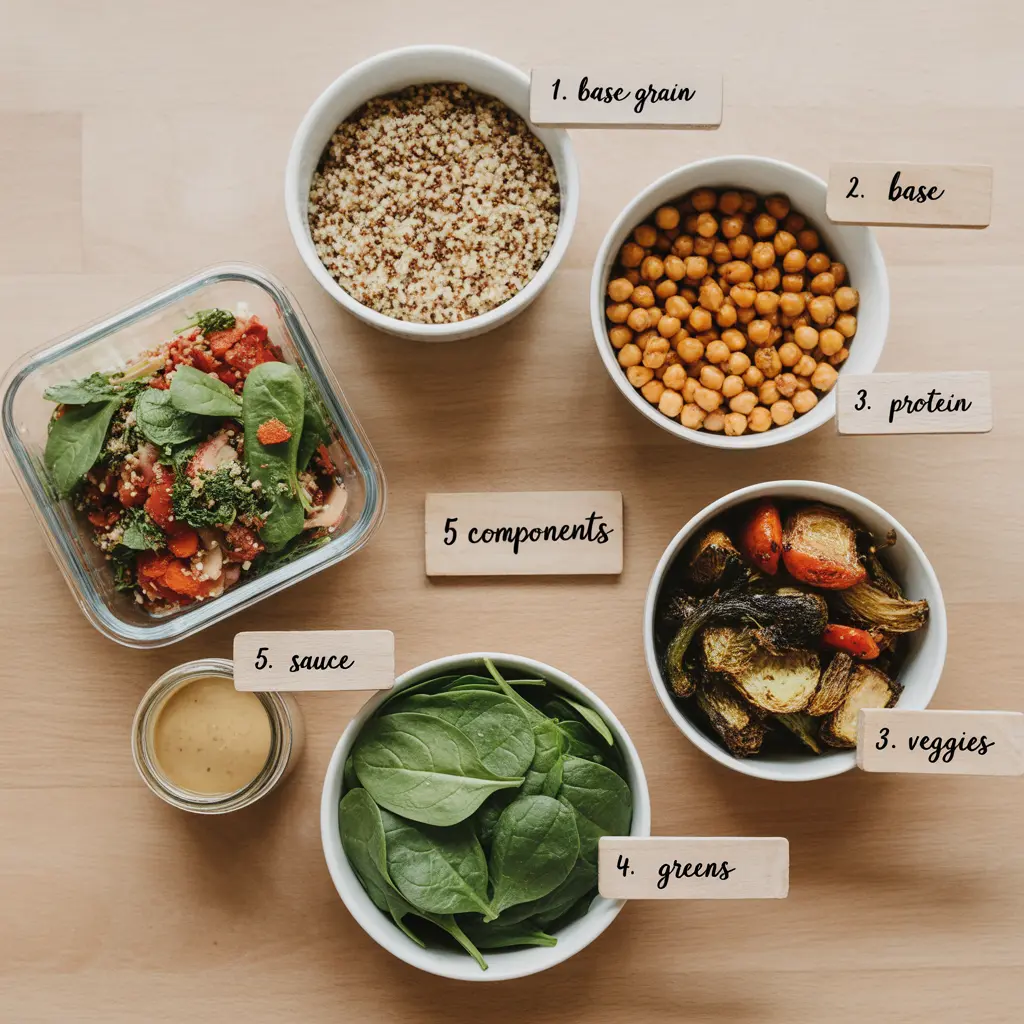
- The system is built around the Batch Component Method used in professional catering: cook building blocks (a grain, a legume, a sauce, a roasted vegetable, a fresh element) rather than complete separate recipes. Everything else is permutation.
- The most time-wasting mistake in meal prep is cooking individual complete meals. Cooking components and combining them differently each day is 4 to 6 times more efficient and produces far more variety.
- The correct sequence is everything. Running multiple cooking processes simultaneously (grain on the hob, legumes simmering, vegetables roasting, sauce blending) reduces 4 to 5 hours of individual cooking to under 60 minutes of combined active and passive time.
- A well-stocked pantry of 12 non-perishable staples eliminates all emergency shopping and makes the weekly prep genuinely achievable without a special trip to multiple shops.
- Nutritional completeness is built into the system architecture: the five components are designed to collectively deliver adequate protein, iron, calcium, omega-3, and fibre across every assembled meal without tracking.
Ultimate Vegan Meal Prep for Busy Professionals: The Complete 1-Hour Weekly Method
The most common reason intelligent, motivated people fail to eat well on a plant-based diet is not a lack of knowledge about nutrition, not a lack of access to good ingredients, and not a lack of genuine desire to eat better. It is time. Or more precisely, the perception that eating nutritious plant-based food requires a level of daily kitchen time that is incompatible with a demanding professional life.
This perception is not wrong when applied to the way most people approach vegan cooking: recipe-driven, one-meal-at-a-time, ingredient-fresh, cooked-from-scratch daily. That approach requires 45 to 90 minutes of active kitchen time per day. For a professional working 50-hour weeks, commuting, exercising, and maintaining relationships, 90 minutes of daily cooking is not a sustainable behaviour. So shortcuts happen. Takeaways happen. The same three easy dishes in rotation happen. Nutritional quality quietly erodes and the relationship between plant-based eating and wellbeing weakens.
This guide delivers the complete professional kitchen meal prep system adapted for plant-based home cooking. The result: one hour on Sunday produces five components that assemble into 21 genuinely varied, nutritionally complete vegan meals across seven days: with zero weekday cooking beyond reheating and simple assembly.
The Production Science Behind 1-Hour Meal Prep
🔬 Why Parallel Processing Changes Everything
The difference between cooking sequentially and cooking in parallel is the difference between 4 hours of meal prep and 60 minutes of meal prep with an identical output. Most home cooks cook sequentially: finish one dish, then start the next. Professional kitchens cook in parallel, with multiple processes running simultaneously across the kitchen, each requiring only occasional active attention.
The 1-hour vegan meal prep system is designed around four simultaneous processes:
- The oven (passive, 35 to 40 minutes): once vegetables and legumes are loaded and the temperature is set, the oven requires no attention. This is the highest-yield passive cooking time available in any kitchen. Use it for roasted vegetables, baked chickpeas, and tempeh preparation simultaneously.
- The main hob ring (semi-active, 30 to 35 minutes): the grain of the week simmers with minimal attention after the initial boil is established. Brown rice or whole grains need checking every 10 minutes, not continuous supervision.
- The second hob ring (active for 15 minutes, then passive): the legume batch (red lentils or pre-soaked chickpeas) simmers actively for the first 15 minutes, then needs only occasional stirring. This overlaps entirely with oven time.
- The blender and board (active, in gaps): sauces, dressings, and fresh components are prepared during the 5 to 10-minute windows when the oven and hob are running but require no active attention.
⚗️ The Component Architecture Principle
The five components are chosen to be flavour-neutral at their base so they can move between cuisine formats: Middle Eastern, Asian, Mediterranean, and Western: through sauce and seasoning changes alone. The components themselves are never seasoned beyond salt, aromatics, and cooking fat during the batch cook. All cuisine-specific seasoning happens at assembly time. This single decision multiplies the number of distinct meal outcomes from the five components from 5 to over 20.
The Five-Component System: What to Cook and Why
🌾 Component 1: The Grain (Brown Rice, Quinoa, or Freekeh)
Cook 400g dry grain in a large pot. This produces approximately 1.2kg of cooked grain, enough for 200g portions across six days plus a lunch portion. The grain is the neutral base that every other component builds on. It absorbs sauce, adds texture, and provides the slow-release carbohydrate that sustains focus and energy through the afternoon: the most practically relevant benefit for a working professional eating lunch at a desk.
Why brown rice over white rice: brown rice provides 1.8g fibre per 100g cooked (versus 0.4g for white rice) and arabinoxylan that feeds gut microbiome species linked to stable energy and reduced afternoon fatigue. The glycaemic index of brown rice (50 to 55) versus white rice (65 to 72) produces meaningfully different postprandial energy dynamics over a working afternoon. For the meal-prepping professional, the choice of grain is a performance decision, not just a nutritional one.
Rotating the grain weekly prevents monotony and diversifies the prebiotic fibre profile: brown rice one week, quinoa the next (complete protein, 8g per 100g cooked), freekeh the week after (higher fibre, smoky flavour). The same system works identically regardless of which grain is chosen.
🫘 Component 2: The Legume (Red Lentil Dal Base or Whole Chickpeas)
This is the nutritional backbone of the entire system. Cook 500g dried red lentils (or 300g dried chickpeas, soaked overnight from Saturday) with onion, garlic, ginger, a teaspoon each of cumin and coriander, and turmeric. Leave unseasoned beyond these aromatics: salt and acids are added at assembly. The resulting base is versatile enough to be a soup with added stock, a dal with added coconut milk, a taco filling with added smoked paprika, or a Buddha bowl base with just a squeeze of lemon.
The protein arithmetic: 200g of this legume base delivers 18 to 22g of plant protein depending on the legume chosen. Combined with 200g brown rice (5g protein) and 2 tablespoons hemp seeds scattered over the top (7g), the assembled bowl delivers 30 to 34g of complete protein: meeting the per-meal protein threshold for muscle protein synthesis without any deliberate protein tracking.
Why red lentils as the default: red lentils require no soaking, cook in 18 to 20 minutes, break down into a creamy base that blends invisibly into sauces and soups, deliver the highest folate of any legume (358mcg per 200g cooked), and cost less per gram of protein than any other plant protein source. They are the professional kitchen’s default protein base for reasons that translate perfectly to a home meal prep context.
🥦 Component 3: Roasted Vegetables (Two Varieties)
Cut two varieties of vegetable: choose two from: sweet potato, broccoli, cauliflower, courgette, red pepper, aubergine, Brussels sprouts, beetroot, or parsnip. Toss with olive oil and minimal seasoning (cumin, smoked paprika, or just salt and pepper), and roast at 200°C for 30 to 35 minutes. The caramelisation that occurs during roasting produces the Maillard compounds and concentrated natural sugars that make these the most flavourful component in the system.
The two-vegetable pairing logic: choose one starchy vegetable (sweet potato, squash, parsnip) and one non-starchy cruciferous (broccoli, cauliflower, Brussels sprouts). This combination provides beta-carotene and complex carbohydrate from the starchy vegetable alongside glucosinolate sulforaphane precursors and calcium from the cruciferous vegetable. Together they cover the widest nutritional spread per roasting tray.
Roasted vegetables keep excellently for 4 to 5 days refrigerated and do not need reheating: they are equally good at room temperature or straight from the fridge, which is essential for desk lunches. This component transitions identically into grain bowls, wraps, soups, pasta, and shakshuka-format dishes without any additional preparation.
🥬 Component 4: The Fresh Element
This component is the one that keeps the other warm, comforting components from becoming repetitive. The fresh element introduces temperature contrast, textural variation, and bright acidity that transforms a bowl of grain and legumes from satisfying into genuinely exciting. Choose one from:
- Shredded red cabbage (dress with apple cider vinegar, a pinch of salt, and a small amount of sugar; keeps 5 to 7 days refrigerated and improves in flavour as it lightly pickles)
- Cucumber and tomato salad (dice, dress with lemon juice, olive oil, and za’atar; keeps 3 to 4 days; makes every bowl feel Mediterranean)
- Massaged kale (remove stems, massage with lemon, olive oil, and salt for 2 minutes; keeps 4 to 5 days significantly better than unmassaged kale; adds calcium and vitamin K1 to every meal)
Preparing this on Sunday eliminates the need to wash, cut, and dress salad every day: the single most time-consuming daily kitchen task that meal prep should eliminate.
🫙 Component 5: The Sauce (Tahini-Lemon Base)
The sauce is the single most impactful component in the system for preventing meal fatigue. A well-made tahini-lemon base that is modified at assembly time (adding miso for an Asian dimension, adding harissa for North African heat, adding fresh coriander for South Asian warmth, adding garlic and herbs for Mediterranean freshness) produces a completely different flavour experience from the same base sauce in every meal.
28-Day Vegan Meal Plan +
Grocery list.
150g good-quality tahini · juice of 2 large lemons · 2 cloves garlic, finely grated · 120 to 150ml cold water · half teaspoon fine salt. Combine tahini and lemon in a bowl: the mixture will seize and appear broken. This is correct. Add cold water tablespoon by tablespoon, whisking vigorously after each addition. The sauce will gradually loosen and become creamy. Adjust consistency with more water; it should flow from a spoon smoothly but coat the back of it. Refrigerate in a sealed jar. It keeps 7 days and thickens in the fridge: thin with a splash of cold water before using. The total cost of this batch is under $0.80. The equivalent jar of commercial tahini dressing costs $4.50 to $7.00 and contains stabilisers, additional sodium, and seed oils.
Monday through Sunday sauce variations from the same base:
- + 1 tsp miso paste + 1 tsp sesame oil = miso-tahini (Japanese-Korean format)
- + 1 tsp harissa or chilli paste = spiced tahini (North African format)
- + 2 tbsp nutritional yeast + garlic = umami tahini (replaces cream sauce)
- + juice of half a lime + fresh coriander = green tahini (South Asian format)
- + pomegranate molasses + a pinch of cumin = Syrian-Lebanese format
The 60-Minute Session: Minute-by-Minute
This is the sequence that makes the system work. The critical discipline is starting multiple processes simultaneously, not sequentially. Every minute saved in the first 10 minutes of the prep session compounds into the total time saved.
🕐 The 60-Minute Vegan Meal Prep Timeline
⚡ The Active vs Passive Time Breakdown
Of the 60 minutes, only approximately 25 to 28 minutes require your physical presence in the kitchen. The remaining 32 to 35 minutes are passive time where the oven, grain, and legumes are cooking unattended. This passive time is not wasted: it is when email is checked, the week is reviewed, or simply when coffee is made. The professional kitchen insight is that passive cooking time is not kitchen time: it is parallel time.
⏱ Weekly Time Comparison: Daily Cooking vs Batch Prep
Net saving: 7 to 9 hours per week. Over a year: 360 to 470 hours: the equivalent of 15 to 20 full working days returned to non-cooking time.
The Weekly Shopping System: Buy Once, Eat All Week
The shopping list for this system is shorter, cheaper, and more consistent than daily ad-hoc grocery shopping. Because the same five-component framework repeats weekly (with variation in which specific grain, legume, and vegetables are chosen), a large part of the pantry staples carry over from week to week without repurchasing. The weekly shop covers only perishables and any depleted pantry items.
🫘 Proteins (Weekly)
- 500g dried red lentils
- 200g firm tofu (optional addition)
- Hemp seeds (100g top-up)
- Frozen edamame (500g bag)
- Nutritional yeast (replenish monthly)
🌾 Grains (Weekly)
- 400g brown rice or quinoa
- Whole grain bread (slice and freeze half)
- Rolled oats for breakfasts (500g)
- Note: Buy 2kg monthly for best price
🥦 Vegetables (Weekly)
- 2 sweet potatoes (for roasting)
- 1 head broccoli or cauliflower
- 1 bag spinach or kale
- Half red cabbage or cucumber
- Cherry tomatoes (for fresh element)
- Bag of onions and garlic (shared pantry)
🧺 Pantry (Monthly top-up)
- Tahini (large jar from Middle Eastern store)
- Canned tomatoes ×6 to 8
- Extra virgin olive oil (3L format)
- Cumin, coriander, turmeric, smoked paprika
- Miso paste
- Low-sodium tamari
❄️ Frozen (Monthly)
- Frozen berries (1kg for breakfasts)
- Frozen edamame (2 to 3 bags)
- Frozen peas (for quick additions)
- Frozen spinach (soup additions)
🍋 Fresh Supporting Items
- Lemons (×5 to 6)
- Fresh ginger (freeze unused)
- Avocados (3 to 4)
- Fresh herbs if budget allows
- Fortified soy milk (×2 cartons)
7 Days of Meals: Every Combination Mapped Out
These are the 21 meals that emerge from Sunday’s five components. Each meal is a different assembly of the same building blocks, dressed differently to represent a different culinary format. The key insight: the same brown rice, lentils, and roasted sweet potato can feel Japanese on Monday, Levantine on Tuesday, and South Indian on Wednesday through sauce variation and garnish alone.
📅 Monday
Oat porridge with frozen berries, 3 tbsp hemp seeds, and ground flaxseeds. Soy milk base. Hibiscus tea.
Brown rice bowl: grain + red lentil base + roasted sweet potato + massaged kale + tahini-miso sauce. Hemp seeds on top.
Same components: different format. Spoon lentils and roasted veg into a wholegrain wrap with avocado, pickled cabbage, and harissa tahini. Edamame alongside.
📅 Tuesday
Chia pudding made with soy milk (prepared Monday evening in 90 seconds). Top with frozen berries, walnut pieces, and hemp seeds.
Lentil soup: blend half the lentil portion with 250ml stock and a squeeze of lemon. Top with roasted sweet potato cubes and a drizzle of plain tahini. Whole grain bread.
Grain salad bowl: room-temperature brown rice, broccoli florets, shredded cabbage, sliced cucumber, edamame (from frozen, defrosted), sesame seeds, tamari-lime-ginger dressing.
📅 Wednesday
Green smoothie: soy milk, frozen spinach, banana, ground flaxseeds, hemp seeds. Quick blend, 90 seconds.
Levantine plate: brown rice, lentil base, roasted vegetables, a generous spoonful of tahini-lemon sauce, pickled cabbage, a wedge of lemon. Exactly as served in a Lebanese restaurant: but costed at under $2.50.
Lentil shakshuka: heat lentil base in a small pan, add 200ml canned tomatoes, cumin, smoked paprika, and a pinch of chilli. Simmer 5 minutes. Serve with toasted whole grain bread and avocado.
📅 Thursday
Overnight oats: made Tuesday evening. Oats, soy milk, chia seeds, grated apple. Topped with walnuts and hemp seeds in the morning.
Brown rice and roasted broccoli bowl with miso-tahini sauce, nori strips, sesame seeds, and a soft-set cube of silken tofu alongside. Clean, Japanese-inspired, zero cooking.
Dal with kale: warm lentil base with 100ml coconut milk added, fresh ginger, and turmeric. Wilt a handful of kale in. Serve with brown rice. Ready in 8 minutes from components.
📅 Friday, Saturday, Sunday
Stuffed sweet potato: reheat remaining roasted sweet potato, fill with spiced lentil base, top with tahini, pomegranate seeds, and fresh parsley. Restaurant-quality in 4 minutes.
Grain and vegetable Buddha bowl with all remaining components. Saturday breakfast: full cooked tofu scramble since you have the time: a reward for 5 days of efficient eating.
Sunday morning: one final assembled meal from any remaining components. Sunday afternoon: the next 60-minute prep session. The cycle is seamless because the framework never changes: only the specific grain and vegetable variety rotates.
🔄 The Permutation Matrix: 21 Meals From 5 Components
🥣 Bowl Format
Grain base + legume + roasted veg + fresh element + sauce. The simplest, most customisable format. Works cold for desk lunches. Works warm for evenings.
~30g protein | ~500 kcal | ~15g fibre🍲 Soup Format
Blend legume portion with stock, lemon, and spice. Top with roasted vegetable cubes and a swirl of tahini. Ready in 5 minutes from components.
~20g protein | ~380 kcal | ~12g fibre🌯 Wrap Format
Legume base + roasted veg + fresh element rolled in a whole grain wrap. Avocado and sauce inside. Portable, desk-friendly, takes 90 seconds to assemble.
~28g protein | ~550 kcal | ~14g fibre🍳 Pan Format
Heat legume base in a pan with canned tomato and spice for a 5-minute shakshuka-style dinner. Serve with bread. The only format requiring active hob time.
~22g protein | ~420 kcal | ~13g fibre🥗 Salad Format
Room-temperature grain as the base of a dressed salad with fresh element, edamame or chickpeas, seeds, and a sauce-as-dressing. No reheating needed.
~25g protein | ~460 kcal | ~12g fibre🥔 Stuffed Veg Format
Use remaining roasted sweet potato or cauliflower as a vessel. Fill with lentil base, top with sauce and seeds. Weekend showpiece from weekday components.
~24g protein | ~480 kcal | ~14g fibreStorage and Food Safety: The Professional Kitchen Guide
Food safety in meal prep is where home cooks most commonly make errors that undermine both health and the economic case for the system. Professional kitchens operate under strict HACCP (Hazard Analysis and Critical Control Points) protocols that produce near-zero food safety incidents. These protocols are easily adapted for home use.
Nutritional Architecture: How the System Delivers Completeness
🔬 Why Completeness Is Built Into the Framework, Not Tracked
The five-component system is nutritionally designed, not nutritionally accidental. The architecture ensures that every assembled meal from these five components, in any combination, delivers adequate protein, adequate iron (paired with the lemon juice that is always present as an acid), adequate calcium through the tahini and fortified soy milk breakfast, adequate omega-3 through the daily flaxseed or hemp seed addition, and adequate fibre through the legume, grain, and vegetable combination.
This is the architectural equivalent of what institutional catering dietitians call “passive nutritional adequacy”: the meal system is designed so that simply choosing from available options consistently meets nutritional needs, without the individual needing to calculate or track anything.
🌱 The Nutritional Gaps This System Addresses Automatically
- Protein completeness: the combination of red lentils (high in lysine, lower in methionine) with the grain of the week (higher in methionine, lower in lysine) creates complementary protein pairs that together deliver all nine essential amino acids across each day. The addition of hemp seeds (complete protein) reinforces this daily.
- Iron absorption: the lemon juice that is included in every lentil preparation and salad dressing is not incidental. Vitamin C triples the absorption of non-haem iron from the legumes. The system includes the iron-absorption enhancer in the same dish as the iron source, automatically, without any additional tracking.
- B12 gap: the nutritional yeast added as a finishing topping to grain bowls (2 tablespoons, 8g protein, B12 if fortified) and the fortified soy milk at breakfast together contribute to daily B12 intake. A daily B12 supplement remains essential for all vegans regardless of dietary quality: this is the one nutrient the food system cannot reliably cover without deliberate supplementation.
- Omega-3 adequacy: 2 tablespoons of ground flaxseeds (added to breakfast daily) plus 3 tablespoons of hemp seeds (added to lunch or breakfast) provide 7 to 9g of ALA omega-3 daily. Combined with an algae DHA/EPA supplement, this meets all omega-3 requirements without any deliberate effort beyond the breakfast ritual.
Reference Tables
The Five Components: Nutritional Value and Weekly Yield
Grain Rotation: Nutritional Comparison and Cooking Times
Chef Tips: The Secrets That Make It Actually Work
🔪 Tip 1: Always Start With the Oven and the Largest Pot
In twenty years of running professional kitchens across Lebanon, Dubai, and Saudi Arabia, the first 10 minutes of any prep session determines the efficiency of everything that follows. Get the oven on before anything else: it needs 10 to 12 minutes to reach temperature, and every minute you delay this is a minute added to the total session length. While the oven heats, get the largest pot onto the hob and start the grain. Do not chop vegetables, do not make the sauce, do not sort containers. Heat the oven. Start the grain. These two parallel processes, both passive within 3 and 8 minutes respectively, are the foundation on which the rest of the session runs.
This is the discipline that separates someone who completes meal prep in 60 minutes from someone who takes 90. The impulse in most home cooks is to start with the task that feels most manageable: chopping vegetables, organising containers, making a list. The professional instinct is to start the longest passive processes immediately so that active time and passive time overlap maximally.
🫙 Tip 2: The Container Investment Pays Back in One Week
The single piece of equipment that most reliably predicts meal prep success or failure is not the quality of the knife, the speed of the blender, or the size of the pot. It is the container system. A disorganised collection of mismatched containers, half of which have lost their lids, produces friction at every stage of the process: searching for the right lid, stacking poorly, not knowing what is in an unlabelled container, transferring food twice because the first container was too small. Professional kitchens use standardised gastronorm containers in specific sizes that stack perfectly, seal completely, and require zero thinking about which container goes with which lid.
The home equivalent: invest $25 to $40 in a matched set of glass containers in three sizes (small 300ml, medium 600ml, large 1,000ml) from a single brand. Label them with masking tape or a permanent marker system that peels off. Stack them in the fridge in the order they will be used. This one-time investment pays back in reduced food waste within the first week.
🌿 Tip 3: Flavour the Day, Not the Component
The most common reason meal prep produces food that feels monotonous by day 3 is that the components are seasoned too specifically during the cook, locking them into a single cuisine format. If your roasted vegetables are seasoned with Italian herbs, they cannot convincingly become a Middle Eastern or Asian dish later in the week. If your lentils are fully spiced as a specific dal, they resist being repurposed as a taco filling.
The professional kitchen rule: components are neutral, dishes are flavoured. Roast vegetables with only salt, pepper, and olive oil. Cook lentils with onion, garlic, and ginger only. Then at assembly, the cuisine direction is set by the sauce and garnish choices: and these take 30 seconds. A neutral lentil base with tahini, lemon, and sumac becomes Levantine. The same lentil base with miso and sesame oil becomes Japanese-inspired. The same base with coconut milk, curry leaves, and mustard seeds becomes South Indian. All in 30 seconds, all from the same Sunday batch.
6 Mistakes That Turn Meal Prep Into a Weekly Ordeal
Cooking complete individual meals instead of components. This is the foundational error that makes meal prep feel like 4 hours of work instead of 60 minutes. Cooking 7 complete, different meals produces repetitive eating (if you make a large batch of one dish) or 7 separate cooking sessions (if you don’t). The component method produces genuine variety through permutation rather than through re-cooking. Every meal prep guide that shows you how to make 5 different complete meals on Sunday is teaching you the wrong system.
Seasoning components too specifically during the batch cook. Fully seasoning your grain, legume, and vegetables during Sunday prep locks every meal into one cuisine format and makes repurposing impossible. A heavily spiced coconut lentil dal will not convincingly become a Levantine bowl later in the week regardless of what sauce you add. Keep components neutral, flavour at assembly, and every meal genuinely feels different.
Not soaking chickpeas on Saturday. If chickpeas are the chosen legume for the week, they require overnight soaking or a 2-hour quick-soak (boil for 2 minutes, soak 1 hour). Forgetting this on Saturday forces a switch to red lentils (which require no soaking) or adds 90 minutes to Sunday’s prep session. Put the chickpeas to soak before you go to bed Saturday. Set a phone reminder. This is the only preparation required the day before, and skipping it derails the 60-minute system reliably.
Inconsistent container labelling leading to mystery fridge content. The primary cause of meal prep food waste is unlabelled containers. By Wednesday, an unlabelled container of brown rice and an unlabelled container of cauliflower couscous are indistinguishable at a glance. When uncertainty about container contents introduces enough friction, the whole system breaks down and takeaway becomes the easier option. Label every container with a strip of masking tape and a marker: content and date, every time, every container, no exceptions.
Prepping too much variety. Cooking five different legume varieties, three grains, and four vegetable preparations is not meal prep: it is restaurant prep, and it requires 3 to 4 hours. The power of this system is its constraint: one grain, one legume, two vegetables, one sauce. Variety comes from assembly permutation, not from cooking variety. When beginners try to prep more components to reduce repetition, they increase prep time dramatically and usually cook less consistently as a result. Start with the five-component system exactly as described before adding any complexity.
Abandoning the system after one imperfect week. The first week of any new system is its least efficient iteration. The session takes longer because the sequence is unfamiliar. The combinations feel less obvious because the muscle memory of reaching for familiar sauces has not been built yet. The container system is not yet optimised. This is normal. By week 3, the same 60-minute session runs in 50 minutes because the sequence is internalised. By week 6, the shopping list is mostly automatic and the weekly prep feels less like a cooking session and more like a brief kitchen routine. The system compounds in efficiency with repetition. Abandoning it after week 1 discards all future return on the initial learning investment.
Frequently Asked Questions About Vegan Meal Prep
Can you really meal prep vegan food in one hour?
Yes, consistently. The 60-minute window is achievable because the system runs four processes in parallel: oven (passive, 35 minutes), main hob grain (passive after the first 5 minutes, 35 minutes), second hob legume (semi-active for 20 minutes), and active preparation (sauce and fresh element, 10 minutes of active time in the gaps). The critical factor is starting the oven and grain before doing anything else, as described in the minute-by-minute timeline. The first session typically takes 70 to 80 minutes as the sequence is learned. By week 3, 60 minutes is standard.
How long does vegan meal prep last in the fridge?
Cooked grains and legumes: 4 to 5 days refrigerated in airtight containers. Roasted vegetables: 4 to 5 days refrigerated (they do not need reheating and are excellent cold). Tahini sauce: 7 days refrigerated. Massaged kale: 4 to 5 days. Pickled cabbage: 5 to 7 days, improving in flavour with time. Cucumber-tomato salad: 2 to 3 days. For a full 7-day system, prepare the cucumber-tomato or any 2 to 3-day fresh element mid-week in under 5 minutes as a single mid-cycle task. Everything else holds for the full week.
Is meal-prepped food as nutritious as freshly cooked?
For the foods in this system, yes. Cooked legumes and grains do not significantly lose nutritional value over 4 to 5 days of refrigeration. Roasted vegetables retain most of their beta-carotene (a fat-soluble compound stable in refrigeration) and fibre. Vitamin C does decrease over 2 to 3 days in cut vegetables, which is why fresh lemon juice is added at assembly rather than during batch cooking. The tahini sauce, being primarily fat and protein, does not degrade nutritionally in the fridge. The resistant starch content of the grain actually increases on cooling, making refrigerated cooked rice and legumes more prebiotic than freshly cooked equivalents.
What equipment do I actually need for this system?
The minimum equipment required: one large pot (at least 4-litre capacity) for the legumes, one medium pot (2 to 3-litre) for the grain, one large baking tray for roasting vegetables, a blender or immersion blender for the sauce, a sharp knife, a chopping board, and a matched set of glass storage containers in three sizes. A kitchen scale (for measuring dry grain and legumes accurately) and a fine grater (for ginger) complete the list. Total investment for a full container set and basic equipment if starting from scratch: $60 to $80, paid back in reduced food waste and avoided takeaway within 2 to 3 weeks.
How do I keep meal prep interesting after week 3?
The three rotation levers that prevent system fatigue are: rotating the grain weekly (brown rice, quinoa, freekeh, barley, millet), rotating the legume monthly (red lentil dal, whole chickpeas, black bean base, white bean base), and rotating the sauce flavour profile daily using the five sauce modifications described in the Component 5 section. These three variables produce over 60 unique weekly combinations from the same structural framework. Additionally, the roasted vegetable selection changes with seasonal availability, producing naturally rotating flavour profiles without any deliberate system changes. Most people who follow this system for 6 or more weeks report no meal fatigue: the variety produced by assembly permutation is consistently underestimated before the system is tried.
Can I use this system for a family rather than just one person?
Yes, with simple scaling. Double or triple all quantities for a family of 3 to 4. The cooking time increases by only 5 to 10 minutes because the passive cooking time is not proportional to the quantity: a large pot of double-quantity lentils still simmers in 20 minutes, not 40. The limiting factor is container space and fridge volume. For families, larger batch cooking typically means cooking the grain twice (two separate rice batches in succession rather than one doubled batch) and using two roasting trays simultaneously. The framework remains identical: five components, assembled differently each day, with sauce variations driving the daily cuisine format change.
Is this method expensive?
No. This is one of the most economical cooking systems available. The core proteins (red lentils, chickpeas) are among the cheapest foods per gram of protein in any market. The grains are purchased in bulk at low unit cost. Seasonal vegetables are bought at their cheapest point. The sauce is made from tahini purchased from a Middle Eastern store at a fraction of supermarket price. The total weekly cost for one to two people is $40 to $55. This compares to $90 to $120 per week for an equivalent nutritional profile built from processed vegan convenience products. Over a year, the saving is $2,500 to $3,400 per year for two people.
What do I do if I forget to soak chickpeas?
The quick-soak method: cover dried chickpeas with at least three times their volume of water in a large pot. Bring to a full boil and boil vigorously for 2 minutes. Remove from heat and soak for 1 hour. Drain, rinse, and cook as normal (they will take 45 to 60 minutes to cook fully after a quick soak versus 30 to 45 minutes after an overnight soak). Alternatively, switch to red lentils that week, which require no soaking and cook in 18 to 20 minutes. Keep a can of chickpeas in the pantry as the emergency backup for the weeks when Saturday soaking is genuinely forgotten.
How do I add enough protein without tracking?
The system delivers protein without tracking through architectural design. Every assembled bowl from these five components automatically delivers: legume base (18 to 22g protein per 200g), grain (5 to 8g protein per 200g), and the recommended daily hemp seed addition (7g per 3 tablespoons sprinkled over the top). This totals 30 to 37g per main meal. Two such meals plus a breakfast with hemp seeds and fortified soy milk delivers 80 to 90g daily protein for most adults. The protein is not tracked: it is built into the framework. The only active decision is including the hemp seed or nutritional yeast sprinkle at each meal, which takes one second.
Can I use this system when travelling for work?
The system is most useful during the non-travel weeks that represent the majority of a working professional’s schedule. During travel weeks, the approach changes: prepare extra portions on the Sunday before travel, ensure the fridge is well-stocked for the partner or family members at home, and approach travel eating as a planned exception rather than a system failure. The non-travel weeks benefit most from the system. Many business travellers find that knowing their home nutrition is reliably managed reduces the stress of travel nutrition choices, making the system valuable even in weeks where it is not directly used every day.
What is the most important thing to make in the batch cook?
The legume is the most important component and the one that should never be skipped or compromised. The grain can be replaced with a quick-cooking alternative (quinoa in 12 minutes, or even whole grain bread from the pantry). The fresh element can be assembled daily from pantry staples in 5 minutes. The sauce can be simplified. But the legume is the protein anchor, the iron and folate delivery system, the fibre backbone, and the most time-consuming element to prepare ad-hoc during a busy week. If only one component is batch-prepped, it should be the legume. Everything else can be managed daily with minimal effort. The legume cannot.
How is this different from standard meal prep advice?
Standard meal prep advice typically focuses on cooking complete individual recipes in bulk: 5 separate dishes made on Sunday. This produces repetitive eating (you eat the same lasagne or the same curry every day until it is finished), requires more cooking time (each recipe is its own production process), and becomes stale by day 4 regardless of how well-made each dish is. The component method produces genuine daily variety through permutation, minimises cooking time through parallel processing, maximises nutritional flexibility (components combine differently to hit different nutritional targets on different days), and is more economical because simpler ingredients are more efficiently bulk-purchased than complex recipe ingredient lists.
Still spending hours figuring out what to eat?
What’s included in your download
- 40+ nutritionist-approved recipes
- Complete 28-day calendar
- Meets protein, iron & B12 needs
- Family & meal prep friendly
- Vibrant photo for every recipe
- Simple, common ingredients
Instant PDF download. No subscriptions. No waiting.