

Nutritional Disclaimer: This content is for informational purposes only and does not constitute medical advice. Always consult a registered dietitian or healthcare provider regarding omega-3 supplementation, especially during pregnancy, for children, or if you have a diagnosed cardiovascular or neurological condition.
Vegan Omega-3 Foods: The Complete Guide to Plant-Based DHA and ALA Sources
TL;DR
Vegan omega-3 foods provide ALA (alpha-linolenic acid), which the body partially converts to EPA and DHA. The conversion rate is low: 5-15% for EPA and only 0.5-5% for DHA. This means plant-based omega-3 from flaxseed, chia, hemp, and walnuts is valuable but insufficient alone for brain and cardiovascular DHA needs. Algae oil is the only plant-derived direct DHA and EPA source. This guide covers the three omega-3 types, the conversion science, the top 20 plant sources ranked, the algae oil guide, conversion inhibitors, omega-3 by life stage, MENA culinary techniques, and 12 FAQs. The conclusion is clear: eat abundant vegan omega-3 foods daily AND supplement algae DHA. Both are required.
Omega-3 Types: ALA, EPA, DHA and Why the Difference Matters
Vegan omega-3 foods are not created equal. The three omega-3 fatty acids have completely different biological roles, different sources, and different implications for human health. Understanding these distinctions is the single most important step in building an effective plant-based omega-3 strategy.
ALA: Alpha-Linolenic Acid
What it is: The essential omega-3. The human body cannot synthesise it. Must come from food. The parent fatty acid from which EPA and DHA are made.
Primary roles:
- Essential fatty acid: must be consumed daily
- Precursor to EPA and DHA (conversion is poor)
- Anti-inflammatory signalling at the cellular level
- Supports normal cardiovascular function
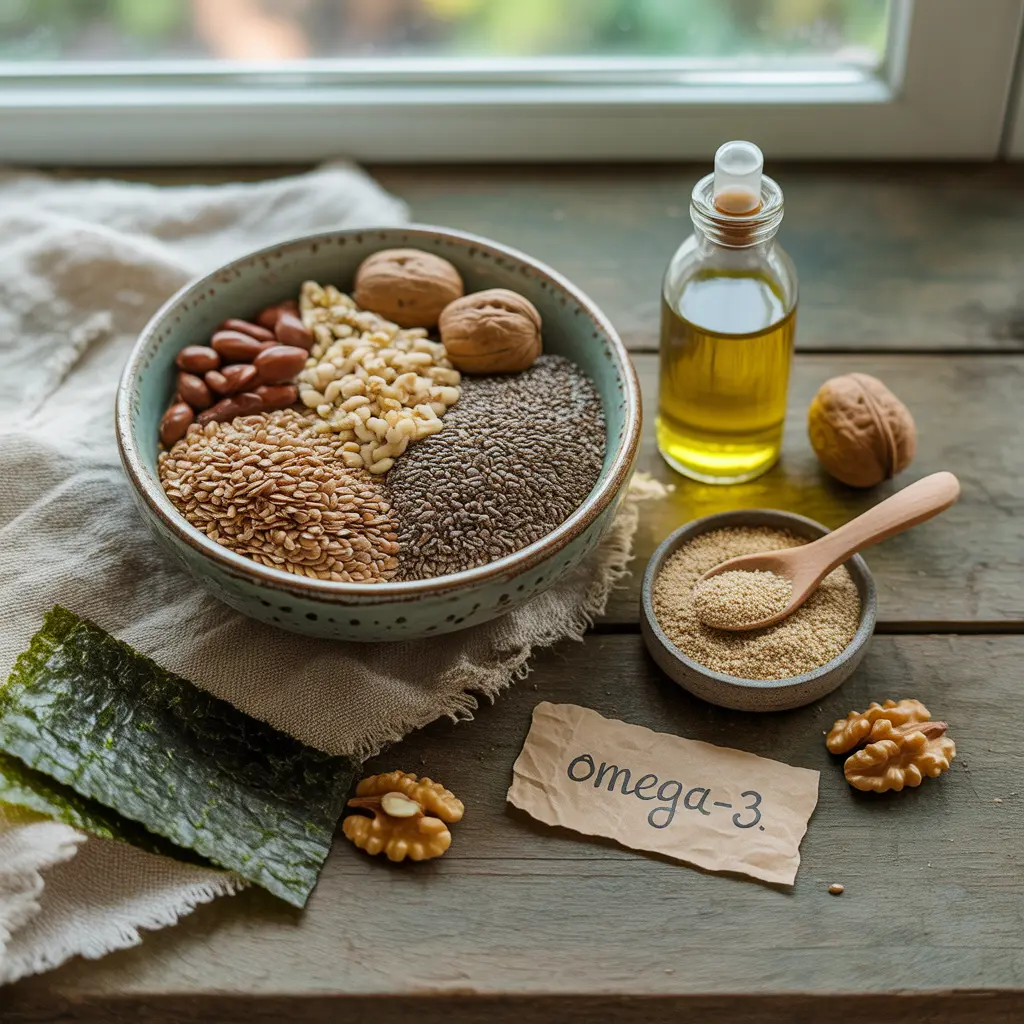
Best plant sources: flaxseed, chia seeds, hemp seeds, walnuts, perilla oil
Daily target: 1.1-1.6g minimum (higher for conversion support)
EPA: Eicosapentaenoic Acid
What it is: A long-chain omega-3. Converted from ALA in the body at low efficiency. The primary anti-inflammatory omega-3.
Primary roles:
- Produces anti-inflammatory eicosanoids
- Reduces triglycerides and inflammatory cytokines
- Supports mood regulation via serotonin pathways
- Protective against cardiovascular events
Vegan sources: algae oil (direct). Conversion from ALA: 5-15%.
Daily target: 250-500mg combined EPA+DHA
DHA: Docosahexaenoic Acid
What it is: The most critical long-chain omega-3. Makes up 40% of polyunsaturated fats in the brain and 60% in the retina. The structural omega-3.
Primary roles:
- Primary structural fat in neuronal cell membranes
- Supports synaptic plasticity, memory, and cognitive speed
- Critical for fetal brain and eye development
- Anti-inflammatory at the neurological level
Vegan sources: algae oil only (direct). Conversion from ALA: 0.5-5% maximum.
Daily target: 250mg minimum. 500mg for pregnancy and athletes.
Why Fish Do Not Actually Make Omega-3
Fish contain DHA and EPA because they eat algae, either directly or through the marine food chain. Algae are the original source of all long-chain omega-3s in the ocean. Supplementing with algae oil bypasses the fish entirely, provides the same DHA and EPA, and eliminates mercury, microplastics, and PCBs that concentrate in fish tissue. Vegan omega-3 foods and algae oil are not inferior alternatives to fish oil. They are the original, cleaner source.
For the full context of how omega-3 fits within the broader vegan nutrient picture, the vegan nutrient deficiencies guide covers every critical nutrient gap alongside omega-3 in one framework.
+ Grocery List
The ALA-to-DHA Conversion Problem: The Real Numbers
The most important single fact about vegan omega-3 foods is this: the body converts ALA to DHA very inefficiently. This is not a reason to avoid plant ALA sources. It is a reason to understand them accurately and supplement strategically.
Why Conversion Is So Poor
The conversion pathway from ALA to DHA requires multiple enzymatic steps, each with its own bottleneck:
- ALA to SDA: Delta-6-desaturase enzyme. This is the rate-limiting step. The same enzyme processes omega-6 linoleic acid. When omega-6 intake is high (as in most modern diets), it competes directly and wins, leaving little capacity for ALA conversion.
- SDA to EPA: Elongation and desaturation enzymes. More efficient than the first step but still limited in total throughput.
- EPA to DHA: Requires a series of elongation steps and beta-oxidation in peroxisomes. This step is the most metabolically expensive and the most commonly rate-limited.
The practical conclusion is clear:
- Eat abundant ALA foods daily (flaxseed, chia, hemp, walnuts) for ALA’s direct cardiovascular and anti-inflammatory benefits
- Supplement algae DHA/EPA directly rather than relying on conversion for long-chain omega-3 needs
- Reduce omega-6 intake from seed oils (sunflower, safflower, corn, soybean) to improve the conversion that does occur
Research reviewed at Examine.com confirms that vegans and vegetarians consistently show lower blood DHA levels than omnivores, and that algae oil supplementation normalises these levels completely within 8-12 weeks of consistent use.
Top 20 Plant-Based Omega-3 Foods Ranked by ALA Content
The bar chart below ranks the top 20 vegan omega-3 foods by ALA content per standard serving. ALA is the essential omega-3 that must come from diet. All of these foods contribute meaningfully to the daily ALA target and support the partial conversion to EPA and DHA.
Ground flaxseed leads by a significant margin. Two tablespoons daily added to porridge, smoothies, or baked goods delivers 6.4g ALA, meeting the daily essential fatty acid requirement multiple times over. The key word in the chart title is ALA: none of these foods deliver meaningful DHA. That is the role of algae oil.
Algae Oil: The Direct DHA Source Guide
Algae oil is the only truly complete vegan omega-3 supplement. It is the source from which all marine DHA ultimately derives. Every gram of DHA in every fish on earth came originally from algae. Supplementing algae oil is not a compromise. It is going directly to the source.
What Is Algae Oil?
Algae oil is extracted from microalgae species, primarily Schizochytrium and Nannochloropsis, that naturally produce DHA and EPA. Commercial algae oil is grown in controlled fermentation tanks, not harvested from the ocean. This means:
- Zero mercury contamination
- Zero microplastics
- Zero PCBs or persistent organic pollutants
- Consistent DHA/EPA concentration per capsule
- Environmentally sustainable production
How Much to Take
Dosing recommendations by life stage:
- General adults: 250-500mg combined DHA+EPA daily
- Pregnancy: 600-900mg DHA minimum (brain formation critical)
- Breastfeeding: 500mg DHA minimum
- Children 2-12: 100-250mg DHA daily
- Athletes: 500-1,000mg for inflammation management
- Seniors 60+: 500-1,000mg for cognitive protection
What to Look For on the Label
Not all algae oil supplements are equal. Key label criteria:
- DHA content clearly stated: not just “omega-3”. Look for explicit DHA mg per capsule.
- EPA content listed separately: combined EPA+DHA is more useful than DHA alone
- Algae species named: Schizochytrium is the highest DHA-producing species
- Third-party tested: IFOS or NSF certification for purity
- Triglyceride form preferred: better absorption than ethyl ester form
When and How to Take It
Practical supplementation guidance:
- Take with food: fat-soluble. Absorption improves significantly with a meal containing fat
- With the largest meal: maximises co-absorption with dietary fats
- Consistent daily timing: DHA accumulates in membranes over weeks. Consistency matters more than exact timing
- Refrigerate after opening: DHA oxidises at room temperature. Rancid oil is less effective and potentially harmful
Seaweed and Spirulina: Do They Provide DHA?
This is one of the most common misconceptions in vegan nutrition. Spirulina contains GLA and some ALA but essentially no DHA. Nori and most edible seaweeds contain trace amounts of EPA and DHA, but at quantities so small (0.1-0.3mg per sheet of nori) that they make no meaningful contribution to daily needs. The exception is certain microalgae like Crypthecodinium and Schizochytrium, which are used specifically for commercial algae oil production. Eating spirulina tablets or nori rolls does not substitute for algae oil supplementation on a vegan diet for omega-3 needs.
For the complete supplement stack for plant-based eaters, the vegan supplements guide covers algae oil alongside B12, vitamin D3, iodine, and zinc in one framework. For monitoring DHA status through blood testing, the vegan blood test guide covers the omega-3 index test, which measures EPA+DHA as a percentage of total red blood cell fatty acids.
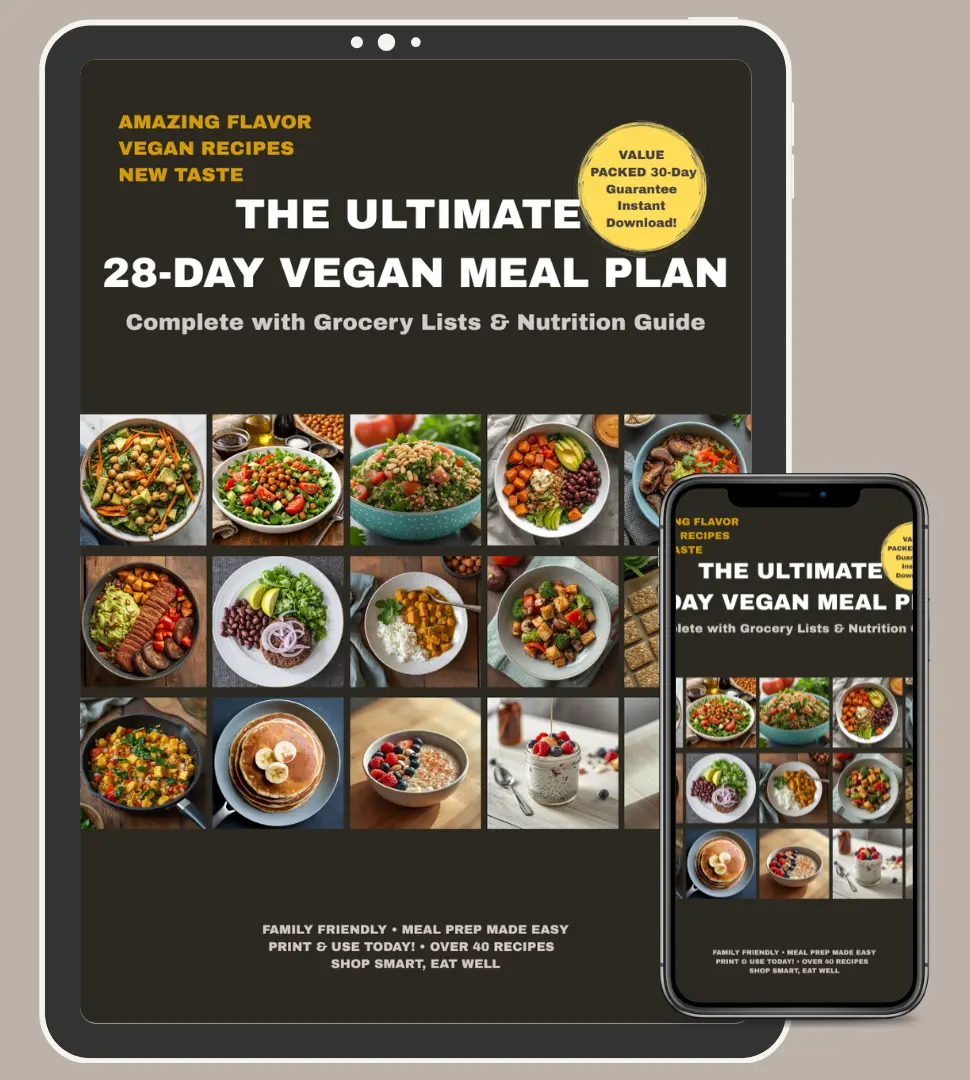
28-Day Vegan Meal Plan + Grocery list.
Transform your lifestyle with our comprehensive guide. This isn’t just a recipe book; it’s a complete system designed for success:
- The Vegan Guide: Essential transition tips and nutritional benefits.
- 40+ Chef Recipes: Breakfast, lunch, and dinner with high-quality photos.
- 4-Week Meal Plan: A fully structured day-by-day calendar.
- Grocery Lists: Categorized weekly lists to save you time and money.
- Photos: High-Quality Recipe Photos.
- Nutritions: Vegan Nutrition Guide Toolkit.
Factors That Reduce Conversion: Omega-6 Ratio, Age, and Genetics
Even the limited ALA-to-DHA conversion that is possible can be significantly further reduced by several dietary and biological factors. Understanding these inhibitors allows plant-based eaters to protect whatever conversion capacity they have.
Factor 1: The Omega-6 to Omega-3 Ratio
This is the single most important conversion inhibitor. Delta-6-desaturase, the enzyme that begins ALA conversion, processes both omega-6 linoleic acid and omega-3 ALA. They compete for the same enzyme. When omega-6 intake is very high, which is typical in modern diets due to sunflower, corn, safflower, and soybean oils, the enzyme is occupied processing omega-6 and has little remaining capacity for ALA.
- Optimal ratio for conversion: 4:1 omega-6 to omega-3
- Average Western diet ratio: 15:1 to 20:1
- Many vegan diets ratio: 10:1 to 15:1 due to high seed oil use
Practical fix: reduce sunflower, safflower, and corn oils. Replace with olive oil (low omega-6) and use flaxseed oil cold for ALA delivery without additional omega-6 loading.
Factor 2: Ageing
Delta-6-desaturase activity declines with age. This means:
- Adults over 50 convert ALA to DHA even less efficiently than younger adults
- Algae DHA supplementation becomes progressively more important with age
- Seniors with cognitive decline concerns should target 500-1,000mg algae DHA daily, not the adult minimum of 250mg
Factor 3: Genetics (FADS Gene Variants)
The FADS1 and FADS2 genes encode the desaturase enzymes responsible for long-chain omega-3 conversion. Common genetic variants in these genes significantly alter conversion efficiency:
- Approximately 15-20% of people carry variants that dramatically reduce conversion capacity
- These individuals may convert as little as 0.1-0.5% of ALA to DHA
- Genetic testing (consumer DNA tests) can identify FADS variants
- Individuals with low-conversion variants should treat algae DHA supplementation as non-optional
Factor 4: Trans Fats and Alcohol
- Trans fatty acids (in heavily processed foods) directly inhibit delta-6-desaturase activity
- Regular alcohol consumption impairs the elongation steps between EPA and DHA
- Zinc deficiency reduces desaturase enzyme activity. Another reason zinc adequacy matters across all vegan nutrient strategies.
The full anti-inflammatory dietary strategy that maximises omega-3 effectiveness is covered in the anti-inflammatory vegan diet guide.
Omega-3 by Life Stage: Pregnancy, Children, Athletes, Seniors
Omega-3 DHA requirements are not uniform across the lifespan. Four life stages have substantially elevated needs, each for different biological reasons. The pathway below maps the specific requirements and strategies for each.
Pregnancy: The Highest DHA Demand of Any Life Stage
DHA is transferred from mother to fetus at very high rates during the third trimester, when 70% of fetal brain development occurs. Maternal DHA status directly determines infant brain and retinal development outcomes.
- Target: 600-900mg DHA daily throughout pregnancy and breastfeeding
- Source: algae oil only. ALA conversion is insufficient during pregnancy.
- Timing: Begin supplementation before conception for optimal stores
- Caution: confirm algae oil supplement is pregnancy-safe (most are). Discuss dose with healthcare provider.
Full pregnancy omega-3 protocol at the vegan pregnancy and fertility guide.
Children: Brain Development Through Adolescence
The prefrontal cortex continues developing until age 25. DHA is required for this ongoing neurological maturation. Children on plant diets without algae supplementation consistently show lower DHA status than omnivore peers.
- Ages 1-3: 100mg DHA daily
- Ages 4-12: 150-250mg DHA daily
- Teenagers: 250-500mg DHA daily (brain development peaks)
- Source: algae oil in liquid or chewable form. Many brands produce child-specific formulations.
See the full guide for plant-based teens at the vegan diet for teenagers guide.
Athletes: Anti-Inflammatory Recovery and Performance
Intense training generates significant systemic inflammation. EPA and DHA are the primary dietary modulators of exercise-induced inflammation through their conversion to anti-inflammatory eicosanoids and resolvins.
- Target: 500-1,000mg EPA+DHA daily on training days
- Timing: take with post-training meal for maximum anti-inflammatory effect
- ALA intake: 3-4g daily from flaxseed and hemp seeds as a conversion base
- Benefit: reduced DOMS, faster muscle recovery, maintained cognitive performance under fatigue
Seniors: Cognitive Protection and Cardiovascular Priority
DHA depletion in brain tissue is directly associated with cognitive decline, Alzheimer’s risk, and reduced neurological resilience. Senior vegans without algae supplementation are at elevated risk for both cognitive decline and cardiovascular events.
- Target: 500-1,000mg DHA daily (higher end for cognitive protection)
- Omega-3 index target: above 8% EPA+DHA in red blood cells (most seniors are below 4%)
- Combine with: B12 supplementation, vitamin D3, and a plant-based diet rich in polyphenols for synergistic brain protection
- Monitor: omega-3 index blood test annually after age 60
The vegan brain health diet guide covers the full cognitive nutrition protocol for plant-based seniors.
Chef Section: Flaxseed, Hemp, and Walnut Techniques from MENA Cooking
Twenty years in professional MENA and Mediterranean kitchens produces a specific respect for the three plant omega-3 anchors: flaxseed, hemp seeds, and walnuts. All three appear naturally in traditional MENA cooking, often in ways that maximise their nutritional contribution without compromising the flavour logic of the cuisine.
Flaxseed: The Most Important Technique Rule
Flaxseed is nutritionally inert if eaten whole. The outer shell is impermeable to digestive enzymes. To access the ALA content, flaxseed must be ground. Two important technique notes:
- Always grind before use: buy whole flaxseed and grind in a small coffee grinder in batches. Or buy pre-ground (flax meal) and store in the fridge. Whole flaxseed passes through the digestive tract largely unabsorbed.
- Never heat flaxseed oil: ALA is highly heat-unstable. Flaxseed oil oxidises rapidly when heated, producing harmful peroxidation products. Use it cold: in dressings, drizzled over finished dishes, or blended into smoothies.
- Ground flaxseed can be baked: unlike the oil, ground flaxseed in baked goods is relatively stable at oven temperatures. It can replace eggs in flatbreads, crackers, and cakes at 1 tablespoon ground flax + 3 tablespoons water per egg.
MENA Application: Za’atar and Flax Flatbread
Mix 2 tablespoons ground flaxseed into whole wheat flatbread dough per loaf. The flax adds structure, a nutty flavour that complements za’atar, and 6.4g ALA per two tablespoons with essentially no impact on the bread’s texture. In a professional kitchen, ground flaxseed is the egg replacer and omega-3 booster that works invisibly in baked goods.
Hemp Seeds: The No-Technique Technique
Hemp seeds require no preparation at all. This is their professional kitchen advantage: they are the only high-omega-3 seed that can be added to any dish at any point without grinding, soaking, or cooking.
- Texture: mild, slightly nutty. Smaller than a sesame seed. Does not alter the flavour profile of any dish.
- Sprinkle on hummus: adds protein, zinc, and ALA to the classic mezze dip. Barely visible, nutritionally significant.
- Into tabbouleh: 2 tablespoons hemp seeds mixed into tabbouleh add 3.5g ALA and 10g protein to the dish without changing its character at all.
- Into lentil soups: stirred in just before serving, they soften slightly and add creaminess along with their omega-3 and protein contribution.
Walnuts: The MENA Omega-3 Nut with the Deepest Cultural History
Walnuts appear throughout MENA cooking in ways that are nutritionally intelligent by accident. Three traditional applications:
1. Muhammara (Walnut-Pepper Dip)
Roasted red peppers blended with walnuts, pomegranate molasses, breadcrumbs, cumin, and Aleppo pepper. A full portion delivers 2.7-4g ALA from the walnut base, plus lycopene from the peppers, ellagitannins from the pomegranate, and curcumin-adjacent compounds from the Aleppo pepper. It is a functional food disguised as a dip.
2. Freekeh Pilaf with Walnut
Toasted walnuts in freekeh pilaf is a classic Levantine preparation. The walnuts are added after cooking, never fried in oil, which preserves their ALA content. The freekeh-walnut combination delivers sustained energy from the grain alongside the omega-3 and polyphenol load of the nuts.
3. The Cold Walnut Dressing Rule
Like flaxseed oil, walnut oil is heat-sensitive. In professional MENA cooking, walnut oil is used exclusively as a finishing oil: drizzled over roasted beets, mixed into grain salads, or used as a dressing base with lemon and sumac. Heating walnut oil destroys its ALA and polyphenol content simultaneously. This is not a health trend. It is culinary knowledge accumulated over centuries.
The Daily MENA Omega-3 Habit
A professional kitchen framework for hitting daily ALA targets without effort:
- Morning: 2 tablespoons ground flaxseed in porridge or smoothie (6.4g ALA)
- Lunch: 3 tablespoons hemp seeds in tabbouleh or salad (3.5g ALA)
- Dinner: small walnut portion in pilaf or muhammara (2.7g ALA)
- Total ALA from food: 12.6g. Well above the 1.6g essential minimum.
- Supplement: algae DHA 250-500mg with the largest meal. This is non-negotiable.
The food provides the ALA baseline. The algae oil provides the DHA that food cannot reliably deliver.
Omega-3 Food Sources vs. Supplements: The Complete Comparison
The question of whether to prioritise food sources or supplements for vegan omega-3 is the wrong question. The correct framework is: food sources for ALA, supplements for DHA. They are not alternatives. They address different parts of the same need.
+ Grocery List
Plant ALA Food Sources
What they do well:
- Provide the essential fatty acid ALA that must come from diet
- Deliver ALA alongside fiber, protein, zinc, and other nutrients
- Support partial conversion to EPA (5-15% efficiency)
- Anti-inflammatory effects at the cellular level from ALA itself
- Contribute to the omega-3 to omega-6 ratio improvement
- No supplementation cost. Available in any supermarket.
Limitations:
- Cannot reliably provide adequate DHA through conversion alone
- Conversion to DHA is 0.5-5%, insufficient for brain and retinal needs
Algae DHA/EPA Supplement
What it does well:
- Delivers DHA directly without conversion dependency
- Normalises blood DHA levels to omnivore equivalents in 8-12 weeks
- Provides EPA directly for anti-inflammatory eicosanoid production
- Supports brain, eye, cardiovascular, and immune health specifically
- Cleaner than fish oil: no mercury, PCBs, or microplastics
- Dose is precise and consistent per capsule
Limitations:
- Does not provide ALA, fiber, or the additional nutrients of food sources
- Adds a daily supplement cost (typically $15-30 per month)
The Complete Vegan Omega-3 Daily Protocol
- 2 tablespoons ground flaxseed daily in porridge, smoothie, or baked goods (6.4g ALA)
- 3 tablespoons hemp seeds daily on salads, soups, or in hummus (3.5g ALA)
- 30g walnuts as a daily snack or in cooking (2.7g ALA)
- Algae DHA/EPA supplement 250-500mg daily with the main meal (direct DHA coverage)
- Reduce omega-6 oils: replace sunflower, corn, and safflower oil with olive oil in all cooking
Total daily ALA from food alone: over 12g. Daily DHA from supplement: 250-500mg. This combination fully addresses every documented vegan omega-3 need for brain, cardiovascular, and inflammatory health.
The Complete Vegan Omega-3 Strategy: Food Plus Supplement
Vegan omega-3 foods are essential, plentiful, and deeply embedded in the traditional plant-based cooking of MENA and Mediterranean cultures. Flaxseed, chia, hemp seeds, and walnuts are not nutritional afterthoughts. They are foundational daily foods that provide ALA, fiber, protein, zinc, and anti-inflammatory compounds simultaneously.
The critical insight is that they are not sufficient alone for DHA. The conversion bottleneck is real, documented, and consistent across populations. No amount of flaxseed in porridge replaces the direct DHA that an algae supplement provides.
The strategy is simple: eat abundant vegan omega-3 foods every day for their ALA content and their complementary nutritional value. Supplement algae DHA/EPA daily for direct long-chain omega-3 coverage. Reduce omega-6 cooking oils. Test your omega-3 index annually. This is a complete, evidence-based vegan omega-3 approach that matches or exceeds what omnivore diets provide without fish, without mercury, and without environmental compromise.
FAQ: 12 Questions About Vegan Omega-3 Foods
You can meet the ALA essential fatty acid requirement from flaxseed and chia seeds without supplementation. ALA itself has direct anti-inflammatory and cardiovascular benefits. However, you cannot rely on food alone to meet DHA needs. The conversion of ALA to DHA is 0.5-5% maximum, and most adults convert at the lower end of this range. For brain health, eye health, fetal development, and cognitive protection, algae DHA supplementation is non-optional on a plant-based diet.
Algae oil provides the same DHA and EPA as fish oil because fish derive their omega-3 from algae. The nutritional equivalence is complete. Algae oil has several advantages over fish oil:
- No mercury, PCBs, or microplastics that concentrate in fish tissue
- No fishy aftertaste or fish burps (common fish oil side effect)
- Environmentally sustainable: no fishery depletion
- Consistent, controlled DHA/EPA concentration per dose
Research reviewed at PubMed confirms equivalent bioavailability of algae DHA versus fish-derived DHA in human trials.
Signs of DHA insufficiency include:
- Dry, flaky skin or brittle nails
- Difficulty concentrating or brain fog
- Mood instability or low mood
- Joint stiffness and elevated inflammation markers
The definitive test is the omega-3 index: a blood test measuring EPA+DHA as a percentage of total red blood cell fatty acids. Target: above 8%. Most unsupplemented vegans are below 4%. The vegan blood test guide covers how to request this test alongside other key vegan markers.
It depends on the food and method:
- Ground flaxseed in baking: relatively stable at normal oven temperatures (up to 180C). ALA loss is modest.
- Flaxseed oil when heated: highly unstable. ALA oxidises rapidly. Never cook with flaxseed oil.
- Whole walnuts when roasted: modest ALA loss at high temperatures. Roasting at below 160C for short periods is acceptable.
- Walnut oil when heated: similar to flaxseed oil. Use cold only.
- Chia seeds when cooked: relatively stable in hot foods. Adding to warm porridge preserves most ALA.
Brand recommendations change as formulations and quality control evolve. The criteria for selecting any algae oil supplement are more reliable than brand loyalty:
- DHA content clearly stated on label (minimum 200mg per capsule)
- Algae species identified (Schizochytrium preferred)
- Third-party purity certification (IFOS or NSF)
- Triglyceride form for superior absorption
- Refrigeration recommended after opening (indicates freshness attention)
Review current best evidence at TheVeganRD.com for regularly updated supplement guidance.
Official minimum RDA for ALA:
- Adult women: 1.1g per day
- Adult men: 1.6g per day
- Pregnant women: 1.4g per day
- Breastfeeding women: 1.3g per day
However, given the poor conversion rate to DHA, consuming 3-5g ALA daily is a more practical target for vegans who want to maximise whatever EPA and DHA conversion does occur. Two tablespoons of ground flaxseed alone delivers 6.4g, already well above any target.
Yes. The brain develops rapidly throughout childhood and adolescence. DHA is the primary structural fat in neuronal membranes. Children on plant-based diets without algae DHA supplementation consistently show lower blood DHA compared to omnivore children. Age-specific targets:
- Ages 1-3: 100mg DHA daily
- Ages 4-8: 150mg DHA daily
- Ages 9-18: 250mg DHA daily minimum
Many brands produce liquid algae DHA formulations designed for children that can be added to food without detection. This is a practical and important investment for plant-based families.
Yes, and it is one of the highest-impact dietary changes available. Three practical steps:
- Replace sunflower, safflower, and corn oil with olive oil in all cooking. Olive oil has an excellent omega-6 to omega-3 ratio and adds polyphenol benefits.
- Add ground flaxseed and hemp seeds daily to increase ALA intake, improving the ratio from the omega-3 side.
- Reduce ultra-processed foods: most contain high omega-6 seed oils as primary fat sources.
These three changes can shift a typical vegan diet ratio from 15:1 to closer to 6:1 within weeks, meaningfully improving whatever ALA conversion occurs.
Yes, though through different mechanisms than DHA and EPA:
- ALA from flaxseed reduces LDL cholesterol and triglycerides through its own direct mechanisms, independent of conversion to EPA/DHA
- Walnuts are associated with cardiovascular risk reduction in multiple large trials, including the WAHA (Walnuts and Healthy Aging) study
- Chia seeds reduce LDL and blood pressure through their combination of ALA and soluble fiber
For the complete cardiovascular nutrition framework, the vegan cholesterol guide covers all dietary levers including omega-3 in context.
For ALA from food sources: no practical upper limit has been established. Even 10-15g daily from flaxseed and hemp seeds is not associated with adverse effects in healthy adults.
For EPA+DHA from algae supplements: the tolerable upper limit in most guidelines is 3,000mg per day combined. At recommended doses of 250-1,000mg, there is significant safety margin. Very high doses (above 3,000mg) may increase bleeding time and should be discussed with a healthcare provider, especially before surgery or if taking blood-thinning medication.
Hemp seeds provide excellent ALA (3.5g per 30g) and have a naturally favourable omega-6 to omega-3 ratio of approximately 3:1, much better than most plant oils. This makes them one of the best daily ALA foods available. However, like all plant sources, they provide only ALA and not DHA. They are an excellent part of a complete vegan omega-3 strategy but cannot substitute for algae DHA supplementation.
The omega-3 index measures EPA+DHA as a percentage of total fatty acids in red blood cell membranes. It reflects long-term omega-3 status over the previous 3-4 months. Target ranges:
- Below 4%: high cardiovascular and cognitive risk zone. Most unsupplemented vegans fall here.
- 4-8%: intermediate zone. Some protection but below optimal.
- Above 8%: optimal zone. Consistent algae supplementation achieves this range.
Annual testing is recommended for all vegans and increasingly for the general population. Available as a home finger-prick blood test from several accredited laboratories. It is the most clinically relevant way to confirm that your algae supplementation dose is working.
Still spending hours figuring out what to eat?
What’s included in your download
- 40+ nutritionist-approved recipes
- Complete 28-day calendar
- Meets protein, iron & B12 needs
- Family & meal prep friendly
- Vibrant photo for every recipe
- Simple, common ingredients
Instant PDF download. No subscriptions. No waiting.