Medical Disclaimer: This article is for informational and educational purposes only. It is not a substitute for professional medical advice, diagnosis, or treatment. Always consult a qualified healthcare provider before making changes to your diet or supplement routine, especially if you are pregnant, breastfeeding, or managing a thyroid condition.
Limited Time — 50% Off
The Ultimate 28-Day Vegan Meal Plan + Complete Grocery List
Everything planned. Nothing left to guess.
28-day calendarEvery meal mapped out — breakfast to dinner, daily
40+ recipesPhoto for every dish. Simple, common ingredients only
4 grocery listsWeekly shopping lists, categorised and budget-smart
Nutritionist-approvedProtein, iron & B12 met at every single meal
Saves 7+ hours/weekNo planning, no guessing — just print and follow
Bonus toolkitVegan nutrition guides, tips & family meal prep
Vegan iodine foods represent one of the most significant and consistently underestimated gaps in plant-based nutrition. Iodine is the leading preventable cause of cognitive impairment globally, according to the World Health Organization, yet most vegan nutrition guides give it a single sentence at the bottom of a deficiency list.
The reason this matters specifically for vegans is straightforward. The two largest dietary iodine sources in omnivorous diets are dairy products and seafood. Remove both from your plate and your intake of vegan iodine foods drops sharply. Unless you have a deliberate strategy, the gap stays open.
This guide gives you every relevant vegan iodine food ranked by reliability, explains why seaweed is both a solution and a risk, and closes with a practical seven-step protocol that works regardless of where you live or shop. Understanding vegan iodine foods is simpler than most guides suggest once the key principles are clear.
Why Iodine Is the Most Overlooked Vegan Nutrient Gap
Most discussions of vegan nutrition focus on B12, iron, omega-3, and calcium. These are important, but iodine is the nutrient that falls off the list entirely in most guides. Multiple systematic reviews of plant-based diets confirm that vegan iodine foods are consistently the most under-consumed iodine source category, with intake often well below 50% of the daily requirement.
The plant diet iodine requirements are straightforward: 150 micrograms per day for adults, 220 mcg during pregnancy, and 290 mcg while breastfeeding. The challenge is that most whole plant foods contain very little iodine, and the amount that does appear varies enormously depending on soil composition.
150 mcg
Adult iodine requirement per day (WHO)
78%
of vegans in UK studies had iodine intake below the lower reference nutrient intake
220 mcg
Required daily during pregnancy, the highest priority life stage
The scale of the problem is significant enough that understanding vegan iodine foods should be a priority for anyone following a plant-based diet long term. A 2011 study published in the British Journal of Nutrition found that median urinary iodine in vegans was half that of vegetarians and well below the threshold for adequacy. Studies since have consistently replicated this finding.
The sources that omnivores rely on: milk, cheese, fish, and eggs are entirely absent from a vegan diet. Plant iodine vs animal sources is not a close comparison: animal products provide predictable, consistent iodine because animals either absorb it from their feed or absorb it from the ocean. Plants absorb iodine only if the soil they grow in contains it, and most agricultural soils are iodine-depleted.
Vegan iodine deficiency presents with symptoms that are easily attributed to other causes: fatigue, difficulty concentrating, feeling cold, slow metabolism, and hair thinning. Many vegans experiencing these symptoms never connect them to iodine because it is rarely included in standard dietary advice. The connection to thyroid health makes this even more significant, because subclinical iodine insufficiency is one of the most common under-diagnosed drivers of poor thyroid function.
Limited Time Offer — 50% Off
Ultimate 28-Day Vegan Meal Plan + Easy Grocery List & 40+ Recipes
The complete done-for-you plant-based nutrition system
✓
Complete 28-day calendar — every breakfast, lunch, dinner, and snack mapped out, week by week
✓
40+ nutritionist-approved recipes — simple, common ingredients with a vibrant photo for every dish
✓
4 categorised weekly grocery lists — organised by aisle so you shop smart and waste nothing
✓
Every meal meets protein, iron & B12 needs — nutritionally complete, no guesswork required
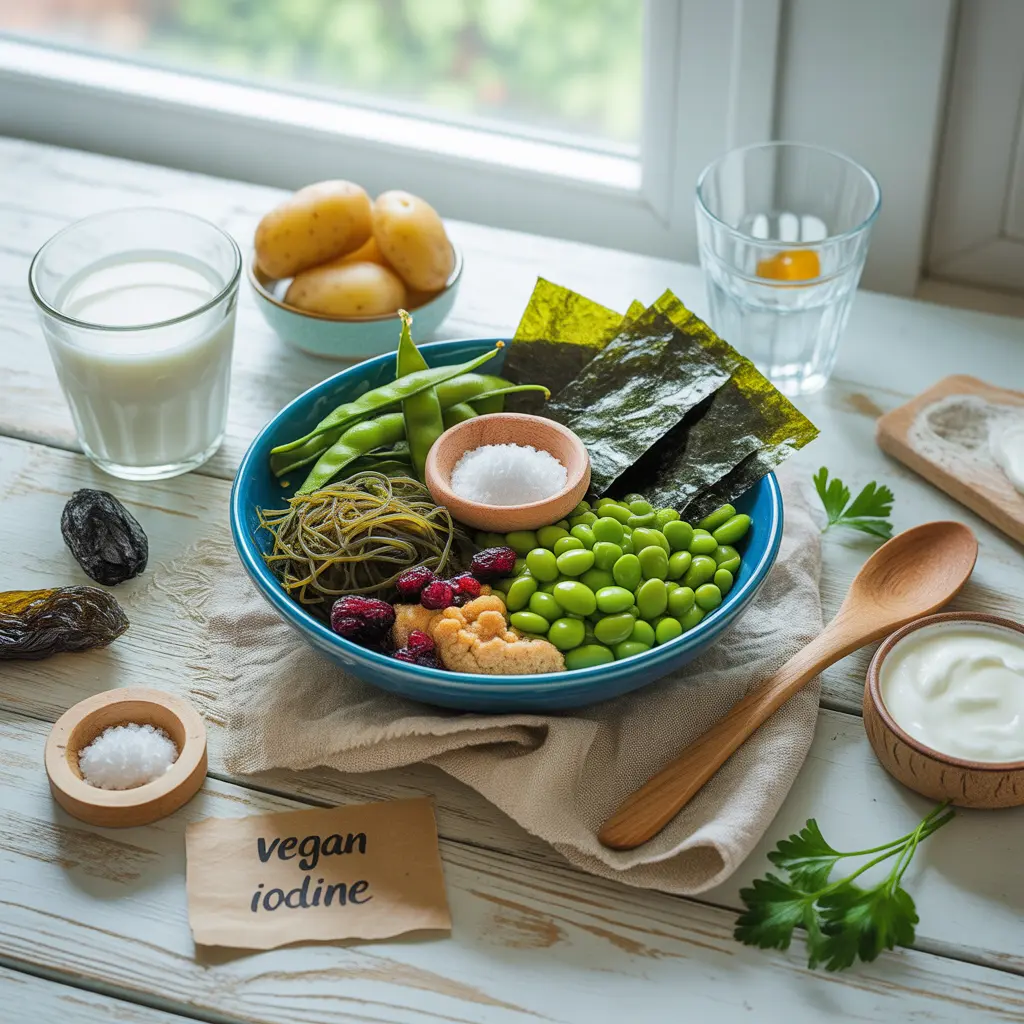
Understanding which plant-based iodine sources are reliable and which are variable is the foundation of any workable strategy. The table below ranks vegan iodine foods by their average iodine content per serving, with a reliability indicator that reflects how consistent that content is across different products and growing regions.
Plant-Based Iodine Sources: Average Content per Serving
Kelp (1g dried)Variable: 20–2,000 mcg
⚠ Extremely variable, unreliable as a daily source
Iodised Salt (½ tsp)~95–115 mcg
✓ Most consistent and reliable plant-compatible source
Nori (1 sheet / 2.5g)~16–43 mcg
✓ Moderate and safer than kelp, useful in rotation
Dulse (7g)~74 mcg
✓ More consistent than kelp, good culinary versatility
Fortified plant milk (240ml)~45–75 mcg
✓ Reliable if label confirms iodine fortification
Seaweed snacks (5g)~15–50 mcg
~ Variable depending on seaweed type and brand
White beans, potatoes, strawberries (per serving)~2–10 mcg
✗ Unreliable and insufficient as primary sources
The most important point from this ranking is that most whole plant foods contain negligible iodine. Grains, legumes, fruits, and vegetables contribute almost nothing to plant diet iodine requirements unless they are grown in coastal, iodine-rich soil. This is why vegan iodine foods require deliberate selection rather than assumption.
Vegan iodine fortified foods are increasingly available but inconsistently labelled. When choosing a plant milk, look for a product that specifically lists iodine on the nutrition panel. Many oat milks and soy milks are fortified, but not all. Checking the label takes thirty seconds and makes a meaningful difference.
The Seaweed Paradox: Too Little and Too Much
Seaweed is the only food that exists naturally in the plant kingdom with meaningful iodine content. This makes it important, but its variability makes it dangerous to rely on as your sole or primary source. Kelp iodine vegan content varies by species, harvest location, season, drying method, and storage. No two batches are the same.
Nori iodine vegan content sits in a safer range. The thin sheets used in sushi rolls typically deliver 16 to 43 micrograms per sheet, making them a useful contributor without the overdose risk associated with kelp supplements. Using nori sheets in cooking two or three times per week provides consistent, moderate iodine as part of a broader strategy rather than as a single-source solution.
Dulse iodine vegan content is more consistent than kelp and sits in a useful mid-range. Dried dulse flakes can be added to soups, stews, and grain dishes as a seasoning. A tablespoon of dried dulse provides roughly 65 to 80 micrograms, making it a practical contributor alongside iodised salt.
The key principle for seaweed and vegan iodine foods is rotation, not reliance. Use nori and dulse as regular but not daily sources. Avoid kelp supplements entirely unless prescribed by a physician. Check all seaweed products for species labelling. And never use seaweed alone as your iodine strategy during pregnancy.