Medical Disclaimer: This article is written for informational and educational purposes only. It does not constitute medical advice and is not intended to diagnose, treat, cure, or prevent any medical condition. The information here should not replace guidance from a qualified healthcare professional, registered dietitian, or physician. If you have a health condition or are taking medication (particularly blood thinners), consult your doctor before making significant dietary changes related to vitamin K intake.
Vegan Vitamin K Foods: The Complete Guide to Plant-Based Vitamin K Sources
The K1 vs. K2 Distinction: What Most Vegan Guides Miss
When most plant-based nutrition guides discuss vegan vitamin K foods, they focus almost entirely on leafy greens and call it a day. This is a significant oversight. Vitamin K is not a single compound. It is a family of fat-soluble vitamins divided into two functionally distinct forms, and they behave very differently in the body. Understanding this distinction is the foundation of sound vitamin K nutrition on a plant-based diet.
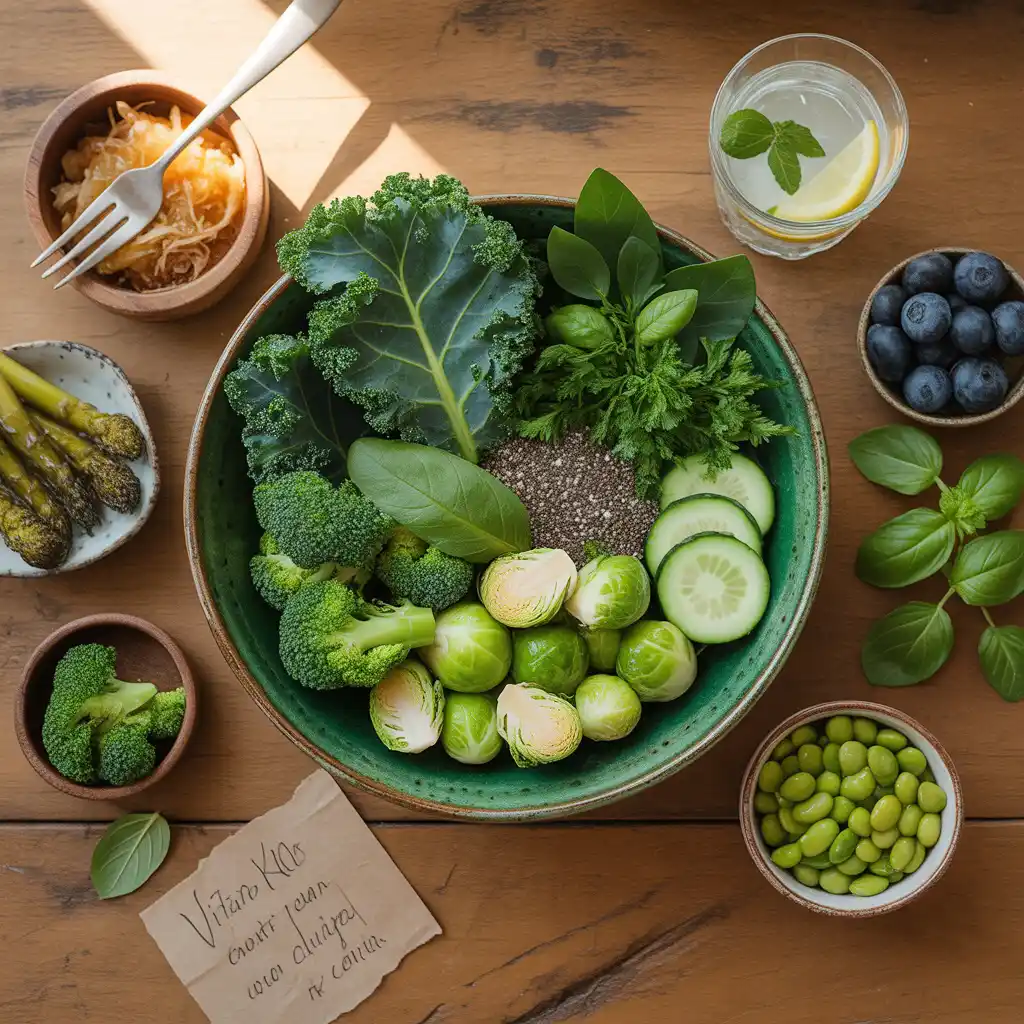
Vitamin K1 (phylloquinone) is found abundantly in green leafy vegetables, broccoli, Brussels sprouts, and many herbs. Its primary function is blood clotting. It activates clotting factors in the liver, which is why patients taking warfarin or other anticoagulants are advised to keep their vegan vitamin K foods intake consistent. Vegans who eat plenty of leafy greens are almost certainly getting adequate K1. This is genuinely good news for those on a whole-food plant-based diet.
Vitamin K2 (menaquinone) is an entirely different story. K2’s primary roles are bone mineralisation and arterial protection. It activates two key proteins: osteocalcin (which anchors calcium into bone tissue) and matrix Gla protein, or MGP (which prevents calcium from depositing in arteries and soft tissue). These functions are essentially absent when you rely on K1 alone. The problem for vegans is stark: K2 is found almost exclusively in animal-derived fermented foods and organ meats. The single meaningful plant-based K2 source is natto, a traditional Japanese fermented soybean food.
Research published in the Journal of Nutrition confirms that K1 and K2 have different bioavailabilities and tissue distributions. K2, particularly the MK-7 subtype found in natto, has a significantly longer half-life in the body than K1, remaining active for up to three days compared to K1’s few hours. This means even small, regular K2 intake can sustain levels over time, but it also means that without a reliable plant-based K2 source in the diet, vegan vitamin K2 status can decline steadily.
The Critical Distinction
K1 and K2 are not interchangeable. Getting plenty of leafy greens does not protect your bones and arteries the way K2 does. Vegans who know their leafy green intake is strong may still have genuinely low K2 status. The two forms serve different biological functions, activate different proteins, and come from different food sources. Treating vegan vitamin K foods as a single category is where many well-intentioned plant-based guides go wrong.
There is also a third category, K3 (menadione), which is synthetic and not found in food. For all practical dietary purposes, the discussion centres entirely on K1 and K2. Of the K2 subtypes, MK-4 and MK-7 are the most studied. MK-7, derived from natto and used in most K2 supplements, is the form with the most robust evidence for bone and cardiovascular benefits.
Why Vegan K2 Intake Is a Real Challenge
The vegan K2 gap is not a minor nutritional footnote. It is a genuine structural challenge for plant-based eaters. Understanding why K2 is difficult to obtain from plant foods helps explain why this is one of the more important decisions a vegan can make about supplementation.
The reasons plant foods contain so little K2 come down to how K2 is produced. In animals, K1 from plant consumption is converted to MK-4 (a short-chain K2 form) in various tissues. In fermented foods, bacteria convert K1 to long-chain MK forms during the fermentation process. Without either animal tissue conversion or bacterial fermentation, most plant foods simply do not produce K2 in meaningful quantities.
For vegans eating a standard Western-style plant-based diet without natto or other K2-rich fermented foods, daily K2 intake may be close to zero. This is not a crisis-level deficiency in the short term, but over years and decades it has implications for bone mineralisation density and arterial calcification risk. Post-menopausal women and older vegans are particularly worth noting here, given the established relationship between bone loss and vegan vitamin K2 status.
Research published by PubMed confirmed a significant association between K2 intake and bone mineral density in cohort studies, with MK-7 supplementation showing statistically significant improvements in bone strength in postmenopausal women. The connection to arterial health is supported by multiple Dutch cohort studies showing inverse relationships between K2 intake and arterial calcification.
The key practical takeaway for those eating plant-based diets is this: if your diet regularly includes natto, certain fermented foods, or a quality MK-7 supplement, you are very likely covering your vegan vitamin K2 needs. If it does not, this is one of the more worthwhile supplements to consider alongside vitamin B12 and vitamin D.
Top Vegan Vitamin K Foods Ranked
The following chart separates K1 and K2 sources clearly, because ranking them together would obscure the key distinction. All vegan vitamin K foods are listed with approximate values per 100g serving (raw unless specified). K1 data is from USDA FoodData Central. K2 content in plant foods is less standardised in databases, and values shown for fermented foods are research estimates.
The message from the data is clear. Leafy greens deliver extraordinary K1 that easily meets daily needs. But K2 is essentially natto or nothing in the plant kingdom, with fermented foods providing modest but meaningful support. A standard daily serving of kale or spinach puts K1 intake well above requirements. A weekly serving of natto provides K2 for several days given its long half-life. Combining both strategies with a plant-based diet covers the full vitamin K picture robustly.
It is also worth noting that K1 absorption improves substantially when leafy greens are eaten with healthy fat. A salad with olive oil or an avocado dramatically increases the amount of K1 your body can absorb from vegan vitamin K foods, compared to eating the same greens with no fat present. This is a practically important detail for anyone tracking their vegan vitamin K intake carefully.
Spotlight: 6 Key Vitamin K Plant Foods
These six plant-based vitamin K foods offer the best combination of reliable nutrient content, culinary versatility, and overall nutritional value. Each is a staple worth building meals around.
One of the richest K1 sources in the plant kingdom. Also provides calcium, vitamin C, and iron. Best absorbed cooked lightly or massaged raw with olive oil for fat-soluble nutrient uptake.
The only plant food with meaningful K2 (MK-7) content. Fermented soybeans with a strong flavour that is an acquired taste but unmatched for plant-based K2 intake. One 50g serving covers K2 needs for several days.
Exceptionally high in K1, and among the most nutrient-dense of all plant-based vitamin K foods. Also provides magnesium and potassium, making it a whole-system mineral powerhouse. Excellent sauteed with olive oil.
A reliable K1 source that also provides sulforaphane, vitamin C, and calcium. More moderate in K1 than leafy greens but widely consumed, making it a consistent daily contributor to plant-based vitamin K intake.
A fermented soy-based condiment used throughout East Asian and MENA fusion cooking. Provides modest K2 alongside probiotics, protein, and a spectrum of B vitamins. A tablespoon in dressings, soups, or sauces adds K2 daily.
An iconic K1 source and a staple of plant-based vitamin K foods lists globally. Note that the oxalates in raw spinach can reduce mineral absorption slightly. Cooking spinach briefly reduces oxalates and increases K1 bioavailability per gram consumed.

The Calcium Routing Mechanism: How K2 Protects Bones and Arteries
The calcium routing mechanism is the most important concept in understanding why K2 matters for vegans who already consume good amounts of plant-based calcium. The issue is not just how much calcium you get. It is where that calcium ends up.
Without Adequate K2
Osteocalcin remains inactive (undercarboxylated). Cannot bind calcium in bone tissue. MGP remains inactive. Calcium migrates freely to soft tissue and arterial walls. Risk of arterial calcification and poor bone mineralisation over time.
With Adequate K2 (MK-7)
K2 activates osteocalcin, anchoring calcium into bone matrix. K2 activates MGP, which actively clears calcium from arterial walls. Calcium goes to bones, not arteries. Bone density supported. Arterial flexibility protected.
The two key proteins in this mechanism are osteocalcin and matrix Gla protein (MGP). Both are vitamin K2-dependent proteins. Without sufficient K2 to carboxylate (activate) them, they remain biologically inactive. You can think of K2 as the switch that turns these calcium-directing proteins on.
Osteocalcin, when fully carboxylated by K2, grabs calcium from the bloodstream and anchors it into the bone matrix. Research published on PubMed confirms that undercarboxylated osteocalcin levels are used as a clinical marker of K2 insufficiency and correlate with reduced bone mineral density. Vegans who are eating adequate plant-based calcium from sources like kale, fortified plant milks, tofu, and seeds, but who are not getting K2, may still have suboptimal bone mineralisation over decades.
MGP is the other critical protein. Its role is arterial protection. It actively removes calcium that has begun depositing in artery walls and soft tissue. Studies from the Rotterdam Cohort, one of the most comprehensive long-term cardiovascular studies, showed that higher dietary K2 intake was associated with a significantly lower risk of aortic calcification and cardiovascular death. The same association was not seen with K1 intake. This is a stark difference between the two vitamin K forms and one that has clinical importance for vegans thinking about long-term cardiovascular health.
Calcium Is Not the Whole Story
Many vegans eating whole-food plant-based diets consume adequate calcium from leafy greens, fortified foods, tofu, almonds, and seeds. This is genuinely good. But calcium adequacy does not guarantee that calcium is going where you want it. Without K2 to activate the routing proteins, calcium can accumulate in arteries and soft tissue regardless of dietary calcium intake. K2 is not optional if long-term bone and cardiovascular health are priorities.
For vegans who are supplementing with vitamin D (as most should, given limited sun exposure in many climates), this connection becomes even more relevant. Vitamin D increases calcium absorption from the gut. This is beneficial. But it also makes the routing question more important. More calcium coming in through enhanced D-driven absorption means more calcium that needs routing via K2-dependent proteins. Vitamin D and K2 work synergistically: D increases calcium supply, K2 ensures it arrives at the right destination. This is why many nutritionists now recommend these two supplements together for vegans. The vitamin D post on this site covers vitamin D in detail.
Fermented Foods as the Vegan K2 Strategy
Given that natto is the dominant plant-based K2 source, the practical question for many vegans is what to do if they do not eat natto regularly, or if the flavour profile does not work for their cooking. The answer involves building a broader fermented food strategy and, where needed, supplementing.
Fermented Vegan Foods and K2: A Practical Guide
Natto (best choice): Even 30–50g weekly provides K2 that persists in the body for several days. Natto has a strong, sticky, pungent character. It pairs well with rice, soy sauce, spring onion, and mustard in traditional Japanese preparations. Some people find the flavour builds on them over time.
Miso: A tablespoon of good fermented miso in soups, dressings, and marinades provides modest K2 daily. Not a substitute for natto but a meaningful contribution, particularly when used consistently throughout the week.
Traditional sauerkraut: Fermented cabbage prepared with live cultures (not the pasteurised supermarket variety, which has minimal K2) provides small amounts of K2. The K2 content depends heavily on the bacterial strains present during fermentation.
Kimchi (vegan versions): Traditional kimchi is not always vegan (fish sauce), but vegan kimchi recipes produce similar fermentation outcomes. K2 content is low but consistent with other lacto-fermented vegetables.
Tempeh: Fermented soy product with slightly more K2 than unfermented soy, though the amounts are modest compared to natto. A valuable fermented food for many reasons beyond K2.
If you consume multiple fermented foods daily, natto several times a week, and eat leafy greens regularly, you are likely achieving good overall vegan vitamin K coverage. If your diet does not reliably include natto, an MK-7 supplement at 100–200 mcg daily is a practical and well-evidenced solution. MK-7 is the most bioavailable K2 form, remains active in the body for 72 hours, and is derived from fermented chickpeas or soybeans in most vegan-friendly supplement formulations.
One note for those taking blood-thinning medication: significant changes in plant-based vitamin K foods intake can affect medication effectiveness. If you are on warfarin or similar anticoagulants, speak with your prescriber before substantially increasing your K1 intake from leafy greens or starting K2 supplementation.
You can read more about the broader role of fermented foods in plant-based nutrition in the fermented foods guide on this site.
-
Complete 28-day calendarEvery breakfast, lunch, dinner & snack planned
-
40+ nutritionist-approved recipesVibrant photo for every single dish
-
Easy weekly grocery listsShop smart, spend less, waste nothing
-
Protein, iron & B12 at every mealNutritionally complete — no guesswork
-
Saves 7+ hours weeklyPrint it once, follow it all month
-
Bonus: Nutrition Guide ToolkitVegan tips, guides & family meal prep
7-Step Vegan Vitamin K Protocol
This protocol brings together the K1 and K2 strategies into a practical daily and weekly framework. It is designed around realistic whole-food eating and supplements only where food sources are genuinely insufficient.
Eat leafy greens at least once daily for K1. One large handful of kale, spinach, collard greens, Swiss chard, or similar dark leafy greens per day provides well above the K1 adequate intake level for most adults. This is the foundation of your vegan vitamin K foods intake.
Always pair leafy greens with healthy fat. K1 is fat-soluble. Without dietary fat present, absorption is significantly reduced. A drizzle of olive oil on sauteed greens, avocado in a salad, or tahini in a dressing dramatically improves K1 bioavailability. This is one of the easiest and most impactful adjustments you can make.
Include natto 2–3 times per week for K2. Given K2’s extended half-life in the body, eating natto two or three times weekly can maintain consistent K2 levels. Even 50g per serving is sufficient. If you find natto challenging, try mixing it into miso soup or serving it over hot rice with soy sauce and sesame oil to mellow the flavour.
Use miso regularly as a K2 contributor. A tablespoon of live-culture miso paste in daily cooking adds consistent low-level K2 alongside beneficial gut bacteria. Use it in soups, salad dressings, and marinades. This is a cornerstone of MENA and Mediterranean fusion cooking and integrates naturally into vegan meal planning.
Consider MK-7 supplementation if natto is not in your routine. If you do not eat natto regularly, 100–200 mcg of MK-7 daily is a well-evidenced, practical way to close the K2 gap. Look for a vegan-certified capsule that uses plant-derived K2. Check the capsule filler, as some brands use gelatin. Resources like Examine.com provide updated summaries of MK-7 evidence and dosing considerations.
Take K2 with your vitamin D supplement. The synergy between D and K2 is clinically relevant. Vitamin D increases calcium absorption; K2 routes that calcium to bones rather than arteries. Taking both together, with a fat-containing meal for absorption, is the most logical daily supplement strategy for vegans.
Review your full vitamin K picture alongside bone health markers. If you have concerns about bone density, vitamin K status can be tested via undercarboxylated osteocalcin (ucOC) or PIVKA-II assays. These are specialist markers, but worth requesting if you have bone health risk factors. The vegan blood testing guide on this site covers which markers to discuss with your GP.
Supplement Note: What to Look for in a Vegan K2 Supplement
Not all K2 supplements are equal. Look for MK-7 (not MK-4, which has a much shorter half-life). Verify the capsule is vegan, as gelatin capsules are common. Confirm the K2 source is fermented chickpeas or soybeans (not animal-derived). A dose of 100 to 200 mcg daily is the most widely recommended range based on current research. Combining K2 with D3 (algae-derived for vegans) in a single supplement is a convenient and cost-effective approach.
Chef’s Perspective: MENA Traditions and Vitamin K
In my twenty years of professional cooking across Lebanon, the Gulf, and Saudi Arabia, I have worked with cuisines that are naturally high in plant-based vitamin K foods without ever labelling them as such. Traditional MENA cooking has always understood the nutritional power of dark leafy greens and fermented preparations, even if the science of K1 and K2 was not on anyone’s mind.
Consider hindbeh bi zeit, the Lebanese dish of wild chicory (or dandelion greens) sauteed in olive oil with caramelised onion. Dandelion greens are extremely high in K1. Sauteing them in olive oil, which is exactly what this dish does, maximises absorption. This is not a coincidence; it is generations of culinary wisdom encoding nutritional value into tradition.
Spinach and silverbeet (Swiss chard) appear throughout the Levantine kitchen, whether in fatayer (stuffed pastries), shakshuka, or simply wilted with garlic and lemon. Saudi and Gulf cuisines have their own versions of slow-cooked greens and herb-heavy stews that stack K1 with magnesium and iron. Even the herb-heavy garnishes typical across MENA, the fresh parsley on almost every dish, the bundles of spring onion, the scattered mint, all contribute meaningfully to daily plant-based vitamin K foods intake.
For K2 specifically, I now incorporate miso into my cooking more than I once did. A tablespoon of white miso dissolved into a lemon-tahini dressing adds umami depth and brings K2 into an otherwise traditional MENA preparation seamlessly. Fermented pickles, which are ubiquitous across Lebanese and Palestinian table settings, also contribute small but consistent amounts when made with live cultures rather than vinegar pickling.
If you are building a vegan diet that takes vitamin K seriously, the MENA culinary tradition gives you a strong foundation. Eat your greens with fat, use fermented condiments freely, and do not underestimate what a well-designed plant-based kitchen has known for centuries.
Frequently Asked Questions About Vegan Vitamin K Foods
Do vegans get enough vitamin K from plant foods?
The answer depends entirely on which form of vitamin K you mean. Vegans who eat leafy greens regularly almost certainly get adequate K1 (phylloquinone). However, K2 (menaquinone) is a different matter. Plant-based diets are almost universally low in K2 unless natto or other K2-rich fermented foods are regularly consumed. Most standard vegan diets provide very little K2. This is not a catastrophic deficiency, but over time it has potential implications for bone mineralisation and arterial health.
What is the best vegan source of vitamin K2?
Natto is by a significant margin the best vegan source of vitamin K2. It contains approximately 939 mcg of MK-7 per 100g, more than any other measured food source. A single 50g serving eaten two or three times a week provides more than enough K2 to maintain adequate levels, given K2’s long half-life. If natto is not practical for your diet, an MK-7 supplement is the most reliable alternative.
Is there a difference between vitamin K1 and K2 for vegans?
Yes, and the difference is significant. K1’s primary role is blood clotting regulation. K2’s primary roles are bone mineralisation and arterial calcification prevention. They come from different food sources, have different absorption rates, and serve different physiological functions. Vegans typically have good K1 intake and potentially low K2 intake. Understanding this distinction is arguably the single most important thing to know about vegan vitamin K nutrition.
Do I need to supplement vitamin K2 on a vegan diet?
If you regularly eat natto two to three times weekly, you likely do not need to supplement K2. If natto is not part of your routine, an MK-7 supplement at 100–200 mcg daily is worth considering, particularly for older vegans, postmenopausal women, and those with bone density concerns. Consult a healthcare professional or registered dietitian for personalised guidance, especially if you take blood-thinning medication.
Does cooking destroy vitamin K in plant foods?
Vitamin K1 is relatively stable to heat. Light cooking, blanching, sauteing, and steaming do not destroy K1 significantly. In fact, cooking leafy greens can increase K1 bioavailability per gram because it breaks down cell walls and reduces volume, making it easier to eat larger quantities. However, prolonged boiling in water and then discarding the water can leach some K1. The main rule is to cook with fat to maximise absorption, not to minimise heat.
Can I get enough K2 from sauerkraut and kimchi without eating natto?
Sauerkraut and kimchi provide small amounts of K2, but they are not reliable substitutes for natto. The K2 content of fermented vegetables varies widely depending on the bacterial strains present during fermentation and the fermentation conditions. Research estimates suggest traditional sauerkraut provides roughly 4 to 10 mcg of K2 per 100g, compared to natto’s 939 mcg. Eating multiple fermented foods daily provides cumulative K2 contributions but may still fall short of recommended levels without natto or supplementation.
How does vitamin K2 affect bone health on a vegan diet?
K2 activates osteocalcin, a protein produced by bone-building cells. When activated (carboxylated) by K2, osteocalcin anchors calcium into the bone matrix, directly supporting bone mineralisation. Without adequate K2, osteocalcin remains inactive. Multiple clinical trials, including randomised controlled studies in postmenopausal women, have shown that MK-7 supplementation improves bone mineral density and reduces markers of bone turnover. For vegans who are already calcium-conscious, ensuring K2 adequacy closes a significant gap in bone protection.
Is there a vitamin K deficiency risk on a whole-food plant-based diet?
For K1, a whole-food plant-based diet rich in leafy greens is one of the best possible dietary patterns. Deficiency is very unlikely. For K2, the risk is genuine unless specific K2-rich fermented foods are included regularly. The practical risk is not acute deficiency causing blood clotting problems, but suboptimal K2 status affecting bone and arterial health over years and decades. This is a chronic, long-term consideration rather than an immediate clinical deficiency scenario.
What vegan vitamin K foods are best for heart health?
For heart health specifically, K2 sources are most relevant. Matrix Gla protein (MGP), activated by K2, is the protein responsible for preventing arterial calcification. The Rotterdam Cohort Study found higher K2 intake associated with lower rates of aortic calcification and cardiovascular events. Natto, miso, and tempeh are the plant-based K2 sources to prioritise. K1 from leafy greens provides general antioxidant and anti-inflammatory benefits but does not activate the arterial calcification-preventing MGP protein.
Does avocado provide significant vitamin K?
Avocado provides a moderate amount of K1 at approximately 21 mcg per 100g. It is not a high-K1 food compared to leafy greens, but it contributes meaningfully and has the added advantage of being high in monounsaturated fat, which improves K1 absorption from everything else eaten at the same meal. An avocado in a salad with leafy greens is an excellent combination: modest K1 from the avocado, plus significantly enhanced K1 absorption from the greens due to the fat content.
Can vitamin K2 be obtained from plant-based cheese alternatives?
Most commercially produced vegan cheese alternatives are not made via traditional bacterial fermentation and contain negligible K2. Some artisan plant-based cheeses made using live cultures may contain small amounts, but these are not standardised or reliably quantified. Dairy cheese is a significant K2 source in omnivore diets precisely because of bacterial MK-4 conversion. For vegans, relying on vegan cheese as a K2 source is not a viable strategy. Natto and supplements remain the most reliable approaches.
Should I take vitamin K2 with my vitamin D supplement?
Yes, combining vitamin D and K2 makes physiological sense. Vitamin D increases intestinal calcium absorption, which is beneficial for bone health. K2 then ensures the absorbed calcium is directed to bones via osteocalcin and kept out of arteries via MGP. Without K2, increased calcium absorption from vitamin D supplementation might theoretically increase the calcium available to deposit in soft tissue. Taking both together, with a fat-containing meal, is a widely recommended approach for vegans supplementing vitamin D. The vitamin D guide on this site has more detail on dosing and testing.

28-Day Vegan Meal Plan
+ Grocery List
Complete Solution · Nutritionist-Approved · Print & Use Today
Read on any device · No apps needed
Conclusion: Building a Complete Vegan Vitamin K Strategy
Vegan vitamin K foods divide neatly into two very different categories, and understanding that division is the key to genuinely complete plant-based vitamin K nutrition. K1 from leafy greens is one of the clearest nutritional strengths of a whole-food vegan diet. Eating kale, spinach, chard, broccoli, and other dark greens daily with a source of dietary fat covers K1 requirements reliably and generously. This is one area where plant-based eating has a natural advantage.
K2 is the area that deserves more attention from vegans than it typically receives. The calcium routing mechanism, the distinction between K2’s functions and K1’s functions, and the scarcity of plant K2 sources all point in the same direction: natto and targeted supplementation are the practical strategies for closing the K2 gap on a plant-based diet.
A well-designed vegan diet that includes dark leafy greens daily, a healthy fat alongside them, natto or quality MK-7 supplementation, and regular fermented foods like miso and sauerkraut covers the full spectrum of vegan vitamin K foods effectively. Paired with adequate vitamin D, this approach gives your bones and cardiovascular system the nutritional support they need for the long term.
To support your nutrient planning further, explore the bone health guide, the vegan calcium foods guide, the vegan supplements guide, and the fermented foods guide for a complete picture of how vegan vitamin K foods fit into a structured, nutritionally complete plant-based lifestyle. Additional guidance on vegan micronutrition is available from VeganHealth.org and Examine.com.